Owner’s manual
 Error Codes






Is GE Café considered high end?
Yes. GE Café is generally considered a high-end (premium) GE appliance line, positioned above standard GE models with upgraded design, finishes, and feature sets. It is separate from your GE GIE17GSNDRSS top-mount refrigerator, which is a more traditional, value-focused configuration.
How GE lines typically compare
GE’s lineup is usually grouped by “good, better, best” tiers. GE Café and Monogram sit in the premium space, but they target different buyers.
- GE (standard): practical features, broad price range
- GE Profile: step-up features and styling
- GE Café: premium styling and curated features (often design-forward)
- Monogram: luxury line with built-in options and higher-end customization
What “high end” means in real-world terms
High-end usually shows up in materials, design, and convenience features more than basic cooling performance.
| What you notice | Standard GE | GE Café |
|---|---|---|
| Styling/finishes | Basic to mid-tier | Premium, design-focused |
| Feature set | Core features | More specialty features |
| Price tier | Lower to mid | Upper/premium |
| Service/parts approach | Standard parts support | Standard parts support (premium models) |
Why it matters when buying parts or planning repairs
Even though GE Café is “high end,” parts selection always depends on the exact model number and serial number, not the product line name. For your GE GIE17GSNDRSS, use the model and serial label location shown in the GIE17GSNDRSS owner’s manual.
- Confirms you order the correct GE refrigerator parts
- Helps match the right revision/version of components
- Reduces returns caused by look-alike parts
- Speeds up troubleshooting when symptoms overlap across models
Quick tip for model identification
- Open the fresh food (refrigerator) door
- Look on the left side, near the middle of the compartment
- Write down the model and serial exactly as shown
Last updated: January 2026
What are the disadvantages of a top mount fridge?
A top-mount (top-freezer) refrigerator like the GE GIE17GSNDRSS is usually efficient and affordable, but the main disadvantages are convenience and features: fresh food sits lower so you bend more, storage is less flexible than many bottom-freezer designs, and dispenser options are often limited. See the GIE17GSNDRSS owner's manual for layout, features, and care details.
Common disadvantages (what most owners notice)
- Less convenient fresh-food access: you reach down more often for everyday items.
- Tighter organization: fewer premium bins and dividers compared with many bottom-mount models.
- Freezer usability: top freezers can feel cramped for bulky frozen items.
- Fewer built-in features: many top-mount models skip exterior ice and water dispensers.
- More door-swing planning: you may need to reverse the door swing to fit your kitchen flow.
Space and installation tradeoffs
Top-mount refrigerators still need proper airflow clearance for reliable cooling. The GE top-freezer installation guidance calls for clearances that vary by capacity (for example, top clearance is typically 1 inch, and back clearance can be 1 to 2 inches depending on size). Use the manual to match the clearance spec to your exact unit.
| Consideration | Top-mount (top-freezer) | Bottom-freezer (typical) |
|---|---|---|
| Fresh-food access | Lower, more bending | Higher, easier access |
| Organization | Simpler shelving/bins | Often more flexible |
| Feature set | Often basic | Often more feature-rich |
| Cost to buy/repair | Often lower | Often higher |
When a “disadvantage” becomes a real problem
- You have back or knee issues and access height matters daily.
- You meal-prep often and need more adjustable fresh-food storage.
- You want frequent access to freezer drawers or large frozen packages.
Why it matters
Choosing the right refrigerator style affects daily ergonomics, food visibility (waste reduction), and how well the unit fits your kitchen. Even small differences in door swing and clearances can impact performance and convenience.
Last updated: January 2026
What is the most common problem with a GE refrigerator?
The most common issue we see with GE refrigerators like model GIE17GSNDRSS is not cooling properly, which is usually caused by an airflow problem (frost buildup, a failed evaporator fan, or a blocked vent) or a dirty condenser area. Use the GIE17GSNDRSS owner's manual to confirm the correct temperature settings and basic checks.
Most common symptoms and what they usually point to
- Fresh food warm, freezer cold: restricted airflow, damper issue, or evaporator fan problem
- Both sections warm: condenser airflow issue, compressor start problem, or control issue
- Loud humming or grinding: fan motor or fan blade contacting ice or wiring
- Water under the refrigerator: defrost drain issue or water line/valve leak (if equipped)
- Door not sealing: gasket out of shape, dirty gasket folds, or door alignment
Quick checks we recommend first (10 to 20 minutes)
- Verify controls are set correctly and doors are closing fully.
- Listen for the evaporator fan running when the compressor is on.
- Check for heavy frost on the freezer back wall (a defrost or airflow restriction clue).
- Inspect and clean door gaskets; GE notes cleaning with warm soapy water and drying folds thoroughly.
- Make sure the condenser area has good airflow (no dust mat, no blocked vents).
Common parts involved (when troubleshooting points there)
| Symptom | Likely area | Example part for this model |
|---|---|---|
| Warm temps with poor airflow | Evaporator fan system | GE refrigerator evaporator fan motor WR60X31522 |
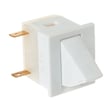
| Light stays off or fan stops when door opens | Door switch | Refrigerator door switch WR23X31507 |
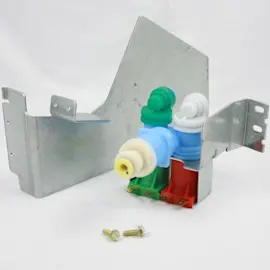
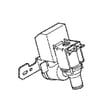
| Ice maker not filling (on some models) | Water supply/valve | Refrigerator water inlet valve WR57X32213 |
| Door not sealing, frost, moisture | Door gasket | Refrigerator freezer door gasket WR14X27234 |
Why it matters
Cooling problems can quickly lead to food spoilage and can also force the compressor to run longer than normal. Catching airflow and door-seal issues early helps the refrigerator cool evenly and run more efficiently.
Last updated: January 2026