Owner’s manual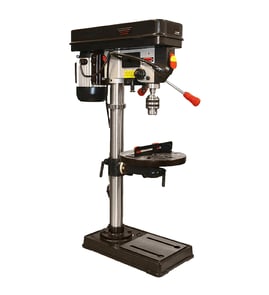

What is the 4 inch rule for drill press?
The 4-inch rule for a drill press means we keep our hands and fingers at least 4 inches away from the rotating drill bit and spinning workpiece at all times. On the Jet JDP-17MF drill press, that typically means clamping the material to the table (or using a drill press vise) instead of holding it by hand.
Use these habits every time you drill:
- Clamp the workpiece to the table, or secure it in a drill press vise.
- Position the work so it contacts the left side of the column when possible; this helps prevent spinning.
- Keep guards in place and working properly before you start.
- Remove adjusting keys and wrenches before turning the drill press on.
- Feed the bit with only enough force to let it cut; do not force the machine.
- Use a scrap wood backer on the table to protect the table and reduce tear-out.
A drill press can grab the material and spin it like a propeller, even with smaller bits. Keeping a 4-inch buffer forces us to use clamps and better workholding so our hands are not in the danger zone if the bit binds, the motor stalls, or the bit breaks.
| Item to check | What “good” looks like | Why it matters |
|---|---|---|
| Workholding | Clamped or in a vise, not hand-held | Prevents spinning and hand injuries |
| Guards | Installed and positioned correctly | Reduces contact risk |
| Feed pressure | Steady, not forced | Helps prevent bit breakage and stalling |
| Speed choice | Set per belt/speed chart | Better cut quality and control |
For the Jet JDP-17MF, we follow the operating and safety instructions in the owner's manual, including guidance on guarding, work support, and proper feeding technique.
Last updated: February 2026
What is a good horsepower for a drill press?
A good horsepower depends on what you drill most often. For typical home shop work, 1/2 HP to 3/4 HP is a strong, practical range; the Jet JDP-17MF drill press is rated at 3/4 HP, which is well-suited for wood, plastics, and many metal-drilling tasks when you use the right speed and feed (see the owner's manual).
- 1/3 to 1/2 HP: light-duty drilling, smaller bits, softer materials
- 1/2 to 3/4 HP: most DIY and hobby use; good all-around capability
- 1 HP and up: frequent metalworking, larger hole saws, bigger bits, tougher materials
- Prioritize low RPM options for metal and larger bits
- Use sharp bits and correct feed pressure to avoid stalling and overheating
Horsepower helps, but the drill press’s speed range and your setup often determine whether the cut feels smooth or bogs down. The JDP-17MF provides 16 speeds with a 200 to 3,630 RPM range, which gives you the low-speed control you want for metal and larger diameters.
| Task | Typical goal | What to prioritize |
|---|---|---|
| Wood drilling | Clean holes, fast cutting | Higher RPM, sharp bit, backing board |
| Metal drilling | Control heat and torque | Lower RPM, cutting oil, steady feed |
| Large bits/hole saws | Prevent stalling and grabbing | Low RPM, firm clamping, gradual feed |
- Clamp the workpiece or use a drill press vise; prevent spinning against the column
- Match RPM to bit size: smaller bit = higher RPM, larger bit = lower RPM
- Feed with steady pressure; too fast can stall or break the bit, too slow can burn
- Clear chips often, especially in metal
- Use a scrap backing board under wood to reduce tear-out
Choosing the right horsepower helps, but using the correct RPM, feed rate, and clamping is what protects the motor, improves hole quality, and reduces bit breakage. A 3/4 HP floor drill press like the Jet JDP-17MF is a proven “sweet spot” for most shops.
Last updated: February 2026
What is meant by JDP-17MF?
On a Jet drill press, JDP-17MF is the model number that identifies the exact 17-inch drill press design and its matching parts list, wiring diagram, and specifications. For the most accurate part identification and service info, use the owner's manual for model JDP-17MF.
When you see JDP-17MF on the nameplate or in documentation, it is used to match the correct:
- Parts breakdown and parts list for the drill press
- Electrical schematic (115V and 230V versions are shown in the manual)
- Operating and safety instructions
- Specifications such as drilling capacity and chuck size
- Service procedures like belt tension and return spring tension adjustments
The JDP-17MF manual lists these specifications for the Jet JDP-17MF drill press:
| Spec | What it means | Value shown in manual |
|---|---|---|
| Type | Floor-standing drill press | Floor |
| Drilling capacity | Max typical bit size in steel (general reference) | 5/8 in. |
| Chuck size | Max chuck capacity | 5/8 in. |
| Swing | Max diameter you can drill centered on the table | 16-1/2 in. |
Using the exact model number prevents mismatched parts and incorrect procedures. Jet drill presses can look similar across model families, but switches, belts, quills, bearings, and wiring can differ.
- Match the model number exactly: JDP-17MF (including hyphens)
- Use the parts list in the manual to confirm the part description before ordering
- If you are diagnosing an electrical issue, reference the correct voltage schematic
- For drilling problems (chatter, slipping, poor hole quality), follow the manual steps for belt tension and chuck setup
Last updated: February 2026
What are the best drill presses?
The “best” drill press depends on what you drill (wood vs. metal), how often you use it, and whether you need benchtop portability or floor-model stability. If you already own the Jet JDP-17MF, it is a strong 17-inch floor drill press choice when it’s set up correctly and used with the right speed and workholding.
- Type: benchtop for small shops and lighter work; floor model for stability and larger stock
- Speed control: variable speed is convenient; stepped pulleys are durable and common
- Capacity: look at swing (often listed as 10 to 20 inches) and quill travel for deeper drilling
- Table and fence: a rigid table that tilts and locks securely improves accuracy
- Runout and vibration: better presses drill straighter and chatter less
- Workholding: compatibility with a drill press vise and clamps matters as much as horsepower
The JDP-17MF manual focuses heavily on safe operation and correct technique. For best results on this model:
- Clamp the work or use a drill press vise; don’t rely on hand pressure
- Use a scrap backer board to protect the table and reduce tear-out
- Match speed to material: wood typically uses higher RPM than metal
- Feed with steady pressure; too fast can stall the motor or break bits, too slow can burn
- Keep the machine maintained; periodic lubrication helps smooth operation
Reference: owner's manual
| Use case | Best fit | What to prioritize |
|---|---|---|
| Furniture and DIY woodworking | Benchtop or floor | Higher RPM range, table support, easy depth stop |
| Metal drilling | Floor model preferred | Lower RPM capability, rigidity, solid vise/clamping |
| Small shop, limited space | Benchtop | Footprint, adequate swing, simple belt changes |
| Frequent bit changes and setups | Either | Good chuck, clear controls, repeatable depth stop |
A drill press is only “best” when it drills accurately and safely for your material. Correct speed selection, solid clamping, and reduced vibration prevent broken bits, burned workpieces, and wandering holes.
Last updated: February 2026
Why are drill presses so expensive?
A quality drill press like the Jet JDP-17MF costs more because it relies on tight machining tolerances and durable components that keep the spindle and quill running true. That precision reduces wobble and vibration, improves hole accuracy, and helps the tool hold up under repeated use.
- Precision in the quill and spindle: better alignment means straighter holes and less bit wander.
- Higher-quality bearings: smoother rotation and better runout control.
- Heavier castings and rigidity: less flex in the column, head, and table under load.
- More stable speed and feed performance: fewer stalls and less chatter when drilling.
- Safety and usability features: guards, proper controls, and a table system designed for repeatable setups.
When a drill press is built with better alignment and rigidity, you typically see improvements in the issues owners notice most:
| What you notice | What it usually points to | Why it affects price |
|---|---|---|
| Vibration or chatter | Belt condition/tension, pulley alignment, rigidity | Better parts and machining reduce vibration sources |
| Bit wandering | Runout, chuck/bit seating, spindle condition | Tighter tolerances cost more to manufacture |
| Burning workpieces | Incorrect speed, dull bit, poor chip clearing | Better speed control and stability help consistency |
| Noise | Dry spindle, loose pulleys, worn components | Higher-quality components run quieter longer |
These are the same fundamentals we recommend for the JDP-17MF to keep performance high over time:
- Clamp small workpieces or use a drill press vise; don’t rely on hand pressure.
- Use a scrap backer board to protect the table and reduce tear-out.
- Match speed to material (wood generally faster than metal; small bits generally need higher RPM).
- Feed with steady pressure; too fast can stall or break bits, too slow can burn.
- Keep key moving points lubricated; the manual calls out periodic grease on gears/rack and spindle splines.
If you need accurate, repeatable holes, the extra cost is usually buying rigidity plus precision. Those two factors reduce troubleshooting time, improve finish quality, and extend the working life of wear components.
For model-specific operating and maintenance guidance, follow the Jet JDP-17MF owner's manual.
Last updated: February 2026