
How old is my furnace by model number?
You usually cannot date a Coleman Evcon furnace by model number alone. For model 7956-856, the reliable way is to use the serial number on the furnace rating plate; the serial format typically encodes the manufacturing year (and often the week). Use our guide in how to find your appliance model number (and what it means for parts) to confirm you are reading the correct tag.
Where to find the information you need
Look for the furnace rating plate (data tag) on the cabinet. Common locations include:
- Inside the burner compartment door
- On the blower door panel
- On a side panel near the gas valve or control board
- On the inside of the upper access panel
How to estimate age from the tag (what to check)
Once you find the tag, write down both identifiers and compare:
- Model number: 7956-856 (identifies the design family)
- Serial number: used to determine build date
- Manufacture date: sometimes printed directly as month/year
- Control board date codes: helpful clue, but not the official build date
Quick guide: model number vs serial number
| Item on the furnace tag | What it tells you | Best use |
|---|---|---|
| Model number (7956-856) | Configuration and parts breakdown | Finding correct replacement parts |
| Serial number | Production date code | Determining furnace age |
| Manufacture date (if listed) | Exact month/year | Fastest way to confirm age |
Why it matters
Knowing the furnace age helps us match the right igniter, flame sensor, gas valve, limit switch, inducer motor, or control board and also helps you plan maintenance. Most furnaces need closer inspection as they get older because wear items and electrical connections become more failure-prone.
Helpful tip for decoding the serial number
Many furnaces use a serial pattern where a pair of digits indicates the year, and another pair indicates the week of manufacture. If you share the serial number format with us internally, we can map it to the most common decoding patterns used on Coleman Evcon units.
Last updated: February 2026
What is the most common part to fail on a furnace?
On a Coleman Evcon furnace model 7956-856, the most common “failure point” we see is the air filter becoming clogged, followed closely by the flame sensor getting dirty and the hot surface igniter wearing out. These issues often stop heat by triggering a safety shutdown or preventing ignition.
Most common furnace failures (and what they look like)
- Air filter (clogged): furnace starts, then shuts off; weak airflow; overheating symptoms
- Flame sensor (dirty): burners light briefly, then go out; repeated short cycles
- Hot surface igniter (failed): inducer runs but burners never light
- Thermostat or low-voltage wiring issue: no heat call, intermittent heat, or erratic cycling
- Limit switch (open from overheating): frequent shutdowns, especially with restricted airflow
- Blower motor or capacitor (weak/failing): poor airflow, humming, slow start, overheating trips
Quick checks you can do first (safe, no special tools)
- Replace the air filter and confirm it is installed in the correct airflow direction.
- Make sure supply registers are open and return grilles are not blocked.
- Confirm the thermostat is set to Heat and the temperature is raised several degrees.
- Check the furnace service switch and the home breaker.
- If the furnace lights then shuts off quickly, plan to clean and inspect the flame sensor.
Common symptoms and the likely culprit
| What you notice | Most likely cause | Typical next step |
|---|---|---|
| Runs briefly, then shuts off | Dirty filter or limit switch opening | Replace filter; check airflow restrictions |
| Ignites, then flame drops out | Dirty flame sensor | Clean flame sensor; verify good ground |
| Inducer runs, no flame | Igniter issue or gas/ignition sequence problem | Inspect igniter; check for ignition attempt |
| No response at all | Thermostat, power, or control issue | Verify power, thermostat call, and wiring |
Why it matters
These parts fail often because they are either maintenance-sensitive (filters, flame sensors) or wear items (igniters, capacitors). Fixing the root cause, especially airflow restriction, helps prevent repeat shutdowns and protects the heat exchanger and blower.
Helpful DIY reference
For electrical troubleshooting steps and tool basics, use our how to use a multimeter to test electrical parts video.
Last updated: February 2026
Where is the reset button on the Evcon furnace?
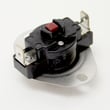
On a Coleman Evcon furnace like model 7956-856, the “reset” is usually a small red (sometimes black) button on a safety switch inside the burner compartment. We typically find it mounted on or near the limit switch/rollout switch area close to the burners and gas valve.
Where to look on model 7956-856
After shutting off power to the furnace at the switch or breaker, remove the front access panel and look for a small button on one of these safety devices:
- Flame rollout switch (often near the burner box opening)
- High-limit switch (often on the furnace vestibule or supply-air plenum area)
- Auxiliary limit (some setups have more than one limit device)
- A small manual-reset safety with two wires attached and a button in the center
If you do not see a button, your furnace may use auto-reset limits for some conditions, and only certain safeties are manual-reset.
Safe reset steps (and what to do first)
Before pressing any reset, address the likely cause of the trip so it does not immediately shut down again:
- Turn power OFF to the furnace.
- Let the furnace cool for 10 to 15 minutes.
- Check and replace a dirty air filter.
- Make sure supply registers and return grilles are open and not blocked.
- Look for obvious loose/burned wires at the switch.
Then press the button once (a gentle click is typical), reinstall the panel, and restore power.
What the reset button means
A manual-reset trip usually indicates a condition that can be unsafe if it repeats. This table helps you decide what to check next.
| What tripped | Common reason | What to check right away |
|---|---|---|
| Rollout switch (manual reset) | Flame “rolling out” of burner area | Blocked flue/venting, burner issues, heat exchanger airflow problems |
| High-limit switch | Overheating | Filter, blower operation, closed vents, restricted ductwork |
| Fuse on control board (if present) | Electrical short/overload | Thermostat wiring, low-voltage shorts, damaged insulation |
Why it matters
The reset button is a safety shutdown, not a normal operating control. If it trips repeatedly, the furnace is protecting your home from overheating or improper combustion, and the underlying airflow, venting, or electrical issue needs to be corrected.
For help with electrical checks, we use guides like how to use a multimeter to test electrical parts video and how to tell if a fuse is blown.
Last updated: February 2026
How to read a furnace model number?
For a Coleman Evcon furnace like model 7956-856, the model number is the identifier we use to match the correct parts list and diagrams; the rating plate on the cabinet also lists key specs such as fuel type, input/output BTUs, and electrical requirements. Use the model number first, then confirm specs from the data plate.
Where to find the model number and what to copy
Look for the furnace rating plate (data plate) on the inside of the burner compartment door, the blower door, or a side panel.
When you write it down, copy it exactly:
- Include all digits and dashes (example: 7956-856)
- Match letters and numbers exactly (some furnaces use both)
- Record the serial number too; it is often needed to determine the manufacturing date
- Take a clear photo before ordering parts
What a furnace model number usually tells you
Model numbers are brand-specific, but most encode a few common “buckets” of information.
| What it identifies | What you may see | Why it helps |
|---|---|---|
| Series or product family | A prefix or leading digits | Narrows the correct parts breakdown |
| Heating capacity class | Numbers like 060, 080, 100 (varies) | Points to approximate BTU size |
| Configuration | Codes for upflow, downflow, horizontal | Affects venting and cabinet layout |
| Fuel and electrical | Gas vs. electric, voltage | Prevents ordering incompatible controls |
How we recommend decoding it (practical method)
Because formats vary by brand and era, the most reliable approach is to use the rating plate plus the model number.
- Start with the exact model number (for this page: 7956-856)
- Compare the rating plate specs to what you are troubleshooting (BTU input, voltage, gas type)
- Use the serial number to determine age when needed
- Match parts by function and location (ignition, gas valve, blower, limit switch) rather than by “looks” alone
Why it matters
A single digit difference can change the cabinet size, blower motor, ignition system, or control board used in the furnace. Using the exact model number helps us keep your repair safe, compatible, and efficient.
For help with identifying and copying the model number correctly, use how to find your appliance model number (and what it means for parts).
Last updated: February 2026
How many square feet will a 90,000 BTU furnace heat?
A 90,000 BTU furnace typically heats about 1,800 to 2,700 sq. ft. in an average, reasonably insulated home. For your Coleman Evcon furnace model 7956-856, the real coverage depends most on climate zone, insulation, duct condition, and the furnace’s actual output (not just input BTU).
Typical square footage range (quick guide)
Use these common rules of thumb for a 90,000 BTU furnace:
- Warm climates: ~2,400 to 2,700 sq. ft.
- Moderate climates: ~2,000 to 2,400 sq. ft.
- Cold climates: ~1,800 to 2,100 sq. ft.
- Older or drafty homes: subtract ~10% to 25%
- Tight, well-insulated homes: add ~10% to 20%
What changes the number the most
Square footage estimates vary because heat loss varies. These factors usually matter more than the BTU rating alone:
- Insulation and air sealing (attic, walls, rim joists, windows, doors)
- Ceiling height (tall ceilings increase the heated volume)
- Ductwork condition (leaks, crushed runs, poor returns)
- Furnace efficiency (AFUE) and whether 90,000 BTU is input vs. output
- Thermostat settings and setbacks (recovery load can feel like undersizing)
Input vs. output BTU (why it matters)
Many furnaces are advertised by input BTU, but what heats the home is output BTU.
| If your furnace is… | What 90,000 BTU usually means | Why it matters |
|---|---|---|
| 80% AFUE | ~72,000 BTU output | Less heat delivered to the house |
| 90% AFUE | ~81,000 BTU output | More usable heat for the same input |
| 95% AFUE | ~85,500 BTU output | Highest usable heat, best coverage |
Sizing tips we use in the field
If you are deciding whether 90,000 BTU is right for your home, these checks help:
- Compare your home’s heated sq. ft. (exclude garages, unfinished basements)
- Confirm your climate zone and typical winter lows
- Inspect and seal ducts; duct losses can mimic an undersized furnace
- If the furnace short-cycles, it can be oversized even if the house feels uneven
- If it runs constantly and cannot maintain setpoint on cold days, it can be undersized (or the home is losing too much heat)
Why it matters
An oversized furnace can short-cycle, create hot and cold rooms, and waste fuel. An undersized furnace can run nonstop and still struggle on the coldest days. Getting the effective output and heat-loss factors right helps your Coleman Evcon 7956-856 heat evenly and efficiently.
Related DIY help: must have tools for appliance repair
Last updated: February 2026