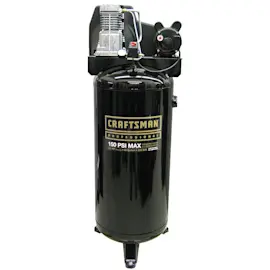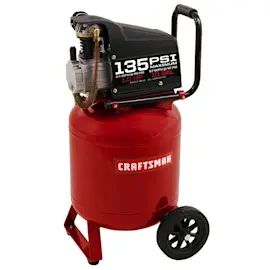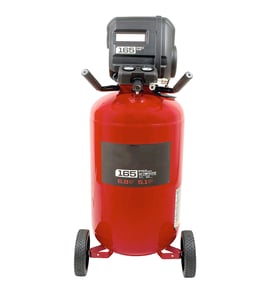

How do I find my compressor model number?
For your Craftsman air compressor, we find the model number on the manufacturer data plate or sticker. On model 919153231, it’s typically on the air tank or the main frame; once you have it, you can match parts and troubleshooting info accurately using our DIY resources like air compressor common questions.
Where to look on an air compressor
Check these common spots first (clean dust and oil off the label so it’s readable):
- Air tank: front, side, or near the base ring
- Pump housing: near the cylinder head or crankcase area
- Motor or frame: on the main rail, handle area, or under the shroud
- Control area: near the pressure switch, regulator, or gauge panel
- Under the unit: underside of the tank or base plate
What to write down (and why)
Record the full ID exactly as printed; one missing digit can pull the wrong parts list.
| Label item | What it’s used for | Tip |
|---|---|---|
| Model number | Finds the correct parts diagrams and repair info | Copy it exactly, including dashes/spaces |
| Serial number | Identifies production run details | Helpful when parts changed mid-series |
| Type/Code (if shown) | Narrows down variations | Write it down with the model number |
Quick tips if the label is hard to read
- Wipe the plate with a damp rag, then dry it
- Use a flashlight at an angle to highlight stamped text
- Take a close-up photo and zoom in
- If the sticker is damaged, check a second label on the tank or frame
Why it matters
The model number is the fastest way to get the right Craftsman air compressor parts and the right repair steps for issues like a pressure switch problem, air leaks, or a compressor that won’t start.
Last updated: February 2026
What does 4.0 SCFM at 90 psi mean?
On a Craftsman air compressor model 919153231, 4.0 SCFM at 90 PSI means the compressor can deliver about 4 standard cubic feet of air per minute while maintaining 90 pounds per square inch of pressure. It is a quick way to judge whether the compressor can keep up with common air tools.
How to use that rating when choosing tools
- Match the tool’s air demand (SCFM) to the compressor’s SCFM at the tool’s working pressure.
- 90 PSI is a common benchmark because many nailers, blow guns, and small impact tools are rated around that pressure.
- If a tool needs more SCFM than 4.0 at 90 PSI, the compressor will run continuously and tank pressure will drop.
- If a tool needs less SCFM than 4.0 at 90 PSI, the compressor cycles normally and pressure stays steadier.
- For “bursty” tools (brad nailers), tank size matters less; for continuous tools (sandblasters, DA sanders), SCFM matters most.
SCFM vs. CFM (why the “S” matters)
SCFM is “standardized” airflow measured under a defined set of conditions so you can compare compressors more fairly. Plain CFM can vary more with temperature, altitude, and test method.
Quick rule-of-thumb table
| Tool type | Typical demand at ~90 PSI | How 4.0 SCFM at 90 PSI usually performs |
|---|---|---|
| Brad/finish nailer | ~0.5 to 2 SCFM | Runs well |
| Blow gun, inflator | ~1 to 3 SCFM | Runs well |
| Small impact/ratchet | ~3 to 5 SCFM | Borderline depending on duty cycle |
| DA sander, grinder | ~6 to 12+ SCFM | Not enough for continuous use |
Why it matters
SCFM at a stated PSI tells us whether your Craftsman 919153231 can maintain pressure while air is flowing, which is what determines real-world tool performance (not just the maximum tank pressure).
For troubleshooting low airflow or pressure drop, use our DIY guide: air compressor won't build tank pressure.
Last updated: February 2026
What is the most common cause of air compressor failure?
The most common cause of air compressor failure (including on Craftsman model 919153231) is poor maintenance that leads to overheating and internal wear. Dirty intake filters, restricted cooling airflow, moisture contamination, and worn valves or seals make the pump work harder until it fails.
Most common failure drivers (what we see most often)
- Overheating from blocked cooling fins, poor ventilation, or long run times
- Dirty intake air (clogged filter) that accelerates cylinder and ring wear
- Moisture in the tank causing internal rust and debris that damages valves
- Air leaks at fittings, regulator, drain valve, or check valve that force longer run cycles
- Electrical stress (weak capacitor, failing pressure switch, loose wiring) that prevents reliable starts
Quick checks you can do first (safe, high value)
- Unplug the compressor and let it cool.
- Inspect and clean dust from pump and motor cooling areas.
- Drain the tank fully; note water, rust flakes, or oily residue.
- Listen for leaks; use soapy water on fittings to spot bubbles.
- If it struggles to start, test with an empty tank versus a full tank.
Symptom-to-cause cheat sheet
| What you notice | Most likely cause | What to check next |
|---|---|---|
| Won’t start | Electrical issue or pressure switch problem | Cord/outlet, switch, capacitor, tank pressure |
| Runs but won’t build pressure | Pump/valve leak or worn seals | Intake, reed valves, head gasket, check valve |
| Builds pressure slowly | Air leak or restricted intake | Fittings, regulator, filter, hose |
| Trips breaker | Overload from heat or motor issue | Ventilation, extension cord use, motor condition |
Why it matters
When an air compressor runs hot or runs longer than normal, the pump and motor see higher friction and load. That speeds up wear on valves, seals, bearings, and electrical components, turning a small maintenance issue into a no-start or no-pressure failure.
Helpful DIY troubleshooting
Last updated: February 2026
Is a 20 gallon air compressor big enough for air tools?
Yes, a 20-gallon air compressor is big enough for many common air tools in a home garage, especially when you use tools in short bursts. For a Craftsman air compressor like model 919153231, the key is matching the tool’s CFM requirement to the compressor’s delivered CFM at 90 PSI, not tank size alone.
What a 20-gallon tank handles well
A 20-gallon tank gives you a useful air “buffer,” so the compressor does not need to run constantly during light to moderate tasks.
- Brad/finish nailers and staplers (intermittent use)
- Blow gun for cleaning and inflating tires
- Small impact wrench for occasional lug nuts
- Light-duty spray work (short passes, pauses between coats)
- Small ratchets and trim tools (short bursts)
Where a 20-gallon compressor struggles
High-demand tools can outpace what many 20-gallon units can continuously supply, so pressure drops and the motor runs frequently.
- Die grinders and cut-off tools (often continuous)
- DA sanders and air sanders (continuous)
- HVLP spray guns used continuously on large panels
- Media blasting (very high, steady air demand)
Quick sizing rule: tank size vs CFM
Tank size affects how long you can work before pressure drops; CFM affects whether you can work continuously.
| What you’re doing | What matters most | What to expect with 20 gallons |
|---|---|---|
| Short bursts (impact, nailer) | Tank + recovery | Works well for most DIY use |
| Continuous sanding/grinding | Delivered CFM @ 90 PSI | Often runs behind the tool |
| Painting large areas | Stable pressure + CFM | Works best with pauses |
How to decide for your specific air tool
Use the tool label or manual and compare it to the compressor’s CFM rating.
- Find the tool’s required SCFM/CFM at 90 PSI (common reference point)
- Compare to the compressor’s delivered CFM at 90 PSI (not “peak” numbers)
- Add 20% to 30% headroom for better performance
- If the tool is continuous-use, prioritize CFM over tank size
- If you see frequent pressure drop, reduce demand (lower duty cycle) or move up in compressor capacity
Why it matters
When the compressor cannot keep up, you get pressure sag, weaker tool performance, longer recovery time, and more heat and wear from frequent cycling.
For more help matching symptoms to airflow and pressure issues, use our DIY resources like air compressor common questions and air compressor can't adjust the output air pressure.
Last updated: February 2026
How do I know what air compressor I have?
You can identify what air compressor you have by finding the brand and model number on the data label; for this Craftsman unit, the model number is 919153231. Once you confirm the model, match it to the tank size, power source, and pressure ratings so you know what parts and performance to expect.
Where to find the model number (fast checks)
Look for a sticker or metal tag in these common spots:
- On the air tank near the handle or wheel bracket
- On the shroud or motor/pump housing
- Near the regulator and gauge panel
- On the rear frame or base plate
- On the underside of a portable unit’s frame
If the label is dirty, wipe it with a damp rag; avoid solvents that can erase printing.
What to write down from the label
These details help you confirm the exact compressor type and capability:
- Brand: Craftsman
- Model number: 919153231
- Voltage and phase (for electric units)
- Max tank pressure (PSI)
- Tank capacity (gallons)
- Oil-free vs. oil-lubricated pump
Match the compressor to your tools (SCFM basics)
Once you know the model, size the compressor to the tools you plan to run. Use the tool’s SCFM requirement at the specified PSI, then add a cushion so the compressor is not running nonstop.
- Find the highest SCFM tool you will use
- Multiply that SCFM by 1.5 for a practical minimum target
- If you run two tools at once, add their SCFM together first
Quick sizing table
| Use case | What to compare | What “enough” looks like |
|---|---|---|
| One tool at a time | Highest tool SCFM | Tool SCFM × 1.5 |
| Two tools at once | Sum of both SCFM | (Tool A + Tool B) × 1.5 |
| Frequent cycling | Duty cycle and recovery | Larger tank or higher SCFM output |
Why it matters
Correct identification (especially the exact model number) prevents ordering the wrong parts and helps you avoid performance issues like slow recovery, pressure drop, and hard starting.
Helpful DIY troubleshooting if you are unsure about performance
If you are trying to identify the compressor because it is not behaving normally, use these guides to narrow it down by symptom:
Last updated: February 2026