Installation guide
 Error Codes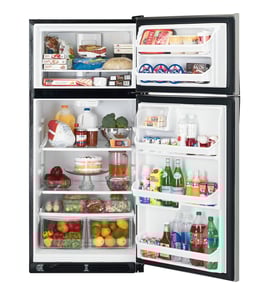



What is the top part of a fridge called?
On the Kenmore 89971335320 top-mount refrigerator, the top compartment is the freezer compartment (often just called the freezer). It’s the section designed to keep food frozen and it also supplies cold air to help cool the fresh food section.
What the top freezer does
- Freezes and stores frozen foods at about 0°F
- Helps cool the refrigerator section through internal airflow
- Often houses the ice maker (if equipped)
- Contains freezer door bins and shelves for organization
Common parts you’ll see in the top freezer area
Some parts are located in or directly support the freezer compartment:
- Airflow components that move cold air
- Door gasket that seals the freezer door
- Ice maker components (on models equipped for ice)
| Freezer-area item | What it’s for | When it becomes a problem |
|---|---|---|
| Freezer door gasket | Keeps warm air out | Frost buildup, sweating, poor cooling |
| Air duct | Routes cold air | Fridge warm but freezer cold |
| Ice maker | Makes ice | No ice, small cubes, leaking |
Where to confirm features for your exact model
We recommend checking the 89971335320 installation guide for model-specific details like door configuration, leveling, and door swing reversal steps.
Why it matters
Knowing the top section is the freezer helps when troubleshooting symptoms like “freezer cold but refrigerator warm,” frost buildup, or ice maker issues. Those problems often trace back to airflow, door sealing, or leveling.
Last updated: January 2026
What is the difference between top mount and top freezer refrigerators?
A “top-mount” refrigerator and a “top-freezer” refrigerator are the same basic design: the freezer compartment is on top and the fresh food compartment is below. For Kenmore model 89971335320, this layout keeps everyday refrigerated items at a comfortable reach while still providing a full-width freezer.
What you get with a top-mount (top-freezer) layout
- Freezer on top; refrigerator section below
- Typically more fresh-food shelf space than many bottom-freezer designs of similar overall size
- Simpler airflow path (freezer cools first, then cold air is directed to the refrigerator section)
- Often fewer complex mechanisms than some French door or bottom-freezer styles
- Easier access to freezer items at eye level
How it compares to other common refrigerator styles
| Style | Freezer location | What it’s best for | Common tradeoff |
|---|---|---|---|
| Top-mount (top-freezer) | Top | Balanced capacity, straightforward design | Fresh food is lower, so you bend more |
| Bottom freezer | Bottom | Fresh food at eye level | Freezer access requires bending |
| French door | Bottom (drawer) | Wide shelves, organization | More doors, more parts, often higher cost |
Why it matters for cooling and controls
On many top-mount refrigerators, the freezer is the primary cooling zone and the refrigerator section is cooled by air routed from the freezer. That means freezer airflow and temperature settings can directly affect fresh-food temperatures.
If temperatures seem off, we use the control and airflow components shown in the 89971335320 installation guide to confirm proper setup and adjustment.
Quick tips to get the best performance from a top-mount refrigerator
- Set the refrigerator to 37°F and the freezer to 0°F (then fine-tune after 24 hours)
- Keep vents between freezer and refrigerator clear of food packages
- Level the cabinet so doors close fully (helps prevent frost and moisture)
- Avoid overpacking the freezer; airflow matters
- If you have an ice maker, confirm the water supply is on and the fill tube is not frozen
Last updated: January 2026
What are the common problems with Kenmore Elite refrigerators?
Common Kenmore Elite refrigerator problems usually come down to cooling and power issues, door sealing problems, and ice maker or water supply faults. On Kenmore model 89971335320 (top-mount), the installation guide troubleshooting points first to power supply, door closure, temperature settings, and leveling.
Most common symptoms and what they usually mean
- Not running at all: unplugged cord, tripped breaker, blown fuse, or a power outage.
- Food not cold enough: door opened too often, door not closing fully, warm temperature setting, or too much unfrozen food added at once.
- Door will not close completely: food packages blocking the door, dirty gasket, or the refrigerator not level.
- No ice or poor ice production: ice maker switched off, water supply issue, or a valve problem.
- Unusual noises: normal refrigerant flow sounds or metal expansion and contraction; persistent loud noise can point to a fan issue.
Quick checks we recommend before replacing parts
- Verify the power cord is fully seated and the outlet has power.
- Confirm both doors close fully and the gaskets are clean.
- Level the cabinet using the front leveling feet (a common cause of warm temps and moisture).
- Set controls colder and allow time for temperatures to stabilize (especially after loading groceries).
- If the unit has an ice maker, make sure the shutoff arm or probe is in the ON position.
Parts that commonly come up for these symptoms (model 89971335320)
| Symptom | Likely area | Example part for this model |
|---|---|---|
| No ice or no water fill | Water supply control | Water valve 3004000060 |
| Warm temps, loud airflow noise | Evaporator airflow | Fan 3000002287 |
| Dead display or no response | Power/control area | Power panel 3005001717 |
Why leveling and door sealing matter
A top-mount refrigerator like the Kenmore 89971335320 depends on tight door sealing and proper cabinet leveling to prevent warm air leaks. When the door does not close correctly, you can get temperature swings, frost, and moisture.
Helpful reference
Use the 89971335320 installation guide for the model-specific leveling steps, door swing guidance, and the built-in troubleshooting table.
Last updated: January 2026