Owner’s manual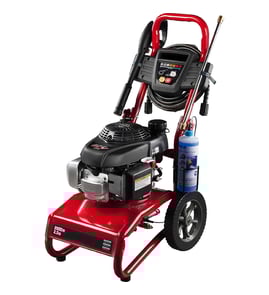




Can you put 87 gas in a pressure washer?
Yes. For the Craftsman gas pressure washer model 580752300, we recommend using clean, regular unleaded automotive gasoline; 87 octane is appropriate for normal operation. Avoid stale fuel and use safe fueling practices described in the 580752300 owner's manual.
Fuel type and what to avoid
Use fuel that keeps the carburetor and fuel system clean and stable.
- Use fresh, clean unleaded gasoline from an approved container.
- Avoid stale gasoline left over from last season.
- Avoid long-term storage of fuel in the tank; fuel can degrade and cause hard starting.
- Be cautious with alcohol-blended fuels during storage; they can attract moisture and contribute to fuel system issues.
- Do not overfill; leave room for fuel expansion.
Safe fueling steps (quick checklist)
Follow these basics any time you refuel a small engine pressure washer.
- Turn the pressure washer OFF and let it cool at least 2 minutes.
- Refuel outdoors only.
- Keep fuel away from sparks, flames, pilot lights, and cigarettes.
- Wipe up spills before starting.
- Store fuel containers away from ignition sources.
Octane guidance for this model
Octane is mainly about knock resistance; most small engines like this one run best on regular fuel.
| Fuel choice | Works for 580752300? | Notes |
|---|---|---|
| Regular unleaded (87) | Yes | Best everyday choice when fresh and clean. |
| Higher octane (89-93) | Usually fine | Typically no performance gain unless the engine requires it. |
| Stale/old gas | No | Common cause of rough running and no-start. |
Why it matters
Using the right fuel helps prevent hard starting, surging, and carburetor varnish. Fresh 87 octane also supports consistent pressure washer performance (starting, throttle response, and steady spray).
Last updated: January 2026
Is it worth repairing a pressure washer?
Yes, repairing a pressure washer is usually worth it when the fix is a common wear item (hose, nozzle, seals, pump oil service) and the engine and pump on your Craftsman 580752300 are still in good shape. If the pump or engine has major internal damage, replacement is often the better value.
Quick decision checklist
- Repair it if the problem is low pressure from a clogged nozzle, air in the pump, or a leaking connection
- Repair it if it only needs routine maintenance (oil change, air filter, spark plug)
- Repair it if the frame, wheels, and hose connections are solid and not heavily corroded
- Replace it if the pump is confirmed faulty after basic checks and cleaning
- Replace it if the engine has lost compression or repeatedly will not start even with fresh fuel and a good spark plug
What we can confirm for model 580752300
Your Craftsman 580752300 is rated at 2,300 PSI and 2.0 GPM (6.0 HP engine). That output is still useful for many home cleaning jobs, so it often makes sense to repair common failures first using the troubleshooting and maintenance steps in the 580752300 owner’s manual.
Common “worth repairing” fixes (and parts that often solve them)
Many “no pressure” or “weak spray” complaints come from the spray tip, hose, or basic pump service.
- Replace a damaged or leaking high-pressure hose: hose 84006753
- Replace a worn or restricted spray tip: generac pressure washer spray nozzle jet 21760GS
- Service pump oil on schedule: pressure washer pump oil 190586GS
| Symptom | Often worth repairing first | Why |
|---|---|---|
| Weak/erratic pressure | Nozzle cleaning or replacement | Low cost, fast fix |
| Leaks at connections | O-ring replacement | Stops pressure loss |
| Pump runs hot at idle | Thermal relief behavior and usage habits | Prevents pump damage |
Why it matters
A small leak, clogged nozzle, or overdue maintenance can make a good pump look “bad.” Doing the basic checks first can restore full pressure and prevent unnecessary pump or engine replacement.
Last updated: January 2026
What PSI should my pressure washer be?
For the Craftsman pressure washer model 580752300, the rated working pressure is 2,300 PSI. That is the PSI you should expect under proper water supply and normal operation; actual spray force varies with nozzle setting, tip condition, and flow.
Confirm the correct PSI for this model
We list 2,300 PSI as the product specification for Craftsman 580752300; you can also verify it in the 580752300 owner's manual.
- Rated pressure: 2,300 PSI
- Rated flow: 2.0 GPM
- Water supply temperature limit: under 100°F
- Minimum supply pressure at the garden hose: 20 PSI (with adequate flow)
Why your PSI might feel lower (or higher)
Even with a 2,300 PSI rating, performance can change if any of these are off:
- Nozzle is set to low-pressure mode (detergent mode)
- Spray nozzle or orifice is partially clogged
- Inlet screen or in-line filter is dirty
- Garden hose is too long, kinked, or supply flow is weak
- High-pressure hose is leaking or restricted
If you suspect a worn or damaged spray tip/orifice, replacing the correct nozzle can restore performance; see generac pressure washer spray nozzle jet 21760GS.
Quick reference: PSI ranges by typical task
Use this as a practical guide for choosing pressure and avoiding surface damage.
| Task | Typical PSI range | Notes |
|---|---|---|
| Washing vehicles | 1,200 to 1,900 | Use wider fan spray, keep distance |
| Decks and fences | 1,500 to 2,500 | Test a small area first |
| Concrete and driveways | 2,500 to 3,500 | Higher risk of etching |
| Delicate surfaces | Under 1,500 | Use low pressure and more distance |
Why it matters
Using the right PSI helps you clean faster while reducing the chance of damaging wood, paint, seals, and concrete. It also helps prevent pump strain caused by restricted water flow or clogged nozzles.
Last updated: January 2026