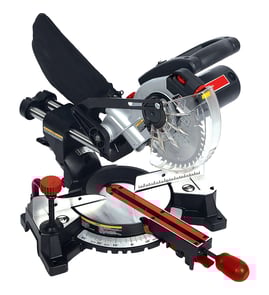

How much horsepower does a Delta 36-040 have?
The exact horsepower rating for the Delta 36-040 (8-1/4" compound miter saw) depends on the motor nameplate specs for your specific saw; many miter saws in this class are labeled by amps (often around 12A to 15A) rather than horsepower. For the most accurate value, read the motor tag on your 36-040.
Look for a label on the motor housing or near the switch handle. It typically lists electrical and motor details.
- Check for HP (horsepower) printed directly on the tag
- If no HP is listed, look for amps (A) and volts (V)
- Note whether it lists max developed HP versus running HP
- Record the full model number 36-040 and any motor ID numbers
- If the label is worn, take a clear photo before cleaning it
Many Delta miter saw motors are marketed by amperage because it is easier to standardize across tools. As a practical comparison, a 120V motor in the 12A to 15A range is typically considered a strong, full-size miter saw motor for common crosscuts in hardwood and plywood.
| What you see on the label | What it tells you | How to use it |
|---|---|---|
| HP listed | Direct horsepower rating | Use that number for comparisons |
| Amps (A) and volts (V) only | Electrical input rating | Compare to other saws by amps |
| RPM listed | No-load speed | Higher RPM often means cleaner cuts |
Horsepower (or amps) helps you match the saw to the work. Higher power reduces bogging in thick stock, supports cleaner cuts with the right blade, and can reduce overheating during repeated cuts.
If you are trying to match a replacement motor, switch, or wiring component to your Delta 36-040, start with the model-based parts lookup; you can also search by model number on Sears PartsDirect. For electrical troubleshooting, use safe testing practices and unplug the saw before inspecting wiring.
Last updated: February 2026
What should you never cut with a miter saw?
On a Delta 36-040 8-1/4" compound miter saw, we never cut materials the saw is not designed for (like ferrous metal or masonry), and we never make cuts that put hands close to the blade (like tiny offcuts without proper support). These situations create high kickback and injury risk.
- Ferrous metals (steel, iron, rebar): they can shatter abrasive wheels, damage the blade, and throw hot chips
- Masonry (brick, concrete, tile): dust and hardness can damage the saw and create unsafe debris
- Unknown composites that can splinter or melt (some plastics, laminates) unless the correct blade and setup are used
- Rip cuts (cutting with the grain like a table saw): miter saws are built for crosscuts and miters, not ripping
- Freehand cuts: always keep the work supported and controlled against the fence
- Small pieces close to the blade: if you cannot clamp it and keep hands well away, do not cut it
- Warped or twisted stock that cannot sit flat on the table and tight to the fence
- Use a table saw or circular saw with a guide for ripping
- Use a metal-cutting saw or the correct tool for steel and iron
- Use a masonry saw or grinder designed for concrete and tile
- For short pieces, use a stop block and clamp, or cut a longer board first and trim later
| Material or cut | Use the miter saw? | Better option |
|---|---|---|
| Crosscutting wood trim | Yes | Clamp and support long stock |
| Ripping a board | No | Table saw or circular saw guide |
| Steel or iron | No | Metal-cutting saw |
| Brick, tile, concrete | No | Masonry tool |
A miter saw can grab the workpiece and launch it (kickback) when the material is too hard, too small, not supported, or the cut type is wrong. Avoiding these cuts protects the blade, the saw’s guard system, and your hands.
For parts and diagrams for your Delta 36-040, start with the model parts list, or search by model number on Sears PartsDirect. For general electrical safety checks related to power tools, we also use guides like how to use a multimeter to test electrical parts video.
Last updated: February 2026
Why is 31.6 on a miter saw?
The 31.6° mark on a miter saw (including the Delta 36-040 8-1/4" compound miter saw) is a common preset used for compound crown molding cuts when you cut the molding laid flat on the saw table. It pairs with a matching bevel setting (often 33.9°) to help produce tight 90° corner joints with less angle math.
When crown molding is cut “flat” (not nested against the fence), you typically use both:
- A miter angle (rotation) such as 31.6°
- A bevel angle (tilt) such as 33.9°
- The correct corner type (inside vs. outside)
- The correct side (left vs. right) of the saw
- Consistent molding orientation (ceiling edge vs. wall edge)
These presets are popular because they match common crown “spring angles” used in many installations.
| Setting on the saw | What it changes | What you’ll see on the tool |
|---|---|---|
| Miter | Turns the table left/right | Degree scale on the base |
| Bevel | Tilts the blade left/right | Degree scale on the pivot/arm |
Crown molding corners are “compound” joints; the molding meets the wall and ceiling at an angle, so a simple 45° miter cut usually will not fit correctly. The 31.6° miter preset helps you get repeatable results faster, especially when you are doing multiple corners.
- Use scrap to make a test corner before cutting finished trim.
- Mark the molding’s ceiling edge and wall edge so you do not flip it.
- Confirm your saw is calibrated: fence square, bevel stop accurate, blade not deflecting.
- Use a sharp blade designed for trim (fine tooth count) to reduce tear-out.
- Clamp the workpiece; crown can shift during the cut.
If your miter detent, bevel lock, or pointer is loose or inaccurate, the angle marks can be “right” but the cut will still be off. We recommend using the model diagrams to identify the correct adjustment or replacement items for Delta 36-040, and you can also search by model on Sears PartsDirect.
Last updated: February 2026