Error Codes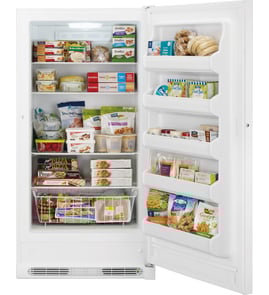



How do I know how many cubic feet my upright freezer is?
To find the cubic feet of your Kenmore upright freezer model 25320211000, measure the inside width, depth, and height in inches, multiply them together, then divide by 1,728. That gives you the freezer’s approximate internal storage capacity.
How to measure it correctly
- Empty the freezer enough to measure the interior walls accurately.
- Measure inside width (left wall to right wall).
- Measure inside depth (back wall to inside of the door liner, not the door gasket).
- Measure inside height (floor to the underside of the top interior surface).
- Use inches for all measurements.
- Multiply: W x D x H.
- Divide by 1,728 (the number of cubic inches in 1 cubic foot).
Quick formula and example
Formula:
- Cubic feet = (W x D x H) / 1,728
| Measurement | Example (inches) |
|---|---|
| Width (W) | 20 |
| Depth (D) | 18 |
| Height (H) | 50 |
| Result | (20 x 18 x 50) / 1,728 = 10.4 cu ft |
Why your result may not match the advertised size
Manufacturers often list capacity based on standardized measurement methods; your tape-measure result can vary because of:
- Interior shelves, bins, and air channels
- Evaporator cover space and interior contours
- The door liner shape and usable clearance
If you are comparing storage space, also consider how shelves and baskets fit your needs. For replacement interior components that affect usable space, match parts to model 25320211000, such as the shelf 216070000.
Why it matters
Knowing cubic feet helps you compare freezer capacity, plan food storage, and confirm whether an upright freezer is the right size for your household before reorganizing or replacing parts.
Last updated: January 2026
What are the disadvantages of an upright freezer?
Upright freezers like Kenmore 25320211000 trade floor-space efficiency for convenience; the main disadvantages are less usable space for bulky items, higher energy use than most chest freezers, and more temperature swings during door openings.
Common disadvantages (what you will notice day to day)
- Less room for bulky items: shelves and door bins limit tall or wide packages.
- More cold-air loss when opened: cold air spills out, so the unit works harder to recover.
- Typically higher energy use than chest freezers: chest designs hold cold air better.
- More frost risk in some conditions: frequent openings and humid rooms can increase frost buildup.
- More parts exposed to wear: door sealing and hinges matter more because the door is used constantly.
Upright vs. chest freezer: quick comparison
| Feature | Upright freezer | Chest freezer |
|---|---|---|
| Storage for bulky items | Fair | Excellent |
| Organization | Excellent (shelves) | Fair (baskets) |
| Energy efficiency | Usually lower | Usually higher |
| Door-open temperature stability | Lower | Higher |
What to check if performance seems worse than expected
If your upright freezer is running a lot, frosting up, or struggling to hold temperature, these are the first items we look at:
- Door seal condition: gaps, tears, or a gasket that will not grip the cabinet.
- Door alignment: a sagging door can cause air leaks.
- Condenser cleanliness and airflow: blocked airflow makes the compressor run longer.
- Loading habits: warm food and frequent openings increase run time.
- Room conditions: hot garages and high humidity make any upright work harder.
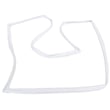
If the door is not sealing well, replacing the freezer door gasket 5304507202 is a common fix for warm temps and frost.
Why it matters
These disadvantages affect operating cost, food quality, and reliability. For example, a small air leak at the door can cause longer run times, frost buildup, and temperature swings that lead to freezer burn.
Last updated: January 2026
How do I find the model number on my 25320211000?
Your Kenmore upright freezer’s model number is printed on the appliance’s ID label (not on the door). On model 25320211000, you’ll typically find that label just inside the cabinet opening, along the side wall near the front, or on the back exterior panel.
Where to look on a Kenmore upright freezer
Check these common label locations in this order:
- Inside the freezer compartment on the left or right side wall near the front opening
- Along the cabinet frame (the face frame you see when the door is open)
- Behind the lower front toe grille or kickplate area (if your unit has one)
- On the back of the freezer cabinet near the bottom
- Near the compressor area on the rear panel
What the label looks like (and what to write down)
The ID label usually includes multiple identifiers. Record them exactly as shown:
- Model number (example format: 253.20211000 or 25320211000)
- Serial number (used for age and production run)
- Electrical ratings (volts/amps) and refrigerant information
Quick ID guide
| Item on label | Why it matters | Example |
|---|---|---|
| Model number | Ensures correct part fit | 25320211000 |
| Serial number | Helps match revisions | Varies |
| Product code/type | Helps narrow diagrams | Varies |
Why it matters
Kenmore model numbers can look similar across different upright freezer versions. Using the exact model number from the label helps us match the correct diagrams and parts, such as the freezer door gasket 5304507202 or ptc starter 5304493950, so the replacement fits and works correctly.
Last updated: March 2026