Owner’s manual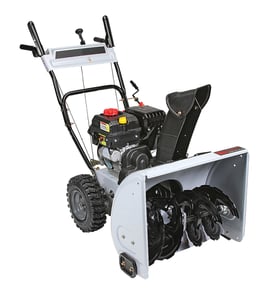



How many years should a snowblower last?
A gas snowblower like Craftsman model 536887250 typically lasts 15 to 20 years with normal residential use and consistent maintenance. Regular lubrication, seasonal tune-ups, and proper off-season storage (as outlined in the 536887250 owner's manual) are what keep the engine, belts, and auger system running for the long haul.
Typical lifespan by use and care
- Well maintained, residential use: 15 to 20 years
- Light use, stored correctly every year: often 20+ years
- Heavy use or poor maintenance: closer to 10 to 15 years
- Commercial or rental use: wears faster because it runs more hours and sees harsher conditions
Quick comparison
| Scenario | What you usually see | What drives the outcome |
|---|---|---|
| Annual tune-up + clean storage | Longest lifespan | Less corrosion, fewer fuel issues |
| Old fuel left in tank | Hard starting, carb problems | Gum deposits, water contamination |
| Worn drive/auger system | Slipping, weak throwing | Belt wear, pulley/idler wear |
What wears out first (and what to plan for)
Even when the machine lasts decades, some items are normal wear parts.
- Spark plug and routine engine service items
- Drive and auger belts (common wear items)
- Shear pins (designed to break to protect the auger/gearcase)
- Friction drive components and cables as hours add up
If your unit starts moving poorly or the auger stops under load, belt wear is a common cause; the snowblower drive belt 1733324SM is one of the model-matched belt options listed for this machine.
Maintenance habits that add years
The manual’s storage guidance is a big deal for longevity, especially fuel handling.
- Clean the snowblower thoroughly after the season
- Lubricate all lubrication points before storage
- Tighten and inspect nuts, bolts, and moving parts for wear
- Protect bare metal surfaces with rust preventative spray
- Run the engine dry or treat fuel with stabilizer for storage
Why it matters
A snowblower’s lifespan is mostly about preventing two expensive problems: fuel-system damage from stale ethanol fuel and mechanical wear from running dry, loose, or out of adjustment. A little preseason and postseason care protects the engine, auger drive, and ground drive system.
Last updated: February 2026
How to tell year of Craftsman snowblower by serial number?
On Craftsman snow thrower model 536887250, the most reliable way to identify the build year from the serial number is to match the serial number format used on your machine to the date-code chart in the 536887250 owner's manual. Once you know the format, the date portion of the serial number points to the year.
Where to find the serial number
Most Craftsman snowblowers place the serial number on an ID label on the frame or rear housing near the handles.
- Look for a sticker or metal tag on the rear frame between the handles
- Check the side of the auger housing near the engine
- Wipe off dirt and oil so every character is readable
- Write the serial number exactly as shown (letters, numbers, and dashes)
How serial number date codes usually work
Craftsman snowblowers were built by different manufacturers over the years, so the serial number pattern is not universal. Common patterns you may see include:
- Letter-coded month (often A through L for Jan through Dec)
- Two-digit day of month (01 to 31)
- Single digit year-in-decade (for example, 1, 2, 3)
- Four-digit year (less common on older units)
Quick pattern check
| What you see in the serial number | What it usually means | What to do next |
|---|---|---|
| Starts with a letter then numbers | Month and day are encoded early | Decode month letter, then day |
| Contains a clear 4-digit year | Year is printed directly | Use that year |
| All numbers, no obvious year | Manufacturer-specific date code | Use the manual’s ID guidance |
A practical way to confirm the year
Use these cross-checks so you land on the correct decade:
- Compare the decoded year to the engine style and controls shown in the 536887250 owner's manual
- If your unit has drive issues, the parts list for this model (for example, snowblower drive belt 1733324SM) helps confirm you are working from the correct model family
- If the serial label is damaged, match your major assemblies (chute, handle, drive) to the diagrams in the manual
Why it matters
The correct year helps you order the right parts (belts, cables, chute hardware) and follow the right adjustment specs for drive and auger controls.
Last updated: February 2026
Is it cheaper to repair or replace a snowblower?
For a Craftsman snow thrower model 536887250, it’s cheaper to repair when the problem is a normal wear item (belt, cable, spark plug, shear pins) or a simple adjustment; it’s smarter to replace when the repair cost approaches about half the price of a comparable new snowblower or when major drivetrain or engine work is needed.
Quick decision checklist
- Repair if the machine starts reliably and only one system is acting up (drive or auger, not both).
- Repair if the fix is a wear part you can replace in under a couple hours.
- Repair if the frame, auger housing, and controls are solid (no major damage or severe rust).
- Replace if the engine has low power, heavy smoking, or repeated fuel system issues season after season.
- Replace if the unit has frequent breakdowns that cause multiple repairs per winter.
- Replace if the drive system needs multiple major parts at once (friction wheel, bearings, sprockets, hex shaft work).
Typical repair costs vs replacement value
| Situation | Usually makes sense to | Why |
|---|---|---|
| Slipping drive or auger belt | Repair | Low parts cost, common DIY job |
| Won’t move forward due to worn friction wheel | Repair (often) | Common wear item; restores traction |
| Major engine or transmission failure | Replace (often) | High labor and parts cost |
| Multiple systems failing at once | Replace | Costs stack quickly |
Model 536887250 repairs that are commonly worth doing
Your owner’s manual calls out normal wear items (including spark plugs and drive belts) as expected maintenance parts, not unusual failures. Use the 536887250 owner’s manual to match the symptom to the right adjustment or replacement.
If you’re seeing drive problems, these are common, cost-effective fixes:
- Replace the ground drive belt: snowblower drive belt 1733324SM
- Replace the auger drive belt: snowblower gas belt 585416MA
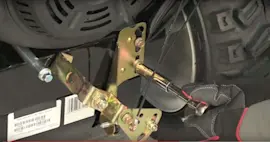
- Inspect and adjust the friction wheel position and linkage (the manual includes friction wheel adjustment and replacement steps).
Why it matters
A well-timed belt, cable, or friction wheel repair can restore performance for a fraction of the cost of a new machine. Replacing the snowblower becomes the better value when reliability drops and you start paying repeatedly for major drivetrain or engine work.
Last updated: February 2026
Should I spray my snowblower with WD-40?
Yes, you can spray a light coating on key metal surfaces of your Craftsman snow thrower model 536887250, but we recommend using it mainly as a rust preventative, not as a long-lasting lubricant. For snow-shedding performance in the chute and auger housing, a silicone spray typically lasts longer and stays slicker.
Where spraying helps (and where it does not)
Use a spray product to protect bare metal and reduce sticking; avoid soaking belts, pulleys, and friction surfaces.
- OK to spray lightly: chute interior, auger housing interior, impeller housing, exposed bare metal
- Avoid spraying: drive belts, auger belt area, pulleys, friction wheel area, tires, and controls you need to grip
- After-use tip: run the machine a few minutes after throwing snow to help prevent auger and impeller freeze-up
- After-use cleanup: remove snow, ice, and debris; flush off salt if possible and wipe dry
- For storage: cover bare metal in the auger and impeller area with a rust preventative spray
For model-specific maintenance and storage steps, follow the 536887250 owner’s manual.
Quick product comparison
| Goal | Better choice | Why |
|---|---|---|
| Prevent rust during storage | WD-40 type water-displacing spray | Helps protect bare metal from moisture |
| Reduce snow sticking in chute | Silicone spray | Longer-lasting slick film for snow shedding |
| Lubricate moving pivots/bushings | Light machine oil (where specified) | Stays in place better than a solvent spray |
Why it matters
Overspray can cause slipping and poor performance. If spray gets on belts or pulleys, the snowblower can lose drive or auger engagement, which often feels like a “weak drive” or “auger not pulling snow.”
If you already sprayed and performance changed
- Wipe down any visible overspray near pulleys and belt paths
- Inspect belts for glazing, cracking, or contamination
- Replace worn or slipping belts if needed: the ground drive belt is snowblower drive belt 1733324SM and the auger drive belt is snowblower gas belt 585416MA
Last updated: February 2026
What are common Craftsman snowblower problems?
Common problems on the Craftsman 536887250 snow thrower are no-start or rough running, weak or no snow throwing, and poor self-propelled drive. Most issues trace to fuel and ignition maintenance, belt wear, or auger/drive adjustments outlined in the 536887250 owner's manual.
Most common symptoms and likely causes
- Engine will not start / runs rough: stale fuel, dirty carburetor, fouled spark plug, incorrect choke or throttle setting
- Auger will not turn / won’t throw snow: jammed auger or chute, worn or loose auger belt, misadjusted auger control cable
- Unit won’t move or slips under load: worn or loose drive belt, traction/drive linkage out of adjustment
- Excess vibration or noise: packed ice, loose fasteners, damaged auger components
- Chute won’t aim or won’t stay put: chute hardware out of position, control rod needs adjustment
Quick checks we recommend (fast, no special tools)
- Fuel: drain old fuel and refill with fresh gasoline; open the fuel shutoff (if equipped).
- Spark plug: remove, inspect, clean or replace if fouled.
- Belts: check for glazing, cracking, or slack; a slipping belt is a top cause of “runs but won’t move/throw.”
- Auger and chute: shut off engine, remove key, wait for all movement to stop; clear packed snow and ice.
- Controls: confirm the auger and drive levers fully engage and return smoothly.
Parts that commonly wear on this model
The manual notes that normal-wear items include spark plugs, drive belts, and shear pins. If symptoms point to belt slip, these model-matched parts are common fixes:
| Symptom | Common part to inspect | Example part for 536887250 |
|---|---|---|
| Won’t move / slips | Ground drive belt | Snowblower drive belt 1733324SM |
| Auger won’t spin / weak throwing | Auger drive belt | Snowblower gas belt 585416MA |
Helpful DIY videos for the same type of repair
- How to check a snowblower spark plug video
- How to replace a snowblower belt video
- How to adjust a snowblower auger control video
Why it matters
Catching belt wear, stale fuel, and control-cable misadjustment early prevents bigger failures and keeps the auger and drive systems engaging at full power when you hit heavy snow.
Last updated: February 2026
Where is the serial number on a snowblower?
On the Craftsman snow thrower model 536887250, the model and identification numbers are typically found on a label or plate on the rear of the unit near the handles or frame. Use those numbers when ordering parts and looking up the correct diagrams in the 536887250 owner's manual.
Where to look on the machine
Check these common locations first (wipe off snow, salt, and grime so the label is readable):
- Rear of the snowblower frame, behind the engine and below the handlebar area
- Back of the auger housing (the front bucket area), near the top edge
- Side of the frame near the wheels or axle area
- Near the belt cover area on the engine side of the unit
- On the handle support tubes or cross brace
What numbers you might see (and what they mean)
Snowblowers often show multiple identifiers on the same label. Here is how we recommend using them when you need parts for Craftsman 536887250.
| Label item | What it’s used for | What to do with it |
|---|---|---|
| Model number | Identifies the exact machine family | Match it to 536887250 before ordering parts |
| Serial number | Identifies your specific unit | Keep it for service records and warranty paperwork |
| Code/date number | Production code or build date | Helpful when a part changed during production |
Why it matters when ordering parts
Using the correct identification numbers helps us match you to the right parts list and diagrams, especially for items that vary by production run (belts, pulleys, cables, and chute hardware).
If you are troubleshooting a drive issue while you are identifying the unit, the most commonly replaced wear items on this model include the snowblower drive belt 1733324SM (ground drive) and the snowblower gas belt 585416MA (auger drive).
Quick tips to read the label successfully
- Take a clear photo of the label before you start a repair
- Copy the numbers exactly (including dots or dashes)
- If the label is damaged, look for a stamped plate on the frame near the rear
Last updated: February 2026