 Installation guide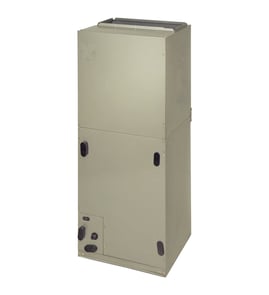

How many cfm is a 4 ton air handler?
A 4-ton air handler is typically set up to deliver about 1,400 to 1,600 CFM in cooling (roughly 350 to 400 CFM per ton). On the Carrier FV4BNF003000 fan coil, the exact airflow depends on the system type selection and the AC/HP airflow adjust settings in the installation guide.
Typical CFM targets for 4 tons
Most 4-ton systems are commissioned in one of these ranges:
- 1,600 CFM (400 CFM per ton): common “standard” cooling airflow
- 1,400 CFM (350 CFM per ton): common for better humidity removal
- About 1,260 CFM (315 CFM per ton): used in some heat pump comfort heating setups
What changes the CFM on FV4BNF003000
This fan coil uses control selections that change airflow by mode:
- System type selection (AC vs heat pump comfort vs heat pump efficiency)
- AC/HP CFM adjust jumper (Nominal, High, Low)
- Operating mode (cooling, heat pump heating, dehumidification)
- Duct static pressure and filter condition (dirty filters reduce delivered airflow)
Quick reference: per-ton airflow by mode (from the setup logic)
| Mode/selection concept | Approx. airflow per ton | 4-ton equivalent |
|---|---|---|
| Standard cooling target | 400 CFM/ton | 1,600 CFM |
| Humidity-focused cooling target | 350 CFM/ton | 1,400 CFM |
| HP comfort heating concept | 315 CFM/ton | 1,260 CFM |
How we recommend confirming your actual airflow
Use the commissioning steps in the installation guide and verify airflow is in the proper range for the installed unit size.
- Confirm the thermostat/control is calling the mode you are testing
- Verify the board settings (system type and airflow adjust)
- Check the filter and coil for restriction
- Measure external static pressure and confirm blower performance
- If airflow is noisy or low, inspect the blower assembly (including the fan wheel LA22LA095)
Why it matters
Correct CFM protects comfort and equipment: too high can reduce dehumidification and increase noise; too low can cause poor cooling, coil icing, and reduced efficiency.
Last updated: February 2026
How much does it cost for an air handler?
For a Carrier fan coil (air handler) like model FV4BNF003000, typical pricing is $1,500 to $4,500 for the air handler equipment and $3,000 to $8,000 total installed. Your final cost depends on capacity, blower motor type, electric heat kit needs, and how much duct, drain, and electrical work the install requires.
What changes the price the most
- Capacity (tonnage): Higher-capacity air handlers cost more.
- Blower type and controls: ECM/variable-speed motors and control boards add cost.
- Electric heat kit: Adding heat strips or increasing kW raises equipment and labor.
- Duct and cabinet modifications: Plenum transitions, return changes, and sealing add time.
- Condensate drain and safety: New trap, overflow protection, or rerouting can add parts.
- Electrical upgrades: Breaker, wiring, disconnect, and code-required items can increase labor.
Typical cost breakdown
| Cost item | Typical range | What it usually includes |
|---|---|---|
| Air handler equipment | $1,500 to $4,500 | Cabinet, blower assembly, controls (varies by features) |
| Installation labor and materials | $1,500 to $3,500 | Removal, set-in-place, transitions, drain, basic electrical |
| Total installed | $3,000 to $8,000 | Higher when access is difficult or upgrades are needed |
Model-specific details that can affect labor
FV4BNF003000 setup time can increase if the installer needs to configure airflow and system type (AC vs heat pump) and verify CFM targets. The installation guide covers airflow selection and adjustment (LO/NOM/HI) and typical CFM-per-ton targets used during commissioning.
When a repair costs less than replacement
If the cabinet and coil are in good shape, replacing a failed component can be far cheaper than a full air handler swap. Common examples include:
- Noisy or out-of-balance blower: replace the fan wheel LA22LA095
- Intermittent electrical issues: inspect harnesses and connections
- Control problems: test the control board and related wiring
Why it matters
Air handler cost is not just the box; correct sizing and airflow setup directly affect comfort, humidity control, noise, and energy use. Paying for proper commissioning helps prevent repeat service calls.
If you are comparing repair vs replacement, we list model-matched parts for FV4BNF003000 on the parts list, and you can also search by model number on Sears PartsDirect.
Last updated: February 2026
What happens when an air handler goes bad?
When a Carrier FV4BNF003000 air handler starts going bad, you typically get weak or uneven airflow, unusual noises, and heating or cooling that cannot keep up. Electrical control issues can also prevent the blower from running, and moisture problems can lead to musty odors and drain pan overflow.
Common signs you will notice
- Little to no airflow from supply vents (even when the thermostat is calling)
- Rattling, scraping, or loud humming from the blower area
- Short cycling (system turns on and off frequently)
- Musty smell, visible moisture, or water around the unit (drain or pan issues)
- Higher energy bills because the blower and controls are not operating efficiently
What is usually failing inside the air handler
Air handlers most often fail in one of these areas: airflow components, electrical controls, or condensate management.
| Symptom | Likely area | What to check first |
|---|---|---|
| No blower operation | Control signals, wiring, ECM motor/module | Thermostat call and low-voltage connections per the installation guide |
| Loud vibration | Blower wheel or mounting | Blower wheel condition and balance; inspect fan wheel LA22LA095 |
| Runs but weak airflow | Dirty filter, coil restriction, incorrect airflow setup | Filter and coil cleanliness; confirm airflow settings |
| Intermittent operation | Loose connections, harness issues, control board | Harness pins and connectors; inspect board circ HK61EA005 |
Safe, practical checks we recommend
- Turn off power at the disconnect/breaker before opening panels; high voltage can remain present at the motor.
- Replace or clean the air filter monthly; this is the main consumer maintenance item.
- Inspect the cooling coil, drain pan, and condensate drain each cooling season; clean as needed.
- If the blower will not run, follow the control-signal checks in the installation guide (jumpering R to G, R to Y1/Y2, and R to W1 is a common diagnostic step for trained servicers).
- If wiring connections look heat-damaged or loose, inspect the harness and connectors; a poor connection can mimic a bad motor or board.
Why it matters
A failing blower, wiring harness, or control board can reduce comfort quickly and can also force the system to run longer than normal. Catching airflow and moisture issues early helps protect the coil, drain system, and electrical components.
Last updated: February 2026
