

What are the 4 important rules for a bench grinder?
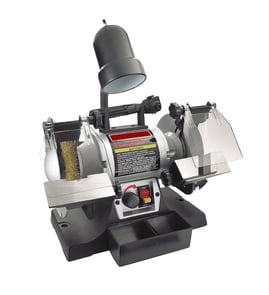
For the Craftsman 152211600 bench grinder, the four most important rules are: wear proper eye and face protection, keep guards and tool rests correctly adjusted, use only wheels rated for the grinder’s RPM, and keep hands, clothing, and hair safely away from the wheel and rotating parts.
- Protect your eyes and face: Wear safety glasses plus a face shield; grinding wheels can throw sparks and debris.
- Set the tool rest correctly: Keep the tool rest close to the wheel (commonly 1/8 inch or less) and tighten it so it cannot shift.
- Confirm wheel speed rating: The grinding wheel’s rated RPM must be equal to or higher than the grinder’s no-load RPM.
- Control entanglement and contact hazards: No loose sleeves, gloves near the wheel, jewelry, or untied long hair; keep fingers clear and use light pressure.
- Inspect the wheel for chips or cracks; replace damaged wheels.
- Make sure the wheel guards and spark deflectors are installed and secure.
- Stand slightly to one side at startup and let the grinder reach full speed.
- Use the wheel face for grinding; avoid side-loading a wheel unless it is specifically designed for side grinding.
- Keep the workpiece supported on the tool rest; do not freehand small parts.
| Item | Typical target | Why it matters |
|---|---|---|
| Tool rest gap | 1/8 in or less | Reduces the chance the workpiece gets pulled into the wheel |
| Spark deflector gap | 1/8 in or less | Helps contain sparks and debris |
| Wheel RPM rating | Wheel rating ≥ grinder RPM | Prevents wheel overspeed failure |
Most bench grinder injuries come from wheel damage, poor adjustment (large gaps), or entanglement. A correctly adjusted tool rest and guard setup helps keep the work steady and reduces kick-in and wheel contact surprises.
If you’re troubleshooting power, switches, or wiring on a bench grinder, we recommend starting with how to use a multimeter to test electrical parts video.
Last updated: February 2026
What is the difference between 6 and 8 bench grinder?
A 6-inch bench grinder and an 8-inch bench grinder mainly differ in wheel diameter, which changes how fast they remove material, how much heat they build, and the grind shape you get. For most sharpening and shaping tasks on a Craftsman bench grinder like model 152211600, an 8-inch grinder is typically better for heavier work and cooler grinding; a 6-inch grinder is usually more compact and budget-friendly.
- Wheel diameter and hollow grind: An 8-inch wheel produces a shallower hollow grind on chisels and plane irons; a 6-inch wheel creates a deeper hollow.
- Heat control: 8-inch wheels generally run cooler at the edge because the contact area and grind geometry are less aggressive.
- Material removal: 8-inch grinders often feel more stable for stock removal; 6-inch grinders are fine for light shaping and touch-ups.
- Tool clearance and workspace: 8-inch units usually give you more room between the wheel and guards/tool rests.
- Footprint and weight: 6-inch grinders are typically smaller and easier to mount on a small bench.
| Feature | 6-inch bench grinder | 8-inch bench grinder |
|---|---|---|
| Wheel size | 6 in. diameter | 8 in. diameter |
| Common speeds | 3,450 RPM (some 1,750 RPM “slow speed”) | 3,450 RPM (many 1,750 RPM “slow speed”) |
| Best for | Light grinding, quick touch-ups | Sharpening tools, heavier grinding, better heat control |
| Grind shape | Deeper hollow | Shallower hollow |
- Choose 8-inch if you sharpen woodworking tools (chisels, plane irons), grind frequently, or want easier heat control.
- Choose 6-inch if you have limited space, do occasional grinding, or mainly deburr small metal parts.
- For either size, using the right wheel grit, keeping the wheel dressed, and using light pressure matters more than raw size.
Wheel diameter changes the grind geometry and heat buildup, which directly affects edge quality and how often you risk overheating and softening tool steel.
For electrical troubleshooting on a bench grinder (switch, cord, motor), our DIY guide how to use a multimeter to test electrical parts video helps you test safely and accurately.
Last updated: February 2026
How do I find the model number on my 152211600?
The model number for your Craftsman bench grinder is printed on the tool’s rating label (nameplate). On model 152211600, that label is typically on the grinder’s base, motor housing, or the rear of the unit; look for a sticker or metal plate with “MODEL” and a number.
Check these common nameplate locations:
- The underside of the base (flip the grinder safely if it is not bolted down)
- The back of the motor housing (near the power cord entry)
- The side of the base near the mounting holes
- Near the on/off switch area
- Along the rear edge of the base plate
Most bench grinder labels include several identifiers. Copy them exactly (including dashes and letters) so we can match the correct diagrams and parts.
| Label item | What it’s used for | Example format |
|---|---|---|
| Model number | Finds the correct parts breakdown | 152211600 |
| Serial number | Identifies production run | Letters and numbers |
| Electrical rating | Confirms power requirements | Volts, amps, Hz |
| RPM | Confirms wheel speed rating | A number like 3450 |
Use these steps to still identify the correct model:
- Check your original packaging, receipt, or registration paperwork
- Look for a second label inside the wheel guard area (unplug first)
- Search by the tool’s identifying information using [how to find your appliance model number (and what it means for parts)]
- If you find multiple numbers, use the one specifically labeled “MODEL”
Bench grinder parts and guards are matched by model because wheel size, arbor size, and guard design vary. Using the exact model number helps ensure the right fit and safe operation.
Last updated: March 2026