Error Codes




What is the cost of AC in a 12X12 room?
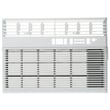
For a 12 x 12 room (about 144 sq ft), we typically recommend a 5,000 to 8,000 BTU window air conditioner; total cost is usually the unit price plus basic installation supplies. For your GE AHC12LYW1 room air conditioner, budget for routine upkeep parts like the room air conditioner air filter WJ85X24905 to keep cooling performance and efficiency steady.
Typical cost ranges (US)
- Window air conditioner (5,000 to 8,000 BTU): about $150 to $400
- Higher-capacity window units (8,000 to 12,000 BTU): about $250 to $600
- Basic install supplies (foam, weatherstripping, support bracket): about $15 to $60
- Electricity to run it: depends on BTU, efficiency, and local rates; most owners notice higher summer bills when the unit runs many hours per day
How to pick the right size for a 12 x 12 room
Most 12 x 12 rooms do best with 5,000 to 8,000 BTU, then adjust up if the space is harder to cool.
- Choose the higher end if the room has strong sun exposure
- Size up if ceilings are tall or the room is open to other spaces
- Size up if more than 2 people are often in the room
- Avoid oversizing; it can short-cycle and leave the room feeling clammy
Quick sizing guide
| Room size | Typical BTU range | Best fit |
|---|---|---|
| 100 to 150 sq ft | 5,000 to 6,000 | Most 12 x 12 bedrooms |
| 150 to 250 sq ft | 6,000 to 8,000 | Sunny rooms, open layouts |
| 250 to 350 sq ft | 8,000 to 10,000 | Larger living areas |
Why it matters
Right-sizing saves money twice: you avoid paying for extra capacity you do not need, and you reduce humidity and cycling issues that can make a room uncomfortable.
Cost-saving maintenance that helps cooling
- Clean or replace the air filter regularly (a clogged filter reduces airflow)
- Keep the front grille and intake clear of dust
- Make sure the unit tilts slightly outward so it drains correctly
- Seal air leaks around the window frame
For maintenance and replacement, the correct filter for this model is the room air conditioner air filter WJ85X24905.
Last updated: January 2026
What size house will a 12000 BTU air conditioner cool?
A 12,000 BTU room air conditioner like the GE AHC12LYW1 is typically sized to cool about 450 to 550 square feet of living space (one large room or a small open area), not an entire house. Real coverage depends heavily on insulation, sun exposure, ceiling height, and heat sources.
Quick sizing guide (what 12,000 BTU usually covers)
Use this as a practical starting point for most homes with 8-foot ceilings.
- 450 to 550 sq. ft.: typical fit for 12,000 BTU
- High sun exposure or poor insulation: plan closer to 400 to 450 sq. ft.
- Shaded rooms, good insulation: can reach 550 to 600 sq. ft.
- Kitchens: add capacity (cooking heat loads the space)
- Open floor plans: treat connected areas as one larger space
Coverage table (rule-of-thumb)
| BTU rating | Typical room size | Best use case |
|---|---|---|
| 8,000 BTU | 250 to 350 sq. ft. | Bedroom, small living room |
| 10,000 BTU | 350 to 450 sq. ft. | Medium living area |
| 12,000 BTU | 450 to 550 sq. ft. | Large living room, studio |
| 14,000 BTU | 550 to 700 sq. ft. | Large open area |
Why “house size” is the wrong target
A window or room air conditioner is designed to cool a zone, not multiple closed-off rooms. If you try to cool a whole house with one unit, you usually get uneven temperatures and long run times.
If your AHC12LYW1 is not cooling the expected area
Start with the most common airflow and control checks:
- Clean or replace the air filter; a clogged filter can cut cooling fast (see room air conditioner air filter WJ85X24905)
- Make sure the front grille and intake are not blocked
- Set mode to Cool and fan to High for initial pull-down
- Close blinds/curtains on sunny windows
- Confirm the unit is sealed at the window to prevent hot air infiltration
For deeper troubleshooting steps, use our window air conditioner running but not cooling guide.
Last updated: January 2026
How do I find the model number on my AHC12LYW1?
The model number for your GE room air conditioner is printed on a rating label on the unit. For model AHC12LYW1, check the label on the side of the cabinet, behind the front grille, or near the air filter area; match the full model exactly.
Where to look on a GE room air conditioner
Check these common label locations (use a flashlight):
- Side panel of the cabinet (often near the power cord entry)
- Behind the front panel or front grille
- Along the air inlet area, near the filter handle or filter frame
- On the back of the unit near the condenser coil cover
- On the chassis edge if the unit slides out of the outer sleeve
If your front cover is damaged or missing, replacing it can also restore access to the label area; see room air conditioner front panel assembly WJ71X24904.
What the label should show
Look for a sticker or metal tag that includes:
- Model number (example: AHC12LYW1)
- Serial number
- Electrical ratings (volts, amps)
- Cooling capacity and refrigerant information
Quick check: model number vs. part number
Use this to avoid ordering the wrong item.
| Item type | What it identifies | Example format |
|---|---|---|
| Model number | The exact air conditioner version | AHC12LYW1 |
| Part number / part ID | A specific replacement part | WJ85X24905 |
Why it matters
GE often uses similar-looking room air conditioner designs across multiple models. Using the exact model number ensures the correct fit for parts like the air filter, remote control, user interface overlay, and Wi-Fi module.
Last updated: March 2026