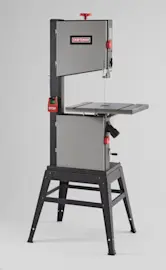
Owner’s manual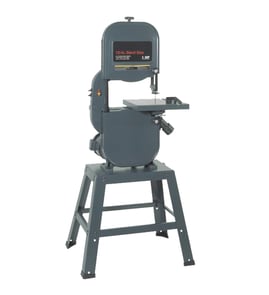

How do I know the size of my bandsaw blade?
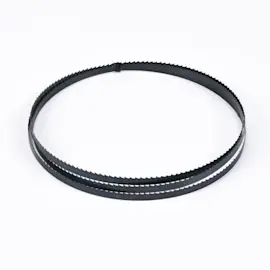
For your Craftsman 113244530 10-inch variable-speed band saw, blade “size” means three specs: blade length (total loop length), blade width (tooth tip to back edge), and teeth per inch (TPI). Measuring all three tells you what replacement blade will fit and cut correctly; see the owner's manual for blade installation and setup steps.
If you already have a blade and need its length, measure the full loop.
- Unplug the saw and open the covers.
- Release blade tension before handling the blade.
- Wear gloves; band saw blades are sharp even when not moving.
- Lay the coiled blade flat on the floor.
- Mark a starting point (often the weld).
- Use a tape measure along the blade edge, rolling the blade until the mark returns.
These two specs affect what the blade can do (curves vs straight cuts, smoothness, and feed rate).
- Width: measure from the tooth tip to the back edge of the blade.
- TPI: count the number of teeth in 1 inch.
- Rule of thumb: keep at least 2 teeth in the material while cutting.
The manual guidance ties curve capability directly to blade width.
| Blade width | Typical use | Minimum circle diameter (approx.) |
|---|---|---|
| 1/8 inch | Tight curves, intricate work | 1/2 inch |
| 1/4 inch | General curve cutting | 1-1/2 inches |
| Wider blades | Straighter cuts, resawing | Larger curves only |
Using the right blade length prevents tracking and tensioning problems, and choosing the right width and TPI helps avoid blade twisting or binding. After changing blades, we follow the manual steps for tensioning, tracking, and adjusting the blade guides so the blade stays supported during operation.
Last updated: February 2026
What is the 4 inch rule for bandsaw?
The 4-inch rule is a bandsaw safety guideline: keep your hands and fingers at least 4 inches away from the moving blade while cutting. On the Craftsman 113244530 10-inch variable-speed band saw, use push sticks, push blocks, or a jig to control small workpieces instead of guiding them with your hands.
- Set the upper guide assembly as low as practical above the workpiece before you start the cut.
- Use a push stick or push block anytime your hands would drift inside that 4-inch zone.
- Keep your hands out of the sawblade path; guide the work from the sides, not in line with the blade.
- For narrow ripping or small parts, use an auxiliary fence, sled, or clamp-on jig to hold the stock.
- Turn the saw OFF before clearing scraps; wait for all moving parts to stop.
| Item to check | What “good” looks like | Why it matters |
|---|---|---|
| Work support | Saw is bolted or clamped so it cannot tip or walk | Prevents sudden movement that pulls hands toward the blade |
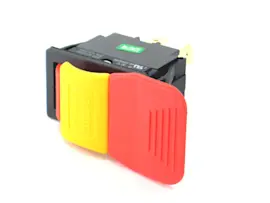
| Switch status | Switch is OFF before plugging in | Prevents accidental starting |
| PPE | ANSI Z87.1 safety goggles (not regular glasses) | Protects eyes from thrown debris |
| Material choice | Cut only appropriate materials for this saw | Reduces binding and loss of control |
Most bandsaw injuries happen when a hand slips into the blade line during a tight turn, a bind, or when someone tries to steady a small offcut. The 4-inch rule forces you to use safer control methods (push tools and jigs) so your hands never become the “clamp.”
We recommend reviewing the safety and basic operation sections in the owner's manual for the Craftsman 113244530, including guidance on keeping hands away from the blade during narrow ripping and waiting for the saw to fully stop before removing loose pieces.
Last updated: February 2026
What is the specs of the Craftsman 12 inch bandsaw 113244530?
The Craftsman model 113.244530 is a variable-speed 10-inch band saw, not a 12-inch band saw. For the most accurate model-specific specifications (capacity, adjustments, electrical details, and setup), we use the 113.244530 Owner's manual.
- Brand: Craftsman
- Model number: 113.244530
- Type: Variable-speed 10-inch band saw
- Category: Power tool parts
- Identification: Model and serial number are listed on a plate on the back of the saw
A “10-inch” band saw rating usually refers to the saw’s approximate cutting capacity (resaw height) or wheel size, depending on the design. For most Craftsman saws in this class, you can expect:
- Resaw height: commonly around 4 to 6 inches
- Throat depth: commonly around 9 to 10 inches
- Blade widths: commonly 1/8 inch to 1/2 inch (varies by guide setup)
Check the owner's manual for the exact capacities and the correct blade length for your specific configuration.
| Feature | 10-inch band saw (113.244530) | 12-inch band saw (different model) |
|---|---|---|
| Size class | Compact bench or light stand saw | Larger capacity saw |
| Typical resaw | 4 to 6 inches | 6 inches or more |
| Typical throat | 9 to 10 inches | 11 to 12 inches |
Ordering the right blade, setting guide bearings, and aligning the table all depend on the correct model and size class. Using 12-inch specs for a 10-inch saw can lead to the wrong blade length, poor tracking, and unsafe operation.
Last updated: February 2026
What is the 3-tooth rule for bandsaws?
The 3-tooth rule means you choose a band saw blade tooth pitch (TPI) so at least three teeth are in the cut at all times. On the Craftsman 113244530 10-inch variable-speed band saw, this helps prevent tooth stripping, rough cuts, and poor chip clearance.
- Measure the workpiece thickness where the blade enters the cut.
- Pick a blade pitch that keeps 3 or more teeth engaged in that thickness.
- For thin stock, use a finer TPI; for thick stock, use a coarser TPI.
- Slow your feed rate if the blade starts to chatter or grab.
- Set the upper blade guide assembly to just clear the workpiece before cutting.
Use this as a practical starting point; then fine-tune for material type (wood vs. metal) and cut quality.
| Workpiece thickness | What you want | Typical blade choice |
|---|---|---|
| Under 1/8 in. | Many small bites, smooth cut | Fine TPI |
| 1/8 to 1/2 in. | Stable cut, good finish | Medium TPI |
| Over 1/2 in. | Good chip clearance | Coarse TPI |
When too few teeth contact the material, each tooth takes too big a bite, which can strip teeth and make the blade wander. When too many teeth are engaged, the gullets cannot clear sawdust or metal chips well, which increases heat and can lead to binding.
Your Craftsman 113244530 manual emphasizes setup that protects the blade and improves tracking and cut accuracy:
- Adjust blade guides so they just clear the sides of the blade (do not let teeth hit the guides).
- Keep the blade tracking centered on the wheels.
- Never start the saw with the cover open.
For the exact adjustment procedure and safety notes, follow the owner's manual.
Last updated: February 2026