Installation guide
 Owner’s manual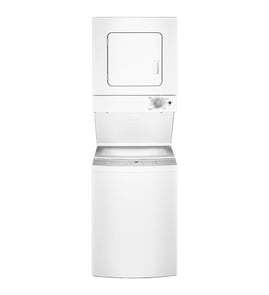




Where to put laundry detergent in GE washer dryer combo?
For the GE GTUP240EM4WW laundry center, we add laundry detergent to the washer tub before loading clothes (or as the washer fills), because this model does not use a pull-out detergent drawer like many newer washer/dryer combos. For cycle and product guidance, use the GTUP240EM4WW owner’s manual.
Where detergent goes on this model
Most GTUP240EM4WW units are a top-load washer design; detergent is used directly in the wash basket, not in the bleach dispenser.
- Measure detergent based on load size and soil level.
- Add detergent first, then add laundry, then start the cycle.
- Use HE detergent only if your detergent is labeled HE; otherwise use regular detergent sparingly.
- Do not pour detergent into the bleach dispenser (that is for liquid chlorine bleach only).
- If you use fabric softener, follow the manual’s directions for the correct location and dilution.
Quick guide: detergent vs. other products
| Laundry product | Where to add it on GTUP240EM4WW | Notes |
|---|---|---|
| Liquid or powder detergent | Washer tub (wash basket) | Add before clothes for best mixing |
| Liquid chlorine bleach | Bleach dispenser (if equipped) | Never mix with detergent in the same cup |
| Fabric softener | Softener dispenser (if equipped) | Often needs dilution with water |
Tips to prevent oversudsing and residue
Using too much detergent is one of the most common causes of long cycle times, poor rinsing, and detergent streaks.
- Use less detergent for small loads and cold water.
- Reduce detergent if you have soft water.
- Avoid “extra” detergent when using concentrated formulas.
- If you see suds late in the cycle, run an extra rinse.
Why it matters
Correct detergent placement helps the washer dissolve and distribute detergent evenly, which improves cleaning and reduces residue on clothes and buildup in the tub and drain system.
Last updated: January 2026
Does a washer/dryer combo exist?
Yes. Washer/dryer combos exist; they are single machines that wash and dry in the same drum. Your GE GTUP240EM4WW is different: it is a unitized (stacked) laundry center with a separate washer and dryer built into one cabinet.
Combo vs. stacked laundry center: what’s the difference?
- Washer/dryer combo: one drum does both washing and drying
- Stacked laundry center (like GTUP240EM4WW): separate washer tub and dryer drum in one frame
- Combos are often used where space is tight and venting may be limited
- Laundry centers typically dry like a traditional dryer and usually require proper venting
| Feature | Washer/dryer combo | GE GTUP240EM4WW laundry center |
|---|---|---|
| Wash and dry in one drum | Yes | No |
| Separate washer and dryer sections | No | Yes |
| Dryer venting | Vented or ventless (varies) | Vented to outdoors (typical for this style) |
What to know for GTUP240EM4WW installations
Because GTUP240EM4WW is a unitized electric washer/dryer, installation details like venting, electrical connection, and drain setup matter for performance and safety. We recommend following the clearances, ducting guidance, and connection steps in the GTUP240EM4WW installation guide.
Quick installation reminders
- Use 4-inch metal ducting for the dryer exhaust (rigid metal is preferred)
- Keep the vent run as short and straight as possible to improve drying
- Avoid flexible plastic ducting
- Confirm the drain standpipe height meets the installation requirements
- Use the correct electrical supply and grounding method for your home
Why it matters
If you shop for a “combo” when you actually need a stacked laundry center (or vice versa), you can end up with the wrong venting setup, electrical requirements, or capacity expectations for your laundry space.
Last updated: January 2026
Does a stackable washer and dryer need a 220 outlet?
For the GE GTUP240EM4WW unitized (stacked) electric washer/dryer, the dryer section requires a dedicated 120/240V (or 120/208V) 30-amp circuit, so you typically need a 220/240-volt style dryer outlet. The washer functions on standard household power, but the combined unit is powered as an electric dryer installation.
What to plan for with GTUP240EM4WW electrical
Use these model-appropriate guidelines from the installation requirements in the GTUP240EM4WW installation guide:
- Use an individual, properly grounded branch circuit (no shared outlet).
- Plan for a 30-amp circuit breaker or time-delay fuse.
- Do not use an extension cord or adapter plug.
- Expect a 3-wire or 4-wire connection option depending on local code and installation type.
- Confirm the voltage and frequency on the unit rating plate before wiring.
3-wire vs 4-wire: what’s the difference?
The outlet and cord type depend on your home wiring and local electrical code. Many newer installations require a 4-wire connection.
| Connection type | Typical use case | What it includes |
|---|---|---|
| 3-wire | Older existing dryer circuits where allowed | 2 hot wires + neutral |
| 4-wire | Newer installs and many code-required situations | 2 hot wires + neutral + ground |
If you are unsure which you need, we recommend having a qualified electrician verify the receptacle and circuit.
Why it matters
Using the correct 120/240V 30-amp circuit helps the dryer heat properly and reduces nuisance tripping, overheating at the terminal connections, and unsafe wiring conditions.
Related part (only if you’re servicing the power connection)
If you are troubleshooting a burned connection at the dryer’s wiring terminals, the compatible replacement is the dryer terminal block and grounding strap WE4M325.
- Replace the terminal block if terminals are loose, melted, or arcing.
- Replace damaged power cord ends at the same time.
- Tighten connections to the specified torque (do not overtighten).
Last updated: January 2026