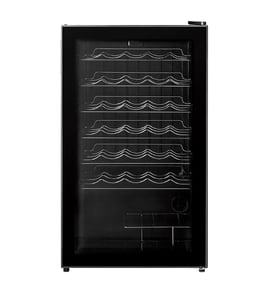



What is the difference between a wine cooler and a beverage cooler?
A wine cooler is built to store wine at stable, moderate temperatures with low vibration and (often) better humidity control, while a beverage cooler is built to chill mixed drinks colder and recover temperature quickly after frequent door openings. Your Frigidaire FGWC46L3SS is a wine and beverage cooler, so it’s designed to do both jobs.
Quick comparison
| Feature | Wine cooler | Beverage cooler |
|---|---|---|
| Typical temperature range | About 45 to 65°F | About 35 to 50°F |
| Best for | Wine storage and serving temps | Soda, beer, sparkling water, energy drinks |
| Shelving | Racks sized for bottles; often horizontal | Flat, adjustable shelves for cans and bottles |
| Key design focus | Temperature stability, low vibration | Fast chilling, frequent access |
How to choose the right one for your needs
- Choose a wine cooler if you store reds and whites for weeks to months and want stable temps.
- Choose a beverage cooler if you want colder temps and open the door often for grab-and-go drinks.
- Choose a wine and beverage cooler (like FGWC46L3SS) if you want one unit for both bottle storage and everyday beverages.
- If you store corked wine long-term, prioritize horizontal racking and steady mid-40s to mid-60s temperatures.
- If you store mostly cans and short bottles, prioritize adjustable shelving and colder setpoints.
Why it matters
Using the right cooler helps protect flavor and carbonation. Wine benefits from steady, moderate temperatures and minimal vibration, while canned and bottled beverages taste best when chilled colder and the unit can handle frequent door openings.
Helpful DIY reference
If you’re troubleshooting cooling performance, wiring, or a no-power issue, start with safe electrical checks and the right tools: how to use a multimeter to test electrical parts video.
Last updated: February 2026
Are wine cooler fridges worth it?
Yes, a dedicated wine and beverage cooler is worth it when you want steadier temperatures than a kitchen refrigerator, less vibration, and storage designed for bottles and cans. With the Frigidaire FGWC46L3SS, the value is highest if you regularly store wine long enough that temperature swings and light exposure affect taste.
When a wine cooler is worth it
- You keep wine for weeks to months (not just overnight chilling).
- Your kitchen fridge is crowded and bottles get moved or shaken often.
- You want a consistent serving temperature for reds, whites, or sparkling.
- You store beverages in addition to wine and want dedicated shelf space.
- You care about presentation (glass door, interior lighting) and organization.
When it is not worth it
- You only buy wine for same-day or weekend use.
- You have a naturally cool, stable storage spot (dark closet or basement).
- You rarely entertain and do not need extra capacity.
Single-zone vs dual-zone: quick comparison
Dual-zone can be convenient, but it is not required for most households.
| Feature | Single-zone cooler | Dual-zone cooler |
|---|---|---|
| Best for | One target temp | Reds and whites at different temps |
| Typical use | Everyday bottles + cans | Mixed collection, frequent entertaining |
| Complexity | Lower | Higher |
What to check before you buy (or before you commit to keeping one)
- Capacity and bottle fit: wider bottles and odd shapes reduce usable capacity.
- Placement and airflow: built-in vs freestanding requirements matter for compressor cooling.
- Noise and vibration: important if installed near living spaces.
- Temperature range: make sure it matches how you actually serve wine.
- Humidity and light control: helpful for longer storage.
Why it matters
Wine is sensitive to heat swings, vibration, and light. A dedicated wine cooler helps keep flavor more consistent and makes it easier to keep bottles ready to serve, especially when your main refrigerator is opened frequently.
For shopping accuracy, we always recommend confirming the exact model tag before ordering shelves, door parts, or controls; use how to find your appliance model number (and what it means for parts).
Last updated: February 2026
Can I look up Frigidaire parts by model number?
Yes. For your Frigidaire wine cooler model FGWC46L3SS, looking up parts by the full model number is the most reliable way to match compatible shelves, door parts, controls, and cooling components because it filters results to the exact configuration your unit was built with.
How to look up parts by model number
- Find the complete model number on the data tag (use the full string, not a shortened version).
- Search using the exact model number: FGWC46L3SS.
- Confirm the product type matches (wine and beverage cooler, not a refrigerator or freezer).
- Compare the part description to what you are replacing (for example: door gasket vs. door handle).
- If multiple versions appear, match any revision info shown on the data tag.
Where to find the model number on a wine and beverage cooler
Most Frigidaire wine and beverage coolers place the data tag in one of these spots:
| Common location | What to look for |
|---|---|
| Inside the cabinet near the door opening | Model and serial label |
| Side wall inside the cooler | Sticker or plate with model/serial |
| Rear exterior panel | Rating plate |
Tips to avoid ordering the wrong part
- Use the model number, not the serial number, for parts lookup.
- Match the symptom to the part category (cooling issue vs. lighting issue vs. door sealing issue).
- If you are troubleshooting electrical problems, test before replacing parts using how to use a multimeter to test electrical parts video.
- If you suspect a power issue, confirm the outlet and check for a blown fuse using how to tell if a fuse is blown.
Why it matters
Frigidaire often uses similar-looking parts across different coolers, but mounting points, wiring connectors, and door dimensions can vary. Using FGWC46L3SS for the lookup helps ensure the replacement part fits and functions correctly.
Last updated: February 2026
What is the most common problem with wine coolers?
The most common problem we see with wine coolers like the Frigidaire FGWC46L3SS is temperature control trouble (not cooling enough, cooling too much, or fluctuating). In most cases, the root cause is restricted airflow, a weak door seal, or a failing temperature control component.
Most common symptoms (and what they usually point to)
- Unit runs but won’t get cold: dirty condenser area, poor ventilation, weak compressor, or sealed-system issue
- Temperature swings: sensor/thermostat problem, frequent door openings, warm room location
- Frost or ice buildup: door gasket leak, door not closing squarely, high humidity
- Runs constantly: blocked airflow, dusty condenser, warm ambient temperature, overloaded cabinet
- No power or dead display: outlet/power cord issue, internal wiring problem, blown fuse on some designs
Quick checks we recommend first (no parts guessing)
- Confirm airflow: keep vents clear inside; leave space around the cabinet for ventilation.
- Check the door seal: close a thin sheet of paper in the door; if it slides out easily, the gasket is leaking.
- Clean dust: vacuum the intake and condenser area (dust makes the compressor work harder).
- Verify settings: setpoint too low can cause icing; too high can mimic “not cooling.”
- Listen and feel: compressor hum with no cooling often indicates airflow or refrigeration-system trouble.
Common causes and DIY difficulty
| Likely cause | What you notice | DIY difficulty |
|---|---|---|
| Airflow/ventilation problem | Warm cabinet, long run times | Easy |
| Door gasket leak | Condensation, frost near door | Easy to moderate |
| Temperature sensor/control issue | Erratic temps | Moderate |
| Compressor or sealed-system issue | Little to no cooling, hot compressor | Pro recommended |
Why it matters
Wine and beverages store best with stable temperatures. Fluctuations force the compressor to cycle harder, increase frost risk, and can shorten component life.
Helpful DIY resources
- Use must have tools for appliance repair to prep for basic checks like cleaning, leveling, and safe access.
- Use how to use a multimeter to test electrical parts video if you’re comfortable testing power and continuity (always unplug first).
Last updated: February 2026
What are the drawbacks of a wine fridge?
A wine fridge like the Frigidaire FGWC46L3SS adds stable storage for wine and beverages, but the main drawbacks are ongoing energy use, potential noise, and more parts that can fail (cooling system and controls). Placement and ventilation also matter more than with a standard cabinet.
Common drawbacks to expect
- Mechanical failures: compressor, thermostat/temperature sensor, control board, or evaporator fan can wear out over time.
- Noise and vibration: a running compressor and fan can be noticeable in quiet rooms.
- Higher energy use: it runs year-round to hold temperature, especially in warm spaces.
- Limited capacity: most units fill up quickly if you store mixed bottle shapes or add cans.
- Humidity and cork concerns: if humidity runs low, natural corks can dry out; if it runs high, labels can peel.
- Sensitive to power outages: temperature swings happen faster than in a full-size refrigerator.
What causes most problems (and how to avoid them)
Good setup prevents many “wine cooler not cooling” and “temperature fluctuates” complaints.
- Leave clear airflow space around the cabinet and vents.
- Keep it out of direct sun and away from ovens, dishwashers, and heat registers.
- Avoid overloading shelves; blocked airflow leads to warm spots.
- Clean dust from the condenser/vent area periodically.
- Use a surge protector rated for appliances to reduce control damage.
Quick trade-off table
| Concern | What you may notice | Best prevention |
|---|---|---|
| Noise | humming, fan sound | level the unit; keep it ventilated |
| Temperature swings | bottles not staying at set temp | avoid hot locations; don’t overpack |
| Humidity issues | dry corks or peeling labels | store corked bottles on their side; keep door closed |
| Operating cost | higher electric bill | cooler room location; clean vents |
Why it matters
Wine and beverage coolers are designed for tighter temperature control than room storage, but that control depends on airflow, a healthy sealed system, and stable room conditions. When any of those are off, performance drops and parts wear faster.
For general DIY readiness and safe troubleshooting habits, use our are diy appliance repairs safe.
Last updated: February 2026
Is there a difference between a wine fridge and a wine cooler?
Yes. In everyday use, people say “wine fridge” and “wine cooler” interchangeably, but a wine fridge is typically built for stable, long-term wine storage, while a wine cooler often focuses on short-term chilling for serving. For a Frigidaire FGWC46L3SS wine & beverage cooler, expect it to behave like a beverage-style cooler: consistent cooling for ready-to-drink storage, not a full cellar substitute.
Key differences that matter
- Temperature stability: Wine fridges prioritize tight, steady control; coolers can swing more with door openings.
- Humidity management: Wine fridges are more likely to support cork-friendly humidity; coolers usually do not.
- Vibration control: Wine fridges often reduce vibration to protect aging wine; coolers are less specialized.
- UV/light protection: Wine fridges more often use UV-resistant glass or lighting choices; coolers vary.
- Storage intent: Wine fridges support aging; coolers support convenience and mixed beverages.
Quick comparison
| Feature | Wine fridge (cellar-style) | Wine cooler (beverage-style) |
|---|---|---|
| Best for | Aging and long-term storage | Serving-ready chilling |
| Typical zones | Single or dual-zone common | Single-zone common |
| Humidity focus | Higher | Lower |
| Vibration focus | Higher | Lower |
How to choose the right type for your needs
Use this checklist to match the appliance to what you store most:
- Mostly reds for aging: choose a wine fridge with stable temps and low vibration.
- Mostly whites/sparkling for near-term drinking: a wine cooler works well.
- Mixed beverages (beer, soda, wine): a beverage-style cooler is usually the better fit.
- You want two serving temps at once: look for dual-zone capability.
- You open the door often: prioritize stability and good airflow.
Why it matters
Wine ages best when temperature stays steady and vibration stays low. If your goal is long-term storage, a cellar-style wine fridge protects flavor development better; if your goal is convenience, a wine cooler gets bottles to enjoyable serving temperature efficiently.
For general appliance selection and repair readiness, we recommend reviewing must have tools for appliance repair.
Last updated: February 2026
Why is my thermoelectric wine cooler not working?
If your Frigidaire FGWC46L3SS wine cooler is not working, the most common causes are a power supply problem, a stalled or blocked fan, or poor airflow around the cabinet. Start with outlet power and ventilation checks, then inspect the fan area for dust buildup or a loose connection.
Quick checks we recommend first
- Confirm the outlet works by testing it with a lamp or phone charger.
- Make sure the control is set to a cooling temperature (not OFF).
- Unplug the cooler for 5 minutes, then plug it back in to reset the control.
- Verify the door closes fully and the gasket is sealing all the way around.
- Clean dust from vents and any visible fan intake or exhaust openings.
- Ensure the cooler has breathing room; do not push it tight against a wall.
Fan and airflow: the most common thermoelectric failure point
Thermoelectric wine coolers rely on a fan to move heat away from the heat sink. If the fan is jammed by debris, coated in dust, or not running, the unit can power on but fail to cool.
What to look for
| What you observe | What it usually means | What to do next |
|---|---|---|
| No fan sound or airflow | Fan not running or no power to fan | Check for dust blockage; inspect wiring connections |
| Fan runs but cooling is weak | Restricted airflow or heat sink clogged | Clean vents and heat sink area; improve clearance |
| Unit cycles on and off quickly | Overheating protection due to poor heat removal | Clean and improve ventilation; re-test |
Electrical checks (when basic steps do not fix it)
If you are comfortable doing basic electrical troubleshooting, these checks help pinpoint a failed switch, fuse, or wiring issue.
- Inspect the power cord for cuts, kinks, or burn marks.
- Check for a blown internal fuse (some models use one on the control board or power input).
- Look for loose, corroded, or disconnected wire terminals at the fan and control.
Use these guides if you need help with safe testing:
- How to tell if a fuse is blown
- How to use a multimeter to test electrical parts video
- Are diy appliance repairs safe
Why it matters
A thermoelectric system cannot cool without removing heat from the hot side. Restoring airflow (fan operation, clean vents, proper clearance) often brings cooling back and prevents repeat shutdowns.
Last updated: February 2026
Why is my Frigidaire wine cooler not cooling?
If your Frigidaire FGWC46L3SS wine cooler runs but won’t cool, the usual causes are restricted airflow (dirty condenser coils or blocked vents), a door gasket leak, or a temperature control/sensor problem that makes the compressor short-cycle or not run long enough.
Quick checks that fix most “not cooling” problems
- Set the control colder and allow 12 to 24 hours to stabilize.
- Confirm the door closes fully and sits square in the opening.
- Check the gasket for gaps, tears, or areas that don’t contact the cabinet.
- Make sure vents are not blocked by bottles or shelving.
- Clean dust from the condenser area and any intake/exhaust grilles.
- Verify the cooler has a few inches of clearance for ventilation.
Symptoms and what they usually mean
| What you notice | Most likely cause | What to do next |
|---|---|---|
| Runs a lot, cabinet feels warm | Dirty condenser or poor clearance | Clean coils, improve airflow |
| Runs briefly, then stops repeatedly | Sensor/control issue or airflow restriction | Fix airflow first, then test electrical |
| Lights on, no compressor sound | Start device, control, or wiring issue | Do basic electrical checks |
| Frost/ice inside | Door leak or airflow problem | Check gasket and loading |
Safe DIY steps
- Unplug the unit.
- Vacuum and brush the condenser area; remove heavy dust.
- Do a “paper test” on the gasket (paper should drag when pulled).
- Reduce loading so air can circulate around bottles.
Electrical checks (only if airflow and gasket are good)
- Follow how to use a multimeter to test electrical parts video to check continuity on accessible components.
- Use how to tell if a fuse is blown if your cooler uses an internal fuse.
Why it matters
Wine coolers rely on steady airflow and a tight door seal. When heat can’t leave the condenser or warm air leaks in, the compressor can’t pull temperatures down and the unit may run constantly or short-cycle.
Last updated: February 2026