Installation guide
 Owner’s manual
 Error Codes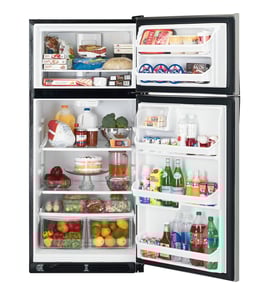



What is the upper part of a fridge called?
On the Frigidaire FFTR1814TBJ top-mount refrigerator, the upper section is the freezer compartment (often just called the freezer). It’s the colder compartment designed to keep foods frozen and, on some setups, it can also house an ice tray or ice maker components; see the FFTR1814TBJ owner's manual for the labeled compartment layout.
What you’ll typically find in the upper (freezer) section
Most top-mount refrigerators like the FFTR1814TBJ use the freezer as the primary cold source, then circulate cold air down to the fresh food section.
- Freezer shelf or storage area for frozen foods
- Ice tray (common on many models)
- Air vents that move cold air to the refrigerator section
- Temperature control area (varies by model)
Common terms people use (and what they mean)
| What people say | What it usually refers to | Where it is |
|---|---|---|
| “Upper part” | Freezer compartment | Top section |
| “Fridge part” | Fresh food compartment | Bottom section |
| “Top freezer” | Same as freezer compartment | Top section |
| “Freezer door” | Door that seals the freezer | Top door |
Why it matters
Knowing the correct name helps when you’re looking up parts, diagrams, or troubleshooting steps. For example, cooling complaints often depend on whether the freezer is maintaining temperature, since it supplies cold air to the refrigerator section.
Quick troubleshooting tip if the “upper part” is not cold enough
If the freezer is warming up, check these basics first:
- Confirm the doors close and seal fully (no gaps)
- Avoid blocking interior air vents with food packages
- Make sure the refrigerator is level so doors seal properly
- Verify installation clearances for airflow (typical guidance is 3/8 inch at sides and top, 1 inch at the rear)
Last updated: January 2026
What is the most common problem with a Frigidaire refrigerator?
The most common problem we see on a Frigidaire top-mount refrigerator like model FFTR1814TBJ is a cooling complaint (refrigerator warm, freezer not cold enough, or temperatures swinging). In many cases, the fix is basic airflow and maintenance, but defrost-system issues can also cause poor cooling.
Quick checks that solve many cooling complaints
- Confirm the controls are not set to “0” (off).
- Allow a full 24 hours after changing settings for temperatures to stabilize.
- After first setup or a power outage, let the refrigerator run at least 8 hours before loading food.
- Make sure the doors close fully and nothing is holding them open.
- If the unit is in a garage or unheated space, keep ambient temperature between 55°F and 110°F for normal operation.
When it is more than a simple setting
If you see frost buildup on the freezer back wall or airflow feels weak, the defrost system or evaporator airflow is often involved.
Common parts related to these symptoms include:
- Refrigerator defrost heater 242044008
- Refrigerator defrost bi-metal thermostat 5303918634
- Evaporator fan blade (if the fan is noisy, rubbing, or not moving air)
Symptom-to-cause guide
| Symptom | Most common cause | What to do first |
|---|---|---|
| Refrigerator warm, freezer OK | Airflow blocked, door not sealing | Check vents, door closure, gasket condition |
| Freezer warm too | Control setting, poor airflow, defrost issue | Verify settings, look for frost buildup |
| Ice maker not working (some models) | Water off, low pressure, freezer not cold enough | Confirm water supply, verify freezer temp |
| Odors | Spills, uncovered food | Clean interior, cover foods |
Why it matters
Cooling problems can lead to food spoilage and can also overwork the compressor. Catching airflow restrictions or defrost frost buildup early helps prevent bigger repairs.
For model-specific control locations, normal operating sounds, and the “Before You Call” checklist, use the FFTR1814TBJ owner's manual.
Last updated: January 2026
Why is my Frigidaire top mount freezer not freezing?
If your Frigidaire FFTR1814TBJ top-mount freezer is not freezing, the most common causes are an incorrect control setting, restricted airflow from frost buildup, dirty condenser coils, or a fan problem. Start by adjusting the freezer control colder and allow a full 24 hours for temperatures to stabilize (per the FFTR1814TBJ owner's manual).
Quick checks we recommend first
- Confirm the refrigerator/freezer control is not set to “0” (off).
- Set the freezer control colder; wait 24 hours for the temperature to stabilize.
- Make sure the freezer door closes fully and is not held open by packages.
- Check for heavy frost on the back freezer panel (a sign of a defrost problem).
- Listen for the evaporator fan running when the freezer door switch is pressed.
- Clean dust from the condenser coils and make sure the unit has airflow around it.
What the symptoms usually point to
| What you notice | Most likely issue | What to do next |
|---|---|---|
| Freezer warm, fridge OK | Airflow or defrost issue | Look for frost buildup; check defrost components |
| Both sections warm | Cooling system or condenser airflow issue | Clean coils; verify condenser fan runs |
| Frost/ice sheet on freezer back wall | Defrost system not working | Inspect defrost heater and defrost thermostat |
| Fan noise stops, temps rise | Evaporator fan issue | Check fan blade for ice obstruction or damage |
Parts that commonly fix “not freezing” on this model
If you find frost buildup or the fan cannot move air, these model-matched parts are common fixes:
- Refrigerator defrost heater 242044008 (melts frost off the evaporator)
- Refrigerator defrost bi-metal thermostat 5303918634 (helps control defrost heating)
- Refrigerator evaporator fan blade 242219302 (moves cold air through the freezer)
Why it matters
A freezer that is not freezing is often an airflow problem, not a “lack of cold.” When frost blocks the evaporator or the fan cannot circulate air, temperatures rise quickly and food safety becomes a concern.
Last updated: January 2026