 Owner’s manual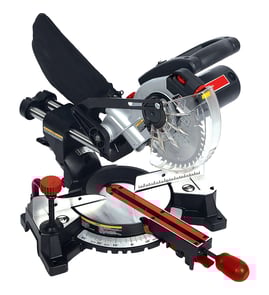

What should you never cut with a miter saw?
For the Craftsman miter saw model 137212520, never cut masonry products or ferrous metals (steel/iron), and never cut small pieces that would put your hands within 6-3/4 inches of the blade. These cuts can bind the blade, shatter material, or throw the workpiece.
Materials and cuts to avoid
- Masonry and masonry products (brick, concrete, tile): this saw is not designed for them.
- Ferrous metals (steel, iron, iron-based metals): they can bind the blade and create dangerous kickback.
- Small workpieces that force your fingers into the 6-3/4 inch “no hands zone”.
- Hand-held metal: if you cut any allowed metal, it must be clamped, not held by hand.
- Workpieces that cannot sit flat and stay fixed against the fence and table.
What you can cut (and the conditions)
This saw is designed primarily for wood and wood-like products. Some manuals also allow non-ferrous metals (such as aluminum) only when set up correctly.
| Material | OK on 137212520? | Key requirement |
|---|---|---|
| Wood, wood-like products | Yes | Keep it flat to fence/table; support long stock |
| Non-ferrous metal (example: aluminum) | Sometimes | Use the correct blade; clamp securely; remove dust bag |
| Ferrous metal (steel/iron) | No | Do not cut |
| Masonry products | No | Do not cut |
Setup rules that prevent binding and kickback
- Keep no gaps between the workpiece, fence, and table.
- Make sure the cutoff can move sideways freely after the cut so it does not wedge into the blade.
- Use clamps or a vise whenever practical.
- Provide side support (stands, sawhorses, blocks) for long or wide boards.
- Never reach around the blade; release the trigger and wait for a complete stop before lifting the saw or moving the work.
Why it matters
A miter saw can grab and throw material in a fraction of a second. Avoiding prohibited materials and too-small workpieces reduces blade binding, kickback, and hand-to-blade exposure.
For the exact safety limits and “no hands zone” guidance for model 137212520, use the owner's manual.
Last updated: February 2026
Why is 31.6 on a miter saw?
On the Craftsman 137212520 miter saw, 31.6° is one of the built-in positive miter stops because it is a common angle used for trim work, especially crown molding compound cuts. It lets you set the miter quickly and repeatably without measuring each time (see the crown molding angle chart in the owner's manual).
What the 31.6° mark is used for
The 137212520 includes positive miter stops at 0°, 15°, 22.5°, 31.6°, and 45° left and right. The 31.6° stop is commonly paired with a 33.9° bevel setting when you cut typical crown molding (52°/38° spring angles) laid flat on the saw table.
Common crown molding settings (laid flat)
| Corner type | Typical miter | Typical bevel |
|---|---|---|
| Inside corner | 31.6° | 33.9° |
| Outside corner | 31.6° | 33.9° |
How to use the 31.6° positive stop on this saw
We use the positive stop locking lever and the quick-cam table lock so the miter table lands exactly on the detent.
- Unlock the miter table (quick-cam table lock).
- Raise the positive stop locking lever.
- Rotate the miter table to 31.6° left or right.
- Release the lever so it snaps into the positive stop.
- Lock the table before cutting.
Why it matters
Crown molding and other finish carpentry cuts need consistent angles. Using the 31.6° detent reduces setup time and helps keep joints tight by making repeat cuts more accurate.
Quick safety and accuracy checks
- Do a dry run with the saw off to confirm clearance and cut path.
- Keep the workpiece firmly against the fence and table.
- Avoid freehand cutting; use proper support and clamping when needed.
- Wait for the blade to stop completely before lifting the handle.
Last updated: February 2026
What are the parts of a miter saw?
A Craftsman miter saw like model 137212520 is built around a cutting head (motor, blade, and guards) mounted to a rotating miter table and base; it also includes bevel and miter locks, fences, and safety controls that let you set accurate angles and cut safely. For the full labeled diagram, use the 137212520 owner's manual.
Main miter saw parts (what you will see and touch)
- Cutting head and switch handle: you push down to make the cut; includes the ON/OFF trigger switch and safety lock-off button
- Saw blade and arbor: the blade mounts on the arbor; many saws include an arbor lock for blade changes
- Upper and lower blade guards: the lower guard retracts as the head lowers
- Miter table and miter scale: rotates left and right to set miter angles
- Miter lock handle: locks the table at your chosen miter angle
- Fence (sliding fence): supports the workpiece and helps keep it from shifting
- Bevel scale and bevel lock handle: sets and locks bevel angle (commonly 0° to 45° left on this style)
Common accessories included with this model
- Hold-down clamp (workpiece clamp) and clamp lock knobs
- Extension tables (left and right) and extension table lock knobs
- Dust bag and dust bag elbow
- Blade wrench (often stored on the saw)
Quick “part to purpose” guide
| Part | What it does | Why it matters |
|---|---|---|
| Miter lock handle | Locks the rotating table | Prevents the angle from drifting mid-cut |
| Positive stop locking lever | Locks common preset miter detents | Speeds up repeatable angle cuts |
| Bevel lock handle | Locks bevel angle | Keeps bevel cuts accurate |
| Lower blade guard | Covers blade until cutting | Reduces accidental contact risk |
Why it matters
Knowing the names of the miter saw parts helps you set up safer cuts, diagnose issues (like a loose miter lock or sticking guard), and match the right replacement hardware when something is missing or worn.
Last updated: February 2026
Which mitre saw is the most accurate?
The most accurate miter saw is the one that holds its settings and can be calibrated precisely; for many users, premium saws (and a well-tuned setup) deliver the most repeatable cuts. Your Craftsman 137212520 includes positive miter detent stops and bevel stops that help you dial in accurate angles when adjusted correctly (see the owner's manual).
What “most accurate” really means
Accuracy is usually a mix of three things: how square the saw cuts at 0°, how repeatable the detents are (15°, 22.5°, 31.6°, 45°), and how well the fence and table stay aligned over time.
Common accuracy factors to compare:
- Miter detent quality (tight, repeatable stops)
- Bevel stop accuracy (especially 0° and 45°)
- Fence straightness and squareness to the blade
- Blade quality (a sharp, appropriate tooth count for trim vs framing)
- Rigidity (less flex in the arm, pivot points, and base)
How to get maximum accuracy from the Craftsman 137212520
This model is designed to be adjustable for precision work. The manual procedure for setting the 45° bevel uses a combination square and the bevel angle adjustment bolt with a jamb nut; once set, tightening the bevel lock and jamb nut helps the saw hold that calibration.
Quick calibration checklist
- Unplug the saw before checking alignment.
- Verify the blade is square to the table at 0° bevel.
- Confirm the 0° miter stop is dead-on using a square.
- Set and verify 45° bevel using the adjustment bolt and jamb nut.
- Recheck after moving the saw or changing blades.
Typical “accuracy features” comparison
| Feature | Helps accuracy by | What to look for |
|---|---|---|
| Positive miter detents | Repeatable angle settings | Minimal play at 0°, 45° L/R |
| Bevel positive stops | Fast bevel setup | True 0° and 45° alignment |
| Electric brake | Cleaner stop at end of cut | Less overtravel and safer handling |
| Stable stand/support | Less movement | Solid mounting and level surface |
Why it matters
Even a top-tier miter saw will cut inaccurately if the fence is out of square, the saw isn’t supported well, or the blade is wrong for the material. For trim and crown molding, small angle errors compound quickly, so calibration and repeatability matter as much as brand.
Last updated: February 2026
How deep can a 210mm mitre saw cut?
On the Craftsman miter saw model 137212520, the maximum cut depth depends on the cut type, not just the blade diameter. The cutting capacity chart lists 2-5/8 in. depth for a 0° crosscut and 1-1/2 in. depth at a 45° bevel; confirm your exact setup in the 137212520 owner's manual.
Cutting depth for Craftsman 137212520 (by cut type)
Use these capacities to match your lumber thickness and avoid binding or incomplete cuts:
- Crosscut (0° miter, 0° bevel): up to 2-5/8 in. deep
- 45° miter right or left (45° miter, 0° bevel): up to 2-5/8 in. deep
- 45° bevel left (0° miter, 45° bevel): up to 1-1/2 in. deep
- 45° miter plus 45° bevel: up to 1-1/2 in. deep
| Setting | Max depth | Max width |
|---|---|---|
| 0° miter, 0° bevel (crosscut) | 2-5/8 in. | 5-1/2 in. |
| 45° miter, 0° bevel | 2-5/8 in. | 3-1/2 in. |
| 0° miter, 45° bevel (left) | 1-1/2 in. | 5-1/2 in. |
| 45° miter, 45° bevel | 1-1/2 in. | 3-1/2 in. |
How to verify real-world cut depth on your saw
Capacity can be reduced by blade kerf, fence position, and how the board sits on the table.
- Unplug the saw before checking clearance
- Set the planned miter and bevel angles
- Hold the workpiece firmly against the fence and table
- Lower the head slowly to confirm the blade path clears the fence
- Make a test cut on scrap of the same thickness
Why it matters
Knowing the correct depth for each angle helps prevent stalled cuts, kickback risk from binding, and inaccurate miters when cutting trim like base molding or crown molding.
Last updated: February 2026