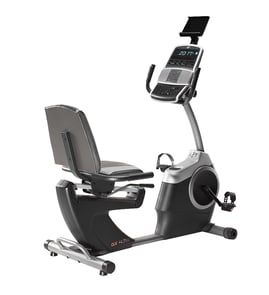

How long should a 70 year old ride a stationary bike?
For a 70-year-old using a stationary bike like the Horizon R6055, a practical target is 20 to 30 minutes at a moderate pace per session, 3 to 5 days per week. If you are just starting, begin with 10 to 15 minutes and add a few minutes each week as comfort and endurance improve.
A simple weekly plan (easy to follow)
- Start with a pace where you can talk in short sentences without gasping.
- Warm up 3 to 5 minutes at very light resistance.
- Ride 10 to 20 minutes at moderate resistance.
- Cool down 3 to 5 minutes at very light resistance.
- Take at least 1 to 2 rest days per week if you feel sore or unusually fatigued.
What “moderate intensity” means
A good rule is the “talk test”:
- Too easy: you can sing comfortably
- Moderate (goal): you can talk, but not sing
- Too hard: you cannot speak more than a few words at a time
Safety checks before and during your ride
- Adjust seat height so your knee stays slightly bent at the bottom of the pedal stroke.
- Keep your grip light; avoid leaning heavily on the handlebars.
- Stop if you feel chest pain, dizziness, or unusual shortness of breath.
- Stay hydrated; older adults often feel thirst later.
- If you have balance concerns, mount and dismount slowly and use stable footwear.
Quick duration guide
| Fitness level | Session length | Frequency |
|---|---|---|
| New or returning | 10 to 15 minutes | 3 days/week |
| Building endurance | 15 to 25 minutes | 3 to 5 days/week |
| Established routine | 20 to 40 minutes | 4 to 6 days/week |
Why it matters
Consistent, moderate stationary cycling supports heart health, leg strength, and joint-friendly movement. For most riders, steady consistency matters more than pushing hard resistance.
For general DIY safety and pacing tips, we recommend reviewing are diy appliance repairs safe before making adjustments or repairs to your exercise bike.
Last updated: January 2026
What are the downsides of recumbent bikes?
Recumbent bikes can be a great low-impact option, but compared with an upright bike they typically deliver less upper-body engagement, can feel bulkier, and may be harder to move and store. If you are comparing styles for a Horizon R6055 exercise bike setup, these tradeoffs matter most for space, workout goals, and ease of use.
Common downsides (what most riders notice)
- Less upper-body involvement: Most effort stays in the legs and glutes, with minimal core and arm engagement.
- Bulkier footprint: Recumbent frames and seats usually take more floor space than upright bikes.
- Harder to move and store: Heavier builds and longer frames can make transport and storage inconvenient.
- Different “feel” for intensity: Some users find it harder to simulate standing climbs or sprint-style efforts.
- Mounting and seat fit can be tricky: The step-through is often easy, but dialing in seat distance and recline takes time.
How to decide if the downside matters for you
| If your priority is… | Recumbent bike downside to consider | What to do |
|---|---|---|
| Small workout space | Larger overall size | Measure your workout area and allow clearance behind the seat |
| High-intensity intervals | Less “out of the saddle” feel | Use higher resistance and structured intervals |
| Full-body training | Limited upper-body work | Add dumbbells, bands, or rowing on alternate days |
| Easy storage | Heavier, awkward to move | Plan a permanent spot or use a mat with sliders |
Why it matters
Choosing between recumbent and upright affects comfort, training style, and how consistently you will use the bike. A recumbent bike often wins for back support and joint-friendly cardio, but it can lose on space efficiency and “athletic” riding feel.
Helpful DIY reference
If you are setting up a workout area and need better connectivity for streaming workouts, see how do i extend wi fi coverage in my home.
Last updated: January 2026
What are the most common issues with R6055?
The most common issues we see on the Horizon R6055 exercise bike involve power and console problems, resistance that will not change smoothly, and drive or pedal noise. Most fixes start with basic checks (power, wiring, and fasteners) before moving to electrical testing or part replacement.
Common problems and what they usually point to
- Console will not power on: loose power connection, failed power supply, damaged wiring, or a bad console/control board
- Display powers on but buttons do not respond: stuck keypad, console failure, or a loose ribbon cable/connector
- Resistance will not change or feels “stuck”: resistance motor/actuator issue, control board problem, or a loose internal connector
- Pedals wobble or click: loose crank hardware, worn pedal threads, or a crank arm issue
- Squeaking, rubbing, or grinding: loose covers, dry pivot points, belt/drive alignment issues, or worn bearings
- Heart-rate grips not reading: dirty sensors, loose sensor wiring, or console input issue
Quick checks we recommend first
- Unplug the bike (or remove batteries if equipped) for 2 minutes, then restore power.
- Confirm the outlet works by testing it with another device.
- Inspect the power cord and plug for damage; reseat the connector at the bike.
- Tighten pedals and visible frame fasteners; recheck after a short ride.
- If the console lights but resistance is wrong, check for pinched or loose wiring at the mast and console.
Troubleshooting guide by symptom
| Symptom | Best first step | Next likely step |
|---|---|---|
| No power | Verify outlet and power connections | Check internal wiring and power supply |
| Resistance not changing | Power reset and reseat connectors | Test resistance motor and control board |
| Clicking at pedals | Tighten pedals/crank bolts | Inspect crank arms and bearings |
| Squeal/rub noise | Check for loose shrouds and fasteners | Inspect belt/drive alignment |
Why it matters
On the R6055, many “major” symptoms come from simple causes like a loose connector in the console mast or hardware that backed out over time. Catching those early prevents damage to the drive system and electronics.
For electrical diagnosis steps (like checking continuity and voltage safely), use our how to use a multimeter to test electrical parts video.
Last updated: March 2026
