Owner’s manual

Are all table saw arbor nuts the same size?
No. Arbor nuts are not all the same size because arbor diameters and thread directions vary by saw design. For the Craftsman 113298722 10-inch table saw, the manual specifies a 5/8-inch arbor, so you must use blades and hardware designed to fit that arbor. See the owner's manual for the correct blade and arbor-nut handling steps.
What is standardized (and what is not)
Many 10-inch table saw blades share a common 5/8-inch arbor hole, but that does not make arbor nuts universal.
- Blade arbor hole is often 5/8 inch on many 10-inch saws
- Arbor nut thread (diameter and pitch) can differ by model
- Thread direction can be standard or reverse-thread depending on the saw
- Nut wrench size (hex size) varies widely
- Flanges/collars and spacers can be model-specific
What we know for Craftsman 113298722
Your saw is designed around a 5/8-inch arbor, and the manual calls out blade fit and safe tightening.
| Item | What to use on 113298722 | Why it matters |
|---|---|---|
| Blade diameter | 10-inch (for thru-sawing) | Keeps the spreader closest to the blade |
| Arbor fit | Blades designed for a 5/8-inch arbor | Prevents wobble and unsafe mounting |
| Arbor nut tightening | Snug with arbor wrenches; do not overtighten | Reduces risk of damage and binding |
Quick checks before you buy or install an arbor nut
- Confirm the saw model is 113298722 (not just “Craftsman 113”)
- Verify arbor diameter is 5/8 inch for this model
- Match the thread direction to your saw’s design
- Inspect collars/flanges for burrs; keep mating surfaces clean
- Tighten securely but do not crank down excessively
Why it matters
Using the wrong arbor nut or mismatched hardware can prevent the blade from clamping flat, which increases vibration, poor cut quality, and the chance of the blade loosening during operation.
Last updated: February 2026
Can you use an 8 inch blade on a 10 inch table saw?
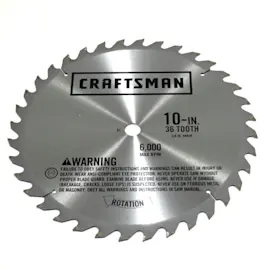
Yes, you can mount an 8-inch blade on the Craftsman 113298722 10-inch table saw as long as it fits the 5/8-inch arbor and is rated for 3450 RPM or higher; however, for through cuts (thru-sawing), we use a 10-inch blade so the guard/spreader alignment stays correct. See the owner's manual.
When an 8-inch blade is OK (and when it is not)
An 8-inch blade is commonly used for non-through operations (like some dado setups) where the blade does not need to reach full 10-inch cutting height.
- OK for some non-through cuts where reduced blade height is acceptable
- OK only if the blade is balanced, undamaged, and properly rated for speed
- Not recommended for thru-sawing on this saw (use a 10-inch blade)
- Not OK if the blade does not match the 5/8-inch arbor
- Not OK if you cannot keep the guard/spreader setup appropriate for the cut
Fit and rating checklist
Use this quick checklist before installing any smaller blade.
| Check | What we look for | Why it matters |
|---|---|---|
| Arbor size | 5/8-inch arbor fit | Prevents wobble and unsafe mounting |
| Blade diameter for thru cuts | 10-inch blade | Keeps spreader closest to the blade |
| Speed rating | 3450 RPM or higher | Reduces risk of blade failure |
| Condition | Unbroken, balanced, clean | Helps prevent vibration and kickback |
Why it matters
On the 113298722, the manual calls out that a 10-inch blade should be used when the blade comes through the workpiece. Using a smaller blade for a through cut can change how close the spreader/guard is to the blade, which increases the chance of binding, kickback, or poor cut control.
Safer setup reminders
- Turn power off and wait for the blade to stop before adjusting
- Use the proper table insert; keep it flush with the tabletop
- Avoid freehand cuts; use the rip fence or miter gauge as intended
- Use a push stick or push block for narrow ripping
Last updated: February 2026
How to get rid of an old table saw?
If your Craftsman 113298722 10-inch table saw still runs, the best way to get rid of it is to sell or donate it; if it is unsafe or incomplete, recycle it as scrap metal and dispose of sharp parts (like blades) safely and separately.
Best options (from easiest to most responsible)
- Sell it if it powers on and the fence, guard, and table are intact.
- Donate it to a community shop, school program, or reuse organization if it is complete and safe.
- Give it away locally (pickup only) if you just need it gone.
- Recycle as scrap metal if the saw is broken, missing key safety parts, or has major damage.
- Dispose of blades separately; treat them like sharp metal and package them so they cannot cut anyone.
Safety steps before moving or disposing
Before you transport or part out a table saw, we follow the same safety mindset as routine service:
- Unplug the saw and confirm the switch is OFF.
- Remove the switch key (if equipped).
- Lower the blade fully and remove the blade if you are transporting the saw.
- Secure loose parts (fence, miter gauge, guard components) so they do not shift.
- Wear gloves and eye protection when handling sharp or rusty parts.
What to do with common table saw components
| Item | Recommended handling | Notes |
|---|---|---|
| Saw body, stand, table | Scrap metal recycling | Remove non-metal pieces if your recycler requires it |
| Motor and wiring | E-waste or metal recycler (varies) | Some facilities accept motors as mixed metal |
| Saw blade | Wrap and label as sharp | Do not toss loose into a bin |
| Guard, spreader, pawls | Keep with saw if selling/donating | These are important safety parts |
Why it matters
A table saw has heavy metal parts and sharp cutting edges. Disposing of it responsibly reduces injury risk during handling and keeps recyclable metal out of the trash stream.
Manual tip for safe handling
Our owner's manual includes safety guidance like unplugging the saw before changing the cutting tool or making adjustments; those same steps help you move and dispose of the saw safely.
Last updated: February 2026
What are the common table saw mistakes?
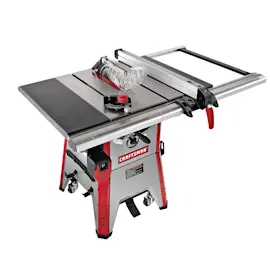
Common mistakes on the Craftsman 113298722 10" table saw include unsafe hand positions, feeding stock from the wrong direction, starting the saw with clutter on the table, and using the saw without the proper table insert. These errors raise the risk of kickback, binding, and serious injury.
Most common mistakes we see (and what to do instead)
- Starting with the switch on or a cluttered table: confirm the switch is OFF before plugging in; clear tools and scraps before turning the saw ON.
- Using the saw without the proper table insert: keep the insert installed and adjusted flush with the tabletop.
- Standing directly in line with the blade: keep your face and body to one side, out of the kickback path.
- Reaching behind the blade: never reach behind the cutting tool to support stock or remove scraps.
- Feeding from the rear or pulling the workpiece through: always feed from the front and push the workpiece against blade rotation.
- Overreaching or losing balance: keep solid footing and avoid awkward hand positions.
- Trying to cut unstable or irregular shapes without support: use a jig or fixture, or choose a better-suited tool.
Quick safety checklist before every cut
- Blade height set as low as practical for the cut
- Fence, miter gauge, clamps, and locks tight with no excessive play
- Work area clean; floor not slippery from sawdust
- Workpiece supported (use outfeed support for long or wide stock)
- PPE and clothing: eye and hearing protection, no loose clothing, hair tied back
“Don’t do this” vs “Do this”
| Risky habit | Safer practice |
|---|---|
| Confine or clamp the cutoff piece | Keep the cutoff piece free to move to prevent wedging and kickback |
| Cut more than one workpiece at a time | Cut one workpiece at a time |
| Ignore new vibration/noise | Stop immediately, turn OFF, unplug, then inspect before restarting |
Why it matters
Most table saw injuries happen fast: kickback, binding, and slips typically start with poor stock control, unstable support, or hands drifting into the blade path. Following the operating rules in the owner's manual reduces those risks and improves cut quality.
Last updated: February 2026