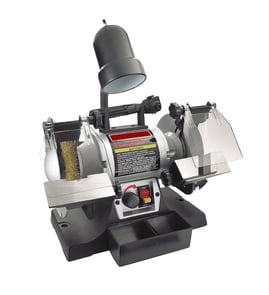

What is a Craftsman bench grinder?
A Craftsman bench grinder (including model 39719320) is a stationary power tool with a motor that spins abrasive wheels to grind, sharpen, and clean up metal. We typically use it for sharpening hand tools, shaping metal, and removing rust or burrs.
What you can do with a 6-inch bench grinder
- Sharpen chisels, plane irons, mower blades, and shop tools
- Deburr cut metal edges after sawing or drilling
- Shape small metal parts (light material removal)
- Clean corrosion using a wire wheel attachment (if equipped)
- Smooth welds and rough edges before finishing
Key parts and features (what they do)
| Feature | What it does | Why it matters |
|---|---|---|
| Grinding wheels (6-inch) | Removes material and sharpens edges | Wheel grit controls speed vs. finish quality |
| Tool rests | Supports the workpiece at a stable angle | Helps you keep consistent bevel angles |
| Eye shields/spark guards | Deflects debris and sparks | Reduces injury risk and improves visibility |
| Motor and switch | Powers and controls the grinder | A weak motor or bad switch causes stalling or no-start |
Safe, practical use tips we recommend
- Wear eye protection and keep guards in place before powering on.
- Let the wheel reach full speed before contacting the work.
- Use light pressure; forcing the tool overheats metal and can glaze the wheel.
- Keep the tool rest close to the wheel (small gap) so parts do not catch.
- If the grinder vibrates, stop and check wheel condition and mounting.
Why it matters
Knowing what a bench grinder is and how it is typically used helps you choose the right wheel grit, set the tool rest angle correctly, and troubleshoot common issues like vibration, overheating, or poor sharpening results. For help identifying the exact model when ordering parts, use how to find your appliance model number (and what it means for parts).
Last updated: February 2026
Can you run a bench grinder with only one wheel?
Yes, a Craftsman bench grinder model 39719320 can run with only one wheel installed, but we only recommend doing it temporarily for testing. A missing wheel changes balance and inertia, which increases vibration and can stress the motor bearings and guards.
What changes when one wheel is missing
- More vibration: the grinder is easier to shake if the remaining wheel is not perfectly balanced.
- Faster spin-up and slow-down: less rotating mass means quicker acceleration and less “flywheel” effect.
- Higher bearing load: vibration and imbalance can shorten bearing life.
- Guard and spark control issues: the unused side still needs proper guarding to reduce risk from debris.
Safe way to do a short test run
- Unplug the grinder and remove the wheel only if the hardware and guard can be reinstalled securely.
- Reinstall the wheel guard and any covers on the empty side so nothing can contact the shaft.
- Stand to the side and run it for 30 to 60 seconds with no grinding load.
- Shut it off immediately if you notice excessive vibration, rubbing, wobble, or unusual noise.
Better options than running one wheel long-term
| Goal | Better approach | Why it’s better |
|---|---|---|
| Keep using the grinder | Replace the damaged wheel and dress the new wheel | Restores balance and smoother operation |
| Reduce vibration | Check flanges, blotters, and wheel seating; dress the wheel | Fixes common wobble causes |
| Diagnose an issue | Test the wheel for damage and check the arbor for runout | Prevents a wheel failure under load |
Why it matters
Bench grinder wheels store a lot of energy at speed. Running with imbalance increases vibration, which can damage bearings, loosen fasteners, and make grinding less controlled.
For help identifying the correct replacement parts for model 39719320, use the model lookup on Sears PartsDirect.
Last updated: February 2026
What are the 4 important rules for a bench grinder?
For the Craftsman bench grinder model 39719320 (6-inch wheel), the 4 most important rules are: wear proper eye/face protection, keep the tool adjusted and guarded, grind only on the wheel’s face (not the side), and start and stop safely (let it reach full speed and come to a complete stop before handling).
The 4 rules (with what to do)
- Wear the right PPE and secure anything loose: Safety glasses plus a face shield are best; tie back hair and avoid loose sleeves or jewelry.
- Keep guards and clearances set correctly: Keep the wheel guard and spark deflector in place; set the work rest close to the wheel (commonly about 1/8 inch) so the workpiece cannot get pulled into the gap.
- Grind on the wheel face only: Do not grind on the side of a standard bench grinding wheel; side loading can crack the wheel.
- Start and stop safely: Stand slightly to one side at startup, let the wheel reach full speed before grinding, and wait for the wheel to stop fully before making adjustments or walking away.
Quick safety checklist before you grind
- Inspect the wheel for chips/cracks and replace damaged wheels.
- Confirm the wheel is rated for the grinder’s RPM.
- Adjust the work rest and spark deflector before powering on.
- Use light pressure; let the abrasive do the work.
- Keep the workpiece moving to avoid overheating and gouging.
Common mistakes and the safer alternative
| Common mistake | Why it’s risky | Better practice |
|---|---|---|
| Grinding on the wheel side | Can damage or break the wheel | Grind on the wheel face only |
| Large gap at the work rest | Work can wedge and kick back | Set rest close (about 1/8 inch) |
| Heavy pressure | Overheats work and stresses wheel | Use light, steady pressure |
| Adjusting while spinning | Pinch and entanglement hazard | Power off and wait for full stop |
Why it matters
A bench grinder can remove metal fast; these rules reduce the biggest risks: wheel failure, kickback, and eye injuries. Good adjustment and guarding also improves control and produces a cleaner grind.
For general DIY safety habits that apply to power tools like a bench grinder, review are diy appliance repairs safe.
Last updated: February 2026
What are the parts of a grinder?
On the Craftsman 39719320 bench grinder with a 6-inch wheel, the main parts are the motor and shaft (spindle/arbor), grinding wheels, wheel guards, tool rests, spark deflectors, and the power switch. These parts work together to spin the wheels safely and support the workpiece during grinding.
Main parts you will see on a bench grinder
- Motor: provides the power to spin the wheels
- Spindle/arbor (shaft): the rotating shaft the wheels mount to
- Grinding wheels: the abrasive wheels that do the cutting/grinding
- Wheel guards: cover the wheel sides to help contain debris
- Tool rests: adjustable supports that hold the workpiece steady
- Spark deflectors and eye shields (if equipped): help direct sparks and protect your face
- Power switch: turns the grinder on and off
Bench grinder vs. angle grinder (quick comparison)
The parts list online often mixes these up. Here is the practical difference:
| Feature/part | Bench grinder (Craftsman 39719320) | Angle grinder |
|---|---|---|
| Typical mounting | Bolted to a bench | Handheld tool |
| Wheel type | Two fixed wheels (often 6-inch) | One wheel/disc |
| Common controls | Simple on/off switch | Trigger/paddle switch, lock button (varies) |
| Work support | Tool rests | No tool rest; you guide by hand |
Why these parts matter for safe, accurate grinding
A bench grinder is safest and most accurate when the guards are in place, the tool rests are adjusted close to the wheel, and the wheels are in good condition. Worn wheels, loose tool rests, or missing guards increase vibration and the chance of the workpiece catching.
Helpful checks when a grinder is not working right
- If it will not start: check the outlet, cord, and switch
- If it vibrates: check wheel condition, mounting tightness, and balance
- If it grinds poorly: dress the wheel and reset the tool rest
- If it sparks excessively: confirm correct wheel type and avoid overheating the metal
For electrical troubleshooting steps and safe testing, use our guide: how to use a multimeter to test electrical parts video.
Last updated: February 2026
How to restore a bench grinder?
Restoring your Craftsman 39719320 6-inch bench grinder means fully cleaning and inspecting it, correcting any electrical or bearing issues, and then reassembling and adjusting it so it runs smoothly and safely. Focus first on safety items (guards, tool rests, wheel condition) before cosmetics.
Safe restoration workflow (recommended order)
- Unplug the grinder and remove the wheels, guards, tool rests, and spark shields.
- Take photos as you disassemble so reassembly is straightforward.
- Degrease and de-rust the housings, flanges, and hardware; clean threads and mating surfaces.
- Inspect the power cord, switch, and internal wiring for brittle insulation, loose terminals, or heat damage.
- Check the motor shaft for play; roughness or wobble usually points to worn bearings.
- Reassemble, then align guards and set tool rests close to the wheel.
What to inspect and replace (common wear points)
Bench grinders typically need attention in these areas:
- Grinding wheels: cracks, glazing, out-of-round, wrong size, or wrong RPM rating.
- Wheel flanges and blotters: bent flanges or missing blotters can cause vibration.
- Bearings: noisy, hot-running, or gritty feel when spinning by hand.
- Switch and cord: intermittent power, arcing, or damaged insulation.
- Tool rests and spark shields: bent, missing, or unable to hold adjustment.
Key setup specs (typical targets)
Use these common setup targets after reassembly:
| Adjustment | Typical target | Why it matters |
|---|---|---|
| Tool rest to wheel gap | 1/16 inch or less | Reduces the chance of the workpiece getting pulled in |
| Spark shield gap | 1/8 inch or less | Helps contain sparks and debris |
| Wheel condition | Runs true with minimal vibration | Improves control and finish |
Electrical checks that prevent repeat failures
If the grinder hums, trips a breaker, or runs intermittently, correct electrical issues before painting.
- Confirm the outlet and plug fit tightly.
- Inspect the cord for cuts or flattened sections.
- Check switch operation for positive on/off action.
- Test continuity and basic electrical function with a meter using how to use a multimeter to test electrical parts video.
Why it matters
A restored grinder that is clean, aligned, and electrically sound runs cooler, vibrates less, and is safer to use. Most “restoration” problems come from skipping inspection of wheels, flanges, bearings, and wiring.
Last updated: February 2026