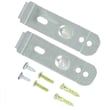
Installation guide
 Owner’s manual




What size is the Samsung DW80R5061UT?
The Samsung DW80R5061UT built-in dishwasher measures 23 7/8 in. wide x 24 in. deep (excluding handle) x 33 7/8 in. high. For installation, plan on a cabinet opening at least 24 in. wide x 24 in. deep x 34 1/8 in. high; see the installation guide.
Dimensions you can use for planning
- Dishwasher size (appliance): 23 7/8 in. W x 24 in. D (excluding handle) x 33 7/8 in. H
- Minimum enclosure opening: 24 in. W x 24 in. D x 34 1/8 in. H
- Countertop depth for a flush door: at least 25 in. deep
- Measure twice: check width at the front and back of the opening
Quick reference table
| Measurement | DW80R5061UT appliance | Minimum enclosure opening |
|---|---|---|
| Width | 23 7/8 in. | 24 in. |
| Depth | 24 in. (excluding handle) | 24 in. |
| Height | 33 7/8 in. | 34 1/8 in. |
Why it matters
Dishwashers are designed to fit tightly in the cabinet opening. Using the enclosure minimums helps prevent installation issues like rubbing on the countertop, pinched drain hose routing, or a door that will not sit flush.
Last updated: February 2026
What is stormwash on a Samsung dishwasher?
StormWash on the Samsung DW80R5061UT dishwasher is a wash option that adds an extra-powerful spray zone in the lower rack to scrub very dirty, hard-to-clean items like pots, pans, and casserole dishes. For best results, load those items face down in the marked StormWash area.
How to use StormWash correctly
- Load pots, pans, and durable serving bowls in the lower rack StormWash zone (identified by guide markings).
- Place items face down so the jets can hit the soiled surfaces directly.
- Keep pot handles and large items from blocking spray nozzles or preventing rotation.
- Select a compatible cycle; StormWash is not available on Delicate or Rinse Only.
- Use the right detergent amount for the soil level; too much can cause excess suds and poor rinsing.
What StormWash changes (and what it does not)
StormWash boosts cleaning power in a specific lower-rack area; it does not simply make the whole dishwasher “hotter” or “longer.” It is designed for targeted, high-impact spray on baked-on food.
| Feature | StormWash OFF | StormWash ON |
|---|---|---|
| Lower rack spray intensity in StormWash zone | Standard | Higher, targeted jets |
| Best for | Everyday loads | Pots, pans, baked-on soil |
| Cycle compatibility | All cycles | Not Delicate, not Rinse Only |
Why it matters
Using StormWash the right way helps prevent re-washing and reduces the need to pre-rinse. It is especially helpful when you have heavy soil in the lower rack but still want to run a normal load in the rest of the dishwasher.
Helpful reference
StormWash placement and option details are shown in the DW80R5061UT owner's manual.
Last updated: February 2026
What is the most common problem with Samsung dishwashers?
On Samsung dishwashers like model DW80R5061UT, the most common issues we see are drainage problems, leak detection events, and control or door-latch related no-start symptoms. Many of these show up as information codes on the display, which point you to the fastest next check in the DW80R5061UT owner's manual.
Most common symptoms and what they usually mean
- Won’t start or stops mid-cycle: door not fully latched, door switch not closing, or control not accepting input.
- Not draining (standing water): kinked or clogged drain hose, blocked sump drain path, or pump issue.
- Leak code or water in the base: moisture in the base pan triggering the leak detector.
- Fills then stops: water supply restriction or inlet issue.
- Poor cleaning: spray arm blockage, low water temperature, or circulation problem.
Quick checks we recommend first (fast, no parts)
- Cancel the cycle and restart after a full door re-latch.
- Check the sink drain and garbage disposer knockout (if recently installed).
- Inspect the drain hose routing for kinks and confirm a proper high loop.
- Clean the filter area and check the sump drain opening for debris.
- If an information code is displayed, match it to the code list and follow the action steps.
Common information codes on this series
These codes are frequently tied to “most common problems” because they point to draining, leaking, and water supply.
| Code | What it points to | What to check first |
|---|---|---|
| 5C | Drain check | Drain hose clogged or folded; sump drain opening blocked |
| LC | Leakage check | Water in base pan; supply connection leaks |
| 4C | Water supply check | Supply valve closed; inlet line frozen or clogged |
| OC | Over-level water check | Shut off water and power; investigate overfill source |
| 3C | Pump operation check | Power reset; pump/circulation issue if it returns |
For code definitions and the exact step-by-step actions, use our Samsung dishwasher error codes guide along with the manual.
When a part is commonly involved
If your troubleshooting points to a specific failure, these parts are often involved in the most common Samsung dishwasher complaints:
- Drain problems: dishwasher drain hose DD97-00403A
- Leak detection: dishwasher leak detector sensor DD94-01062A
- No-start/door issues: dishwasher door switch DD81-02132A
Why it matters
Catching a drain restriction or small leak early helps prevent repeat shutdowns, protects the circulation system, and reduces the chance of water collecting in the base where the leak sensor can stop the dishwasher.
Last updated: February 2026
Is the DW80R5061UT a good dishwasher?
Yes; the Samsung DW80R5061UT is a solid built-in dishwasher for most homes because it is designed for 15 place settings and includes a Sanitize option that heats the final rinse up to 163°F (73°C) on supported cycles. Overall “good” comes down to how you use it (cycle choice, loading, and maintenance) and whether you prioritize sanitizing performance and capacity.
What “good” means for this model
From the DW80R5061UT user documentation, we can point to a few concrete strengths:
- Capacity: rated for 15 place settings
- Sanitize option: final rinse can reach 163°F (73°C)
- NSF 184 note: the Normal cycle with Sanitize is the combination designed to meet NSF 184 soil removal and sanitization requirements
- Typical built-in specs: 120 V, 60 Hz, 15 A circuit; water pressure 20 to 120 psi
For cycle details and option availability, use the DW80R5061UT owner's manual.
How to get the best results (and avoid common “bad dishwasher” complaints)
Most negative experiences come from setup and day-to-day use issues (not enough water heat, poor loading, clogged filters, or restricted spray).
- Run the Normal + Sanitize combination when you need maximum sanitizing performance.
- Avoid blocking spray paths; keep tall pans from shielding the upper spray.
- Use fresh detergent and do not overfill the dispenser.
- Clean and maintain the dishwasher regularly (filters, sump area, spray arms).
- If cycles feel “too long,” compare cycle selections; Auto and Normal can vary widely by soil sensing.
Quick comparison: when to use Sanitize
| Goal | Recommended choice | What to expect |
|---|---|---|
| Sanitizing and strong soil removal | Normal + Sanitize | Final rinse up to 163°F (73°C) |
| Faster everyday loads | Normal (no Sanitize) | Shorter, less heat boosting |
| Delicate items | Delicate | Sanitize not available |
Why it matters
A dishwasher can be “good” on paper but disappointing if the cycle and options do not match the load. On the DW80R5061UT, choosing the right cycle (especially when you need NSF-style sanitizing) and keeping water flow paths clear makes the biggest difference in cleaning and drying performance.
Last updated: February 2026