Owner’s manual
 Error Codes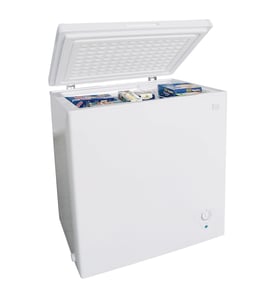



How can I tell what size my chest freezer is?
To tell the size of your Kenmore chest freezer model 25316502102, look for the capacity in cubic feet on the rating/serial label or in the 25316502102 owner's manual. If you only need physical size for moving or wrapping, measure the exterior width, depth, and height.
Fast ways to identify the freezer “size”
Most people mean one of two things: storage capacity (cu ft) or outside dimensions (inches).
- Capacity (cubic feet): Check the model/serial label and the specifications section in the manual.
- Outside dimensions: Measure the cabinet so you know if it fits through doors, into a truck, or under a counter.
- Usable space: Capacity is not the same as usable space; baskets and interior contours reduce what fits.
Where to find the capacity for model 25316502102
For chest models like this one, the manual notes the model/serial plate is typically on the left exterior wall.
- Unplugging is not required just to read the label, but keep hands dry around cold metal surfaces.
- Write down the full model number and serial number for accurate parts and spec matching.
- If the label is worn, use the manual’s model identification section as your backup reference.
How to measure the exterior dimensions (for moving or wrapping)
Use a tape measure and record in inches.
- Width: Left to right across the front (include hinges/handles if they stick out).
- Depth: Front to back (include the lid overhang if it extends past the cabinet).
- Height: Floor to the top lip or highest point of the lid.
- Measure twice; chest freezers often have a lid “lip” that changes the top measurement.
Quick measurement checklist
| What you need | Measure | Include |
|---|---|---|
| Fit through a doorway | Width and height | Handles, hinges, lid overhang |
| Fit in a vehicle | Width, depth, height | Any protrusions |
| Storage planning | Capacity (cu ft) | Use label/manual, not tape |
Why it matters
Capacity (cubic feet) helps you plan food storage and freezing loads; the manual also notes a common guideline of freezing about 3 lb of fresh food per cubic foot at one time. Exterior dimensions matter for delivery, wrapping, and placement.
Last updated: January 2026
How to move a chest freezer by yourself?
To move your Kenmore chest freezer model 25316502102 by yourself, we recommend emptying it, defrosting and drying it, then securing loose items and keeping the freezer upright during transport to prevent damage. Follow the handling and moving steps in the 25316502102 owner's manual.
Safe solo-moving checklist
- Unplug the freezer from the wall outlet.
- Remove all food; then defrost, clean, and dry the interior.
- Tape or secure loose items (baskets, shelves, base panel) so they cannot shift.
- Close the lid and secure it so it cannot swing open while you tilt or roll the unit.
- Use an appliance dolly with a strap; keep the freezer as upright as possible.
- Protect the cabinet with a blanket or padding during transport.
Upright vs. on its side (what to do)
The manual guidance for moving focuses on transporting the freezer upright and securing it so it cannot move in the vehicle. If you must tip the freezer to get it onto a dolly, keep the tilt brief and return it upright as soon as possible.
| Position during transport | Best practice | Why it matters |
|---|---|---|
| Upright | Recommended | Helps prevent internal damage and keeps the unit stable |
| Briefly tilted (to load/unload) | Acceptable | Minimizes risk while still allowing solo handling |
| Fully on its side | Avoid when possible | Increases risk of leaks, damage, and restart issues |
Step-by-step: moving it alone
- Empty the freezer; remove the basket and tape it inside the cabinet or move it separately.
- Defrost and dry the interior so water does not spill during the move.
- Strap the freezer to a dolly (strap across the cabinet, not the lid handle).
- Roll slowly; avoid stairs when possible. If stairs are unavoidable, use a helper.
- In the vehicle, keep it upright and strap it so it cannot slide.
Why it matters
A chest freezer is heavy and top-opening; if the lid opens or the cabinet shifts, you can damage the liner, hinges, or sealed system. Securing loose parts and keeping the unit upright protects cooling performance and helps prevent frost and moisture problems later.
Last updated: January 2026
Which is better chest freezer or deep freezer?
A “deep freezer” usually means a standalone freezer for long-term storage; a chest freezer is one type of deep freezer. For Kenmore model 25316502102 (a chest freezer), chest-style units are typically better for bulk storage, energy efficiency, and holding temperature longer during a power outage; uprights are typically better for everyday organization.
Chest vs upright: what you gain and what you give up
Chest freezers (like 25316502102) are designed to keep cold air from spilling out when opened, which helps with efficiency and temperature stability.
- Chest freezer strengths: best for bulk buys, large cuts of meat, and long storage
- Chest freezer tradeoffs: harder to organize, you reach down to access items
- Upright freezer strengths: shelves and bins make it easier to see and grab food
- Upright freezer tradeoffs: typically uses more energy and warms faster when opened
Quick comparison
| Feature | Chest freezer (like 25316502102) | Upright freezer |
|---|---|---|
| Energy use | Typically lower | Typically higher |
| Organization | Baskets and dividers help, but stacking happens | Best (shelves, bins) |
| Floor space | Wider footprint | Smaller footprint, taller |
| Power outage hold time | Typically longer | Typically shorter |
Tips to make a chest freezer easier to live with
We recommend these habits to get “upright-like” convenience from a chest freezer:
- Use a basket for high-use items; the 25316502102 uses a freezer basket 216848200
- Group foods in labeled bins (meat, veggies, meals, bread)
- Keep a simple inventory list on the lid
- Avoid overpacking; leave space for air circulation around items
- Let the temperature stabilize after adjustments (several hours between changes per the 25316502102 owner's manual)
Why it matters
Choosing “better” comes down to how you shop and cook. If you store bulky items and want strong temperature stability, chest is the better fit. If you open the freezer often and want fast access, upright is usually the better fit.
Last updated: January 2026