Error Codes



Are bottom mount fridges better?
Bottom-mount refrigerators like the Frigidaire GRFS2853AF4 are often “better” for many kitchens because the fresh-food section sits at eye and waist level, so you reach everyday items more comfortably. Whether it’s best depends on your cooking habits, freezer use, and space needs.
A bottom-mount design typically prioritizes fresh-food access and organization.
- Fresh foods are easier to see and grab without bending as much
- Wide shelves can make meal prep and leftovers easier to organize
- Freezer items store in lower drawers, which can reduce cold-air spill when you open the fridge doors
- Many models offer flexible bins and deli/crisper storage for produce and beverages
- The freezer can feel less convenient if you access frozen items frequently
| Feature | Bottom-mount refrigerator | Top-freezer refrigerator |
|---|---|---|
| Fresh-food access | More ergonomic | Requires more bending |
| Freezer access | Lower drawer(s) | Eye-level freezer |
| Organization | Often more shelf/bin options | Often simpler layout |
| Typical fit/price | Often larger and higher cost | Often smaller and lower cost |
Bottom-mount is usually a great fit if you:
- Cook often and use fresh ingredients daily
- Prefer wide shelves for platters, meal prep, and leftovers
- Want freezer drawers for better separation (meat, veggies, ice)
- Value convenience for the refrigerator section over the freezer
Choosing the right configuration affects comfort, food visibility, and how well your refrigerator matches your routine. If you use filtered water and ice, keeping up with filter changes also helps taste and flow; see how to replace the water filter in a Frigidaire refrigerator.
Last updated: January 2026
What is the life expectancy of a Frigidaire Gallery refrigerator?
A Frigidaire Gallery refrigerator like model GRFS2853AF4 typically lasts 10 to 15 years, with about 12 years being a solid real-world expectation when it’s installed correctly and kept clean (especially the condenser area) and the doors seal tightly.
- Condenser coil cleanliness (dust buildup makes the compressor work harder)
- Door gasket condition (air leaks cause longer run times and frost issues)
- Water quality and filter changes (helps protect the dispenser and ice maker system)
- Airflow and loading (overpacking blocks vents and stresses cooling)
- Room temperature and ventilation (hot garages and tight cabinets shorten life)
- Vacuum and brush the condenser area every 6 to 12 months.
- Keep doors closing squarely; fix sagging or misalignment early.
- Replace worn gaskets if you feel cold air leaking or see heavy frost.
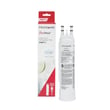
- Change the water filter on schedule; for this model, a common replacement is the Frigidaire refrigerator water filter FPPWFU01.
- Watch for early cooling symptoms (warm fridge, noisy fan, long run times) and address them before the compressor is overworked.
| If your GRFS2853AF4 is… | Usually worth repairing | Usually time to consider replacement |
|---|---|---|
| Under 8 years old | Yes | Rarely |
| 8 to 12 years old | Often | Sometimes |
| Over 12 years old | Sometimes (small fixes) | Often (major sealed-system issues) |
A refrigerator’s most expensive wear items are tied to heat and run time. Simple upkeep like coil cleaning, good door seals, and timely filter changes reduces run time, which helps the compressor, fans, and control system last longer.
If your unit uses a push-button style filter or you want step-by-step guidance, use how to replace the water filter in a Frigidaire refrigerator.
Last updated: January 2026
Can the bottom freezer drawer be removed?
Yes. On the Frigidaire GRFS2853AF4 bottom-mount refrigerator, the bottom freezer drawer assembly is designed to be removable for cleaning and for accessing the slide rails and baskets. The exact clip and screw locations can vary by production revision, but the removal approach is generally the same.
- Unplug the refrigerator (or switch off power at the breaker).
- Pull the freezer drawer fully open and remove food.
- Lift the upper basket up at the back, then lift the front and remove it.
- Look for screws inside each drawer railing that secure the drawer front to the rails; remove them if present.
- Lift up evenly on both sides of the drawer handle/front to separate the drawer railings from the rail assemblies.
- Slide the rail assemblies back in carefully so they do not rack or bind.
Wear, debris, or a bent rail can make the drawer feel rough or sit crooked. These model-compatible parts are commonly involved:
| What you notice | What to inspect | Example compatible part |
|---|---|---|
| Drawer sticks or feels rough | Left and right slide rails for damage or debris | Refrigerator freezer basket slide rail assembly, left 5304507979 |
| Drawer sits low or feels unsupported | Rail support and mounting points | Refrigerator freezer drawer rail support 5304509676 |
Removing the drawer the right way helps prevent bent rails and misalignment that can lead to air leaks, frost buildup, and temperature swings in the freezer.
Last updated: January 2026
What is the most common problem with a Frigidaire refrigerator?
Cooling complaints are the most common issue we see on Frigidaire refrigerators, including model GRFS2853AF4: the fresh-food section warms up, the freezer develops frost, or temperatures fluctuate. In many cases, the cause is restricted airflow, dirty condenser coils, or a door seal problem.
- Fridge not cold enough: blocked vents, weak evaporator fan, or a temperature sensing issue
- Freezer frost buildup: door not sealing, door left ajar, or defrost and airflow problems
- Ice maker or dispenser slow/no ice: restricted filter, low water flow, or a valve issue
- Runs a lot or seems loud: dirty coils, warm room conditions, or airflow problems
- Water leaks/puddles: drain path issues or water line connections
- Set temperatures to 37°F (refrigerator) and 0°F (freezer)
- Keep food packages from blocking air vents and the air tower
- Clean condenser coils and the area behind and under the refrigerator
- If water or ice is weak, replace the filter and purge air from the dispenser
- Inspect door gaskets for gaps, rips, or spots that do not grip the cabinet
If basic checks do not help, these model-compatible parts are often involved:
| Problem area | What to inspect/replace | Model-compatible example |
|---|---|---|
| Water/ice flow issues | Water filter | Frigidaire refrigerator water filter FPPWFU01 |
| Poor cooling or warm fridge | Evaporator fan not running or noisy | Frigidaire refrigerator evaporator fan motor 809069206 |
| Frost or warm temps from air leaks | Torn or warped gasket | Frigidaire refrigerator freezer door gasket (gray) 5304537408 |
| Temperature swings | Sensor out of range | Refrigerator temperature sensor 5303918775 |
Most “common problems” start small (restricted airflow, dirty coils, a clogged filter) but can turn into food-safety issues, heavy frost, or a refrigerator that runs constantly. Fixing the root cause early helps protect the compressor and keeps temperatures stable.
Last updated: January 2026