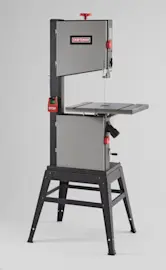
Owner’s manual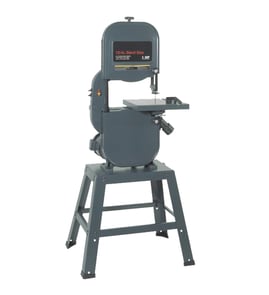

How do I know the size of my bandsaw blade?
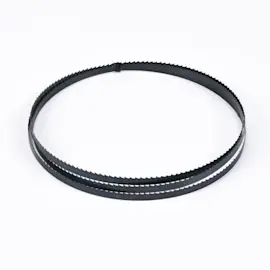
For your Craftsman band saw model 113244500, the blade size is defined by length, width, and tooth count (TPI); the parts list in the 113244500 owner's manual shows this saw uses a 56-7/8 inch blade, and you then match the width and TPI to your cut type.
What “blade size” means (and what to measure)
A complete band saw blade spec includes:
- Length: total loop length (this model uses 56-7/8 in.)
- Width: from tooth tip to the back edge of the blade
- TPI (teeth per inch): tooth density along the blade
- Kerf and set: how wide the cut is and how far teeth are bent outward (affects cut quality)
How to measure your current blade safely
If the blade is already off the saw, we recommend:
- Wear work gloves and eye protection
- Lay the blade loop flat on the floor (keep it controlled so it does not spring open)
- Mark a starting point (often the weld) with tape or marker
- Use a tape measure to follow the blade around until you return to the mark
- Measure width across the blade (tooth tip to back)
- Count teeth across 1 inch to get TPI
Picking width and TPI for the job
Blade width affects how tight a curve you can cut. The manual notes:
| Blade width | Typical use | Smallest circle you can cut (approx.) |
|---|---|---|
| 1/8 in. | Tight curves | 1/2 in. diameter |
| 1/4 in. | General curves | 1-1/2 in. diameter |
TPI selection (general guidance):
- 3 to 6 TPI: thicker wood, faster ripping
- 6 to 10 TPI: general-purpose wood cutting
- 10 to 18 TPI: thinner stock, plastics, finer finish
Why it matters
Using the correct 56-7/8 inch length keeps tensioning and tracking stable, and choosing the right width and TPI helps prevent slow cutting, wandering cuts, and ragged edges.
Last updated: February 2026
What is the 3-tooth rule for bandsaws?
The 3-tooth rule is a band saw blade selection guideline: during a cut, at least 3 teeth should be in contact with the workpiece so the blade cuts smoothly without snagging, stripping teeth, or vibrating. We use this rule when choosing blade TPI for the Craftsman 113244500 band saw.
How to apply the 3-tooth rule (quick method)
- Measure the material thickness (the direction the blade teeth travel through).
- Choose a blade TPI so 3 to about 24 teeth are engaged in that thickness.
- Too few teeth engaged (under 3): the blade can grab, chatter, and strip teeth.
- Too many teeth engaged (very fine TPI in thick stock): gullets pack with sawdust, the cut slows, and the blade heats up.
- Match feed rate to the blade: if the saw bogs down, reduce feed pressure and let the blade clear chips.
Simple TPI starting points (wood)
Use this as a practical starting chart, then fine-tune based on cut quality and how hard you are feeding.
| Material thickness | Typical blade choice | What you will notice |
|---|---|---|
| 1/8 to 1/4 in. | 14 to 18 TPI | Cleaner cut, less tooth snagging |
| 1/4 to 3/4 in. | 6 to 10 TPI | Good general-purpose cutting |
| 3/4 to 2 in. | 3 to 6 TPI | Faster ripping and resawing |
Why it matters on the Craftsman 113244500
Your saw’s cut quality depends heavily on blade setup and technique. The manual highlights that blade guides support the blade to prevent twisting, and that tracking and tension adjustments are needed when blades are changed. Use the 3-tooth rule first, then set up the saw correctly so the blade runs true.
- Set proper blade tension before cutting.
- Adjust tracking so the blade runs centered on the wheels.
- Adjust upper and lower blade guides and the back-up bearing after blade changes.
- Keep the upper guide assembly just above the workpiece for control.
For model-specific setup steps (tensioning, tracking, and guide adjustment), follow the owner's manual. For performance symptoms that often trace back to the wrong TPI or a dull blade, see band saw cutting slowly.
Last updated: February 2026
What is the specs of the Craftsman 12 inch bandsaw 113244500?
The Craftsman model 113244500 is a 10-inch band saw (not a 12-inch). For the most accurate model-specific specifications (cut capacity, table size, blade length range, motor details, and adjustments), we use the Owner's manual as the primary reference.
Key specs to confirm in the manual
Because band saw specs vary by configuration and setup, we recommend verifying these items for model 113244500:
- Throat capacity (often described as the “10-inch” capacity)
- Maximum cutting height (resaw capacity)
- Blade length and width range supported
- Table size and tilt range (bevel capability)
- Motor rating and electrical requirements
- Recommended blade types for wood thickness and cut quality
Typical spec ranges for 10-inch vertical band saws
If you are comparing tools or shopping for blades, most 10-inch vertical band saws commonly fall into these ranges (use your manual for exact numbers):
- Max cutting height: about 4 to 6 inches
- Blade width range: about 1/8 to 1/2 inch
- Table tilt: commonly 0° to 45°
- Blade length: varies by design; confirm before ordering
| Spec item | What it affects | Why you should match it exactly |
|---|---|---|
| Blade length | Fit on wheels and tracking | Wrong length will not tension or track correctly |
| Blade width | Curve cutting vs straight ripping | Too wide will not turn tight radii; too narrow can wander |
| Cutting height | Resaw thickness | Determines max stock thickness you can cut |
| Table tilt | Bevel cuts | Impacts accuracy for angled work |
Why it matters
Using the correct specs for Craftsman 113244500 helps you choose the right blade, set proper tension and tracking, and avoid issues like drift, slow cutting, or ragged cuts.
Helpful DIY references
If your question is tied to performance (not just dimensions), these guides help you connect “specs” to real-world cutting results:
Last updated: February 2026