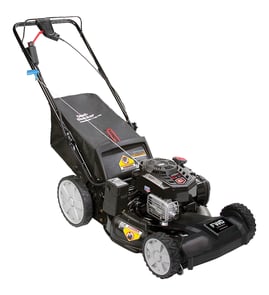
Can I put 87 gas in my lawn mower?
Yes. For the Murray 8-22251 gas walk-behind mower, regular unleaded 87-octane gasoline is the correct choice for normal operation; higher octane does not add power or make it run better.
What fuel to use (and what to avoid)
Use fresh, clean gasoline and avoid fuel that creates starting and carburetor problems.
- Use regular unleaded 87 octane
- Buy fuel in small amounts so it stays fresh
- Avoid old gas (especially gas that has been sitting for 30 days or more)
- Avoid mixing in oil unless your engine is a 2-cycle design (most walk-behind mowers are 4-cycle)
- Do not use race fuel or higher-octane fuel expecting better performance
Ethanol guidance (E10 vs. E15)
Most walk-behind mowers run best on standard pump gas with up to 10% ethanol.
| Fuel type | Typical label | What we recommend for mower use |
|---|---|---|
| Regular unleaded | 87 octane | Best everyday choice |
| E10 | Up to 10% ethanol | Commonly acceptable |
| E15 | 15% ethanol | Avoid for small engines |
| Non-ethanol | 87-90 octane | Great for storage and fewer fuel issues |
Why it matters
Using the right gas helps your mower start easier, idle smoother, and reduces varnish buildup that can clog the carburetor, fuel line, or fuel filter. Fresh 87-octane fuel is one of the simplest tune-up steps you can do.
If it will not start after fueling
If you filled with fresh 87 and it still will not start, focus on the common basics:
- Check the spark plug condition and gap
- Make sure the air filter is clean and not oil-soaked
- Confirm the fuel shutoff (if equipped) is on
- Prime correctly (if your mower has a primer bulb)
- Drain old fuel from the tank and carburetor bowl (if accessible)
For step-by-step fuel storage tips, use our guide: how to keep lawn mower gas from going bad.
Last updated: February 2026
How do I find out what year my Murray lawn mower is?
To find the year of your Murray lawn mower (model 8-22251), we use the mower’s ID/data tag and decode the date code printed on it. On most walk-behind mowers, the tag is on the mower deck (often near the center or rear area).
Where to look for the ID/data tag
Check these common spots on Murray walk-behind mowers:
- Top of the mower deck near the engine mounting area
- Rear of the deck near the discharge opening
- Near the height-adjuster brackets by a rear wheel
- Under the rear flap (if equipped)
- On the deck surface near the handle mounting points
If the tag is dirty or faded, wipe it clean and use a flashlight; a phone camera zoom often helps.
How to decode the date code
Once you find the tag, look for a field labeled Date Code (or similar). Many Murray tags use a 4-digit date code.
- The last two digits typically indicate the year (for example, …19 = 2019).
- The first two digits are commonly a week number (01 to 52).
Quick example
| Example date code | Interprets as | What it means |
|---|---|---|
| 2319 | Week 23, 2019 | Built around early summer 2019 |
| 0516 | Week 5, 2016 | Built around early February 2016 |
If you cannot find “Date Code” on the tag
Some tags list a serial number instead. In that case, we use the serial number format to estimate the build year.
- Write down the full model number and serial number exactly as shown
- Look for any obvious year-like digits (often near the beginning of the serial)
- Compare the tag format to common Murray walk-behind mower tag layouts
A good next step is to use our DIY reference for mower identification and maintenance while you have the mower tipped safely for inspection: easy diy lawn mower repairs.
Why it matters
Knowing the build year helps us match the correct blade, air filter, spark plug, carburetor parts, and drive components for your Murray 8-22251, especially when a model had mid-year production changes.
Last updated: February 2026
What is the average lifespan of 8-22251?
A Murray walk-behind gas mower like model 8-22251 typically lasts 8 to 12 years with normal residential use and routine maintenance. Lifespan depends most on engine care (oil, air filter), blade condition, and how the deck is cleaned and stored.
Typical lifespan by use
- Light use (small yard, weekly in-season): 10 to 12 years
- Average use (medium yard, longer run time): 8 to 10 years
- Heavy use (tough grass, dusty conditions, frequent mowing): 5 to 8 years
| What affects lifespan most | What to do | How often |
|---|---|---|
| Engine oil condition | Change oil, keep level correct | Every season or 25 to 50 hours |
| Air flow to engine | Clean or replace air filter | Every season, more in dust |
| Cutting load | Sharpen/replace blade, avoid scalping | 1 to 2 times per season |
| Corrosion and buildup | Clean underside of deck after mowing | As needed, especially wet grass |
Maintenance habits that add years
- Change engine oil on schedule and never run low.
- Keep the air filter clean so the engine does not run rich and foul the plug.
- Use fresh fuel; don’t store old gas in the tank over the off-season.
- Keep the blade sharp to reduce engine strain and improve cut quality.
- Store the mower dry; rinse and dry the deck to slow rust.
Signs it’s nearing end of service life
- Hard starting even after tune-up items (spark plug, filter, fresh fuel).
- Excessive vibration (bent blade, worn crankshaft, loose engine mounts).
- Loss of power under normal cutting load.
- Deck rust-through or wheel height adjusters that no longer hold.
Why it matters
Knowing the expected lifespan helps you decide whether to invest in maintenance and repairs or plan for replacement. If you’re pricing out repairs, we recommend confirming the exact model number and using [how to find your appliance model number (and what it means for parts)] to match the right Murray parts.
Last updated: March 2026