
How do you start a Craftsman edger?
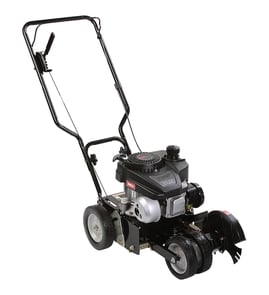
To start a Craftsman lawn edger model 536797580, set the controls for a cold start (choke on, throttle engaged if equipped), then pull the starter rope in smooth, firm strokes until the engine fires; move the choke toward RUN as it warms up.
Quick start steps (cold engine)
- Check fuel level and use fresh gasoline (and correct oil mix if your edger is 2-cycle).
- Move the unit to a flat, clear area; keep the blade away from concrete and debris.
- Set the choke to CHOKE/START.
- Press the primer bulb 3 to 5 times (if your carburetor has one); a cracked primer can prevent starting.
- Hold the throttle control (if your handle has a throttle trigger or lever).
- Pull the starter rope 5 to 10 times, using short, controlled pulls.
- When the engine pops or starts, move the choke to HALF then RUN.
If it will not start: what to check first
Most no-start issues on edgers come from fuel delivery, air flow, or ignition. Start with these fast checks:
- Old fuel: drain and refill; stale fuel is the most common cause after storage.
- Primer bulb: if it is hard, cracked, or will not fill, replace the primer 36045A.
- Fuel line: look for splits, soft spots, or leaks; replace the Craftsman lawn & garden equipment engine fuel line 29774.
- Air filter: a clogged filter can flood the engine; replace the troybilt lawn & garden equipment engine air filter 35066.
- Carburetor internals: sticking needle or varnish can block fuel; consider the Craftsman lawn and garden engine carburetor rebuild kit 632592.
Symptom guide
| What you see | Most likely cause | Best next step |
|---|---|---|
| Engine will not “pop” at all | No fuel getting through or no spark | Prime, check fuel line, then inspect ignition |
| Starts then dies when choke is moved to RUN | Lean fuel delivery or dirty carburetor | Check fuel line; rebuild carburetor |
| Strong fuel smell, wet plug | Flooded engine | Choke off, throttle open, pull to clear |
Why it matters
Correct choke and priming settings prevent flooding and reduce pull-start wear. If the edger has been sitting, replacing common fuel-system wear parts (primer bulb, fuel line, air filter) restores reliable starting and smoother idle.
Last updated: February 2026
What engine is on a Craftsman edger?
For Craftsman lawn edger model 536797580, the exact engine make and displacement depend on the engine family installed on your unit (many of these edgers were built around common small 4-cycle engines). The fastest way to identify it is to read the engine model and type numbers stamped on the engine shroud, then match parts like the troybilt lawn & garden equipment engine air filter 35066.
How to identify the engine on model 536797580
Look for an engine ID label or stamped numbers in these common spots:
- Recoil starter housing (pull-start cover)
- Valve cover area
- Blower housing near the spark plug
- Fuel tank or tank bracket
- Muffler heat shield area
Write down what you see (engine model, type, and code). That engine ID is what determines the correct carburetor, ignition, and tune-up parts.
What engines are commonly found on Craftsman edgers like this
Most Craftsman walk-behind edgers in this class use a small 4-cycle gasoline engine (often in the 3 to 5 HP range, roughly 120cc to 160cc depending on the build year and engine supplier).
Quick comparison (what you will see)
| What you find on the engine | What it tells you | Why it matters |
|---|---|---|
| Engine model/type numbers | Exact engine family | Ensures correct parts fit |
| Carburetor primer bulb present | Primer-style carb setup | Helps diagnose no-start issues |
| Foam/paper air filter style | Filter design | Affects maintenance interval |
Why it matters
The edger model number (536797580) identifies the machine, but the engine ID identifies the powerplant. That is critical for ordering the right air filter, fuel line, primer bulb, needle seat, ignition coil, and carburetor rebuild parts.
Parts that often relate to engine identification and tune-up
If your edger is hard to start, surges, or won’t stay running, these engine-related parts are commonly involved:
- Primer 36045A (cracked or stiff primer bulb)
- Craftsman lawn & garden equipment engine fuel line 29774 (leaks, air intrusion)
- Needle seat 631021B (fuel metering issues)
- Lamination 34443D (weak or no spark symptoms)
Last updated: February 2026
How do I find the model number on my 536797580?
For a Craftsman lawn edger like model 536797580, the model number is printed on the product ID label (a sticker or metal tag) attached to the frame or engine area. Match the full number on that label to ensure you get the correct diagrams and replacement parts.
Where to look on a Craftsman lawn edger
Check these common label locations (wipe dirt off first):
- On the rear of the frame near the wheels
- On the handle support or handle mounting bracket
- Near the engine, typically on the shroud or engine mounting plate
- Along the deck or main housing close to the blade guard area
- Under a protective cover (if your unit has one)
What the label should show
Most Craftsman outdoor power equipment labels include more than one identifier. Use the model number for parts lookup.
| Label item | What it’s used for | Example format |
|---|---|---|
| Model number | Finds the correct parts diagrams and lists | 536797580 |
| Serial number | Identifies your specific unit | Varies |
| Engine model/type/code | Helps with engine-specific parts | Varies |
Tips to avoid ordering the wrong parts
- Write the model number exactly as shown, including all digits
- If the label is worn, take a clear photo and zoom in to read it
- Use the model number to select parts, then confirm by diagram callouts
- If you are replacing fuel or carburetor items, confirm whether the part is for the engine system (not the handle or frame)
Why it matters
Craftsman model numbers can look similar across different edger/trimmer builds. Using the exact 536797580 model number keeps you aligned with the correct parts list, including items like the Craftsman lawn & garden equipment engine fuel line 29774 when you are servicing the fuel system.
Last updated: March 2026