Owner’s manual
 Error Codes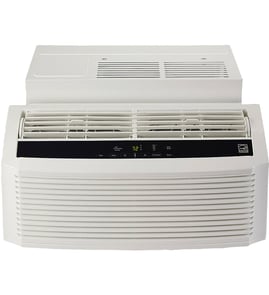



How many square feet will a 18,000 BTU air conditioner cool?
An 18,000 BTU room air conditioner like the GE AHE18DXL1 typically cools about 700 to 1,000 square feet, depending on ceiling height, insulation, sun exposure, and how many people are in the space. For the best match, confirm sizing guidance in the AHE18DXL1 owner's manual.
What changes the real-world coverage?
BTU-to-square-foot charts assume average conditions; your actual cooling area can be smaller or larger.
- Sun exposure: west-facing rooms and lots of glass need more BTUs
- Insulation and air leaks: older windows and poor insulation reduce coverage
- Ceiling height: ceilings above 8 feet increase the load
- Heat sources: kitchens, electronics, and many occupants add heat
- Climate and humidity: hot, humid regions require more capacity
Quick sizing table (typical guidance)
| Room conditions | Typical coverage for 18,000 BTU |
|---|---|
| Shaded, well-insulated, 8 ft ceilings | 900 to 1,000 sq ft |
| Average insulation, mixed sun | 800 to 900 sq ft |
| Hot sun exposure, leaky/older windows, high humidity | 700 to 800 sq ft |
How we recommend you dial it in for your space
Use these steps to avoid an undersized or oversized setup:
- Measure the room (length × width) and total the square footage
- Add capacity if the room has strong afternoon sun or many occupants
- Reduce the estimated coverage if the space is open to hallways or has high ceilings
- Set expectations: when first turned on, the room needs time to cool down
- Keep airflow strong by cleaning or replacing the room air conditioner air filter WJ71X10668
Why it matters
Correct sizing helps the AHE18DXL1 maintain comfort without running constantly. It also supports steadier temperature control and better airflow through the filter and coils.
Last updated: January 2026
What are the most common issues with AHE18DXL1?
For the GE AHE18DXL1 room air conditioner, the most common problems are weak or warm airflow, the unit not turning on, water leaking or poor drainage, and unusual fan noise or vibration. These issues usually trace back to airflow restriction, electrical controls, or drainage setup; use the AHE18DXL1 owner's manual for model-specific checks.
Common symptoms and what they usually point to
- Not cooling or weak airflow: dirty or clogged air filter, blocked coils, fan not running
- Won’t power on: outlet or cord issue, internal control problem, failed capacitor
- Water dripping inside: unit not tilted correctly, drain path blocked, drain valve issue
- Loud buzzing/rattling: loose cover or panel, fan blade rubbing, worn motor bearings
- Short cycling (turns on and off quickly): restricted airflow, sensor issue, control board behavior
Quick checks we recommend first
- Confirm airflow: remove and inspect the filter; clean or replace if loaded with dust.
- Verify settings: set to Cool, lower the set temperature, and use a higher fan speed.
- Check drainage: make sure the unit is slightly tilted to the outside and the drain path is clear.
- Listen to the fan: scraping or ticking often indicates a fan blade or housing contact.
- Power reset: unplug for a few minutes, then restore power and retest.
Parts commonly involved (and why)
| Symptom | Part to inspect | What it does |
|---|---|---|
| Weak airflow, icing, poor cooling | Room air conditioner air filter WJ71X10668 | Keeps dust from restricting airflow across the evaporator coil |
| Dead unit, erratic operation | Room air conditioner electronic control board WJ29X10053 | Manages inputs, temperature control, and operating modes |
| Humming, hard starts | Capacitor WJ20X10207 | Helps the compressor and/or fan motor start and run properly |
| Loud fan noise, no airflow | Room air conditioner fan motor WJ94X20191 | Drives the blower and/or condenser fan |
| Water not draining correctly | Drain valve WJ58X10044 | Routes condensate out of the base as designed |
Why it matters
Airflow and drainage problems can quickly reduce cooling performance and increase icing, noise, and run time. Catching a clogged filter or drainage issue early helps protect the compressor and control components.
Last updated: March 2026
How do I find the model number on my AHE18DXL1?
You’ll find the model number for your GE room air conditioner on the rating label located on the side of the unit. For model AHE18DXL1, the label lists both the model and serial number so you can record them for parts and service.
Where to look on the air conditioner
Check these common spots first:
- The side panel of the air conditioner cabinet (rating label)
- Near the front, behind or beside the front grille area
- Along the outer case where it slides into the window opening
- On a label that includes both “Model” and “Serial” fields
If you need a picture or exact label wording, use the AHE18DXL1 owner’s manual.
How to read and use the label
Once you find the label, copy the information exactly as shown.
| What you’ll see | Why we need it |
|---|---|
| Model number (AHE18DXL1) | Matches the correct diagrams and replacement parts |
| Serial number | Helps identify production details for service and compatibility |
Why it matters
Using the exact model number prevents ordering the wrong GE air conditioner parts (like a control board, fan motor, or air filter) and helps ensure the replacement part fits and functions correctly.
Quick tips before you start
- Unplug the air conditioner before reaching around the cabinet
- Use a flashlight; rating labels are often small print
- Take a clear photo of the label for reference when ordering parts
Last updated: March 2026