Error Codes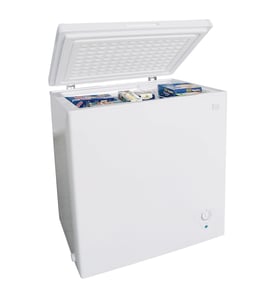

How can I tell what size my chest freezer is?
To tell the size of your Kenmore chest freezer model 2539135311, measure the outside width, depth, and height, then estimate capacity in cubic feet from the interior measurements. For the most accurate “size,” use interior length x width x depth and convert to cubic feet.
What to measure (and where)
Use a tape measure and record measurements in inches.
- Exterior width: left to right across the front
- Exterior depth: front to back (include the lid overhang if it sticks out)
- Exterior height: floor to the top lip or highest point of the lid
- Interior length/width/depth: inside wall to inside wall, and bottom to the underside of the lid
If you are measuring for a tight space, also check clearance for lid swing and airflow.
Convert interior measurements to cubic feet
Chest freezer “size” is usually capacity (cu. ft.), not exterior dimensions.
- Multiply interior length x width x depth (in inches) to get cubic inches.
- Divide by 1,728 to convert to cubic feet.
| What you want | Use these measurements | Why |
|---|---|---|
| Capacity (cu. ft.) | Interior L x W x D | Matches how freezers are marketed |
| Fit in a room | Exterior W x D x H | Ensures it fits the space |
| Door/lid clearance | Exterior + lid swing space | Prevents installation headaches |
Quick tips for accurate results
- Measure to the outermost lip at the top edge if it extends past the cabinet.
- Remove baskets and bulky items before measuring the interior.
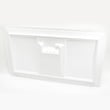
- If the freezer is not cooling well, heavy frost can reduce usable space; check the frost indicator 216140400 if your model uses it to help you monitor frost buildup.
Why it matters
Knowing both the exterior dimensions and the interior cubic feet helps you buy the right replacement chest freezer, plan a move, order a cover, or confirm storage capacity for bulk food.
Last updated: January 2026
What are the common chest freezer problems?
Common problems with the Kenmore 2539135311 chest freezer include not freezing or freezing too much, heavy frost buildup, long run times, water on the floor, and unusual noises. Most issues trace back to airflow restrictions, a lid seal leak, dirty condenser areas, or a failing temperature control.
Most common symptoms and what they usually mean
- Too warm: lid not sealing, warm food load, poor airflow, or a weak cooling system
- Too cold or items freezing solid: temperature control set too cold or failing
- Heavy frost: lid opened often, humid room air leaking past the gasket, or lid not closing fully
- Runs constantly: warm room, overpacked cabinet, dirty condenser area, or control issue
- Water on floor: defrost meltwater during manual defrost, or a poor lid seal causing excess frost and melt
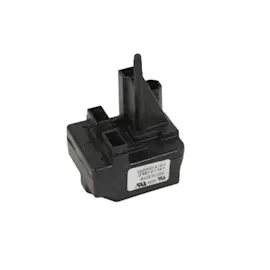
- Clicking/buzzing: relay/start issues, compressor strain, or vibration against a wall
Quick checks we recommend first (no parts needed)
- Confirm the freezer is on a dedicated outlet and the cord fits tightly.
- Set the control to a mid setting and allow 24 hours to stabilize.
- Make sure packages are not blocking the lid from closing.
- Leave space around stored food so cold air can circulate.
- Vacuum dust from the condenser area (if accessible) and keep clearance around the cabinet.
Parts that commonly solve these problems on model 2539135311
| Symptom | Likely part to check | What it affects |
|---|---|---|
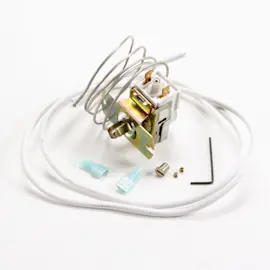
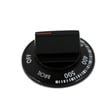
| Too warm or too cold | Chest freezer temperature control 5304496560 | Senses temperature and cycles the compressor |
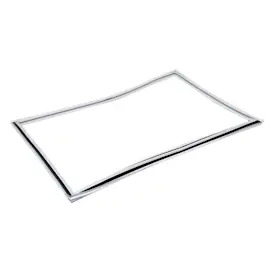
| Heavy frost, warm spots | Lid gasket (white) 216481211 | Prevents humid air leaks at the lid |
| Lid will not stay shut | Latch (almond) 5303209634 | Helps the lid close tightly |
| Poor cooling after sealed-system work | Filter 5303305677 | Helps keep the refrigerant system clean and dry |
Why it matters
Chest freezers are designed to hold steady temperatures for long periods. Small issues like a lid seal leak or a drifting thermostat can cause big swings in temperature, higher energy use, and faster frost buildup.
Last updated: January 2026
What is the average life of a chest freezer?
A Kenmore chest freezer like model 2539135311 typically lasts 12 to 16 years, and 10 to 20 years is common with normal use. Chest freezers often outlast uprights because cold air stays in better when the lid is opened.
What affects lifespan most
- Room temperature and ventilation: hot garages and tight spaces make the compressor work harder.
- Lid seal condition: a leaking gasket causes long run times and frost buildup.
- Temperature setting: running colder than needed increases wear.
- Cleaning and airflow: dust and pet hair reduce heat transfer.
- Power quality: frequent outages or low voltage can stress the start components.
Quick maintenance checklist (best ROI)
- Keep the freezer reasonably full (cold mass helps stabilize temperature).
- Defrost when frost gets to about 1/4 inch thick.
- Clean around the cabinet and keep vents clear.
- Confirm the lid closes squarely and latches securely.
- If temperatures swing, test or replace the chest freezer temperature control 5304496560.
Common “end-of-life” symptoms vs. fixable issues
| Symptom | Often fixable? | What to check first |
|---|---|---|
| Runs constantly, warm inside | Sometimes | Lid seal, airflow, temperature control |
| Heavy frost buildup | Yes | Lid gasket fit, lid alignment |
| No power, intermittent power | Yes | Outlet, cord, wiring connections |
| Loud clicking, won’t start | Sometimes | Start components, power supply |
Why it matters
A chest freezer that runs longer than normal uses more electricity and can shorten compressor life. Simple steps like keeping the lid seal tight and using a stable temperature setting protect food and extend the service life.
Last updated: January 2026