 Owner’s manual






What size is the wfw8300sw05?
The Whirlpool WFW8300SW05 is a 27-inch wide front-load washer. The exact depth and height can vary by installation (for example, leveling feet position and required clearances), so we recommend confirming the full footprint in the WFW8300SW05 washer manual.
What “size” usually means for this model
Most customers mean one (or more) of these:
- Width: 27 inches (cabinet width)
- Capacity: often listed in cubic feet (varies by model series and marketing materials)
- Installed space needed: washer dimensions plus clearance for door swing, ventilation, and hookups
- Stacked or pedestal height: changes overall height and required space
Installation clearances to plan for
Your WFW8300SW05 needs room to operate and to be serviced. Plan for:
- Space for the door to open fully
- Clearance around the cabinet to help reduce noise and vibration transfer
- Room behind the washer for fill hoses and the drain hose
- A drain setup that matches your home (standpipe, laundry tub, or floor drain)
Quick sizing checklist
Use this checklist before you measure your laundry area:
- Measure the opening width (side-to-side)
- Measure depth to the back wall, including hose space
- Measure height to shelves or cabinets above
- Confirm the standpipe height and drain location
- Confirm the outlet is a grounded 3-prong receptacle
Common “size” specs at a glance
| Spec type | What to verify | Where to confirm |
|---|---|---|
| Cabinet width | 27 inches | WFW8300SW05 washer manual |
| Installed footprint | Width, depth, height plus clearances | WFW8300SW05 washer manual |
| Capacity | Cubic feet rating | Model tag and WFW8300SW05 washer manual |
Why it matters
Getting the size right helps prevent installation problems like a door that cannot open fully, kinked hoses, poor draining, and excess vibration during high-speed spin.
Last updated: January 2026
What is the most common problem with Whirlpool washers?
On the Whirlpool WFW8300SW05 washer, the most common issue we see is a “won’t start” situation where the control panel lights up but the cycle will not begin. This is often tied to the Start control input, door-lock sensing, or power supply conditions described in the WFW8300SW05 washer manual.
Quick checks that solve many “won’t start” calls
- Confirm the washer is plugged into a grounded 3-prong outlet (no extension cord).
- Make sure the door is fully closed until you hear the lock click.
- Press and hold START for about 1 second (a quick tap may not start the cycle).
- If Control Locked is on, press and hold End of Cycle Signal for 3 seconds to unlock.
- Cancel and restart: press PAUSE/CANCEL once, reselect the cycle, then hold START.
- If the washer shut itself off, reselect POWER and start again (auto shutoff can occur after inactivity).
Parts that commonly relate to this symptom on WFW8300SW05
If the door is closed but the washer still will not start, these model-compatible parts are common suspects:
- Washer interlock switch WPW10085220 (door lock and safety interlock function)
- Electronic control WPW10525351 (main control board that processes Start and cycle logic)
- Washer wire harness WPW10201879 (wiring connections between controls and components)
Symptom-to-cause guide (fast triage)
| What you notice | Most likely area to check | What to do first |
|---|---|---|
| Lights on, nothing happens when you press Start | Control lock, Start input, control board | Unlock controls; then power-cycle and retry |
| Door won’t lock or unlocks immediately | Door lock/interlock system | Inspect latch area; consider interlock switch |
| Starts then stops mid-cycle | Control sensing, wiring, load issues | Cancel, rebalance load, retry cycle |
Why it matters
A washer that powers up but will not start is usually a safety or control decision (door lock, control lock, or control board logic). Checking the simple settings first can prevent unnecessary part replacement and downtime.
Last updated: January 2026
What is the difference between 4.5 cu ft and 5.0 cu ft washer?
A 5.0 cu. ft. washer has about 0.5 cu. ft. more drum volume than a 4.5 cu. ft. washer, so it fits bulkier loads and can reduce the number of loads you run. Your Whirlpool WFW8300SW05 is a smaller-capacity front-load design than either size; use the loading guidance in the WFW8300SW05 washer manual to avoid overpacking.
What the size difference means
That extra 0.5 cu. ft. is roughly an 11% increase in tub volume, which mainly helps with bulky items and larger mixed loads.
- More room for comforters, blankets, and large towel loads
- Better tumbling space when you do big loads (less “packed tight”)
- Potentially fewer loads per week for families
- Slightly higher water and energy use per cycle if you routinely fill it
- More important to avoid overloading so the washer can balance and spin properly
Quick comparison
| Item | 4.5 cu. ft. | 5.0 cu. ft. |
|---|---|---|
| Drum volume difference | Baseline | +0.5 cu. ft. |
| Relative capacity | Baseline | ~11% larger |
| Best fit | Average loads | Bulkier, larger loads |
How this relates to WFW8300SW05
Whirlpool model numbers do not reliably indicate tub size by themselves, and the WFW8300SW05 is not in the 4.5 to 5.0 cu. ft. class. For best performance on this model:
- Load the drum full but not tightly packed
- Mix large and small items for better balance
- Avoid washing a single heavy item by itself
- Use HE detergent as directed
Why it matters
Capacity affects cleaning and spin performance: when a washer is packed too tightly, items cannot tumble freely, rinsing suffers, and the machine may struggle to balance at high spin speeds.
Last updated: January 2026
Does a Whirlpool front load washer have a filter to clean?
For Whirlpool model WFW8300SW05, the user care information in the WFW8300SW05 washer manual does not identify a routine, user-accessible “pump filter” or “coin trap” cleaning step. You can still prevent most drain and odor issues by cleaning the door seal area, running the Clean Washer cycle, and keeping the drain path clear.
What you can clean and check on WFW8300SW05
These are the maintenance items the manual supports and that help with slow draining, residue, and odors:
- Run the Clean Washer cycle monthly (empty drum)
- Wipe the door boot and the area under the rubber rim after loads
- Use only HE detergent and avoid over-dosing
- Check the drain hose for kinks, crushing, or improper standpipe height
- Inspect inlet hose screens if fill is slow (not a drain filter, but common maintenance)
If you suspect a drain restriction
If the washer won’t drain, drains slowly, or makes a rattling/grinding sound during draining, debris may be in the pump or hoses. On this model, that typically becomes a repair access task rather than a normal user-cleaning step.
| Symptom | Most likely area | What we recommend first |
|---|---|---|
| Standing water after cycle | Drain pump or drain hose | Check hose routing, then consider pump inspection |
| Rattling during drain | Pump impeller area | Plan for pump inspection/cleanout |
| Odor or residue | Door boot, tub | Clean boot, run Clean Washer cycle |
Parts that may be involved (when it’s a repair)
If troubleshooting points to the drain system, these model-compatible parts are commonly involved:
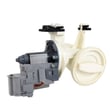
- Washer drain pump assembly WPW10730972 (moves water out of the tub)
- Drain hose and clamps (if leaking or restricted)
Why it matters
Front-load washers can trap lint and small items around the door seal and in the drain path. Regular tub and door-boot cleaning helps prevent odors and reduces the chance of drain problems that can strain the pump.
Last updated: January 2026



