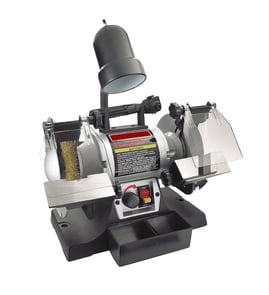

What is the maximum clearance that the tool rest should be on a bench grinder?
For a Craftsman bench grinder model 152211080, set the tool rest so the gap to the grinding wheel is no more than 1/8 inch (0.125 in). Keeping this clearance tight helps prevent the workpiece from getting pulled into the wheel area.
Recommended tool rest clearance
- Maximum gap: 1/8 inch
- Best practice: adjust as the wheel wears down
- Check often: before each use and after changing wheels
- Keep it rigid: the rest should not flex or shift under pressure
How to set the clearance safely
- Unplug the bench grinder before adjusting the tool rest.
- Rotate the wheel by hand to confirm it clears the rest without rubbing.
- Adjust the rest to within 1/8 inch of the wheel face.
- Tighten all fasteners firmly so the rest stays locked.
- Recheck the gap after tightening (it can change slightly).
Quick reference table
| Item to check | Target setting | What to watch for |
|---|---|---|
| Tool rest to wheel gap | 1/8 in max | Workpiece can wedge if gap is larger |
| Tool rest stability | Rigid, no movement | Vibration, slipping, or shifting |
| Recheck frequency | Often | Wheel wear increases the gap |
Why it matters
A tool rest set too far from the wheel increases the chance that a small part, edge, or corner can catch and jam. Keeping the rest within 1/8 inch supports the work properly and improves control during grinding.
Related DIY help: are diy appliance repairs safe
Last updated: February 2026
What are the 4 important rules for a bench grinder?
For a Craftsman bench grinder like model 152211080, the four most important rules are: wear proper eye/face protection, keep guards and tool rests correctly adjusted, use only wheels rated for the grinder’s speed, and keep hands, clothing, and hair safely controlled while grinding.
The 4 rules (with what to do)
- Protect your eyes and face: Wear safety glasses plus a face shield; grinding wheels can throw sparks and debris.
- Set the guards and tool rests before you start: Keep the tool rest close to the wheel (commonly about 1/8 inch) and keep the spark guard close as well; re-adjust as the wheel wears.
- Match wheel speed to grinder speed: Only install a grinding wheel whose RPM rating meets or exceeds the grinder’s no-load RPM.
- Control what can get pulled in: No loose sleeves, gloves near rotating parts, jewelry, or dangling cords; tie back long hair and keep a stable stance.
Quick safety checklist before each use
- Inspect the wheel for chips or cracks; replace damaged wheels.
- Confirm the wheel is seated and tightened correctly (do not overtighten).
- Stand to one side at startup and let the grinder reach full speed.
- Grind on the face of the wheel unless the wheel is specifically rated for side grinding.
- Use light pressure; forcing the work can overheat the wheel and the motor.
Common setup targets (typical)
| Item to adjust | Typical target | Why it matters |
|---|---|---|
| Tool rest gap | ~1/8 in. | Reduces the chance the workpiece wedges between rest and wheel |
| Spark guard gap | Close to wheel | Helps contain sparks and debris |
| Wheel RPM rating | ≥ grinder RPM | Prevents wheel overspeed failure |
Why it matters
Most bench grinder injuries come from wheel damage, poor rest/guard adjustment, or entanglement. Following these four rules reduces kickback, binding, and the risk of wheel failure.
For more DIY safety context before working on tools or wiring, see are diy appliance repairs safe.
Last updated: February 2026
What is a Craftsman bench grinder?
A Craftsman bench grinder (including model 152211080) is a stationary power tool with one or two abrasive wheels that we use to grind, shape, deburr, and sharpen metal. It mounts to a workbench for stability and is common in home garages and workshops.
What it’s used for
A bench grinder is built for controlled material removal and edge maintenance on metal tools and parts.
- Sharpening chisels, lawn mower blades, and other cutting edges
- Removing rust, paint, or burrs from metal
- Shaping small metal parts (light stock removal)
- Smoothing welds and rough edges
- Polishing with the correct wheel or buffing accessory
Key parts and features you’ll typically see
Most Craftsman bench grinders share a similar layout, even when exact specs vary by model.
| Feature | What it does | Why you care |
|---|---|---|
| Grinding wheels | Abrade metal to sharpen or shape | Wheel type and grit affect finish and speed |
| Tool rests | Support the workpiece near the wheel | Helps control angle for sharpening |
| Eye shields/spark guards | Deflect debris and sparks | Reduces risk of injury and mess |
| Motor and arbor | Spins the wheels at a fixed speed | Power and speed affect performance |
Safe, practical operating tips
- Bolt the grinder securely to a solid bench before use.
- Keep the tool rest close to the wheel (a small gap) so workpieces do not get pulled in.
- Let the wheel reach full speed before grinding.
- Use light pressure; overheating can damage tool temper and glaze the wheel.
- Stand slightly to one side at startup in case a wheel is damaged.
Why it matters
Knowing what a bench grinder is designed to do helps you choose the right wheel, set the tool rest correctly, and avoid common issues like overheating, chatter, and uneven sharpening.
For general DIY safety guidance before working on power tools, use our are diy appliance repairs safe resource.
Last updated: February 2026
Can I use a bench grinder as a polisher?
Yes. You can use your Craftsman 152211080 bench grinder as a polisher by swapping the grinding wheel for a buffing wheel and using the right compound; keep speeds, pressure, and workholding safe to avoid grabbing and kickback.
What you need to convert it to polishing
- Buffing wheel sized for your grinder (cotton or sisal, depending on cut and finish)
- Correct arbor hole size and any required bushings or adapters
- Buffing compound (cutting compound for initial shine; finishing compound for final gloss)
- Eye protection and a dust mask; polishing throws lint and compound
- A stable work surface and solid mounting (bench grinders must not walk)
Setup and technique that works best
- Unplug the grinder before changing wheels.
- Install the buffing wheel and confirm it spins true without wobble.
- Stand slightly to one side at startup; let it reach full speed.
- Use light pressure; let the compound and wheel do the work.
- Hold the workpiece below the wheel centerline so it is less likely to be pulled upward.
Speed, wheel, and compound quick guide
| Task | Wheel type | Compound type | Pressure |
|---|---|---|---|
| Remove light oxidation | Sisal or firm cotton | Cutting | Light to moderate |
| Brighten and refine | Medium cotton | General polish | Light |
| Final mirror finish | Loose cotton/flannel | Finishing | Very light |
Common problems and fixes
- Part gets yanked from your hands: reduce pressure, keep the part below centerline, use better grip or a holding jig.
- Streaks or haze: use less compound, switch to a cleaner wheel, finish with a finer compound.
- Wheel loads up (caked compound): rake/clean the wheel and reapply compound lightly.
Why it matters
A bench grinder like the Craftsman 152211080 has plenty of torque; that makes polishing fast, but it also makes it easier for the wheel to grab edges. The right wheel, compound, and light technique give a better finish and reduce the chance of damage to the part.
For general DIY safety practices before starting, review are diy appliance repairs safe.
Last updated: February 2026
How to restore a bench grinder?
Restoring a Craftsman bench grinder like model 152211080 means making it safe first, then cleaning, inspecting wear parts (wheels, bearings, cord, switch), and finally reassembling and testing. Most “restoration” time is spent on inspection and setup so the grinder runs smooth and guards are correctly positioned.
Safety first (before any teardown)
- Unplug the grinder and remove the wheels before deep cleaning or paint work.
- Wear eye protection and a dust mask; old grinding dust and rust are hazardous.
- Do not run cracked, dropped, or out-of-round grinding wheels.
- Keep guards and tool rests installed; they are part of safe operation.
- If wiring insulation is brittle or nicked, replace the cord before testing.
Step-by-step restoration checklist
- Document and disassemble: Take photos of spacers, flanges, guards, and tool rests so reassembly is correct.
- Degrease and de-rust: Clean the housing, guards, and hardware; remove rust from bare metal parts.
- Inspect mechanicals: Spin the shaft by hand; it should turn freely with no grinding feel. Check for shaft play that suggests worn bearings.
- Inspect electricals: Check the power cord, strain relief, switch, and internal connections for heat damage or loose terminals.
- Repaint (optional): Prime and paint only after parts are clean and dry; keep paint out of bearing areas and threads.
- Reassemble and set up: Install wheels with correct flanges, set tool rests close to the wheel, and align spark guards.
Quick “replace vs restore” guide
| What you find | What it usually means | Best next step |
|---|---|---|
| Wheel has cracks or chips | Unsafe wheel | Replace wheel before any testing |
| Strong vibration | Wheel imbalance, bent shaft, worn bearings | Dress/balance wheel; inspect bearings |
| Motor hums but won’t start | Bad capacitor (if equipped), stuck bearings, switch issue | Check shaft free-spin; test electrical parts |
| Cord is stiff or cracked | Aging insulation | Replace cord and strain relief |
Why it matters
A bench grinder can look “restored” but still be unsafe if the grinding wheel, tool rest gap, or wiring is wrong. A careful inspection and correct setup prevents wheel failure, kickback, and overheating.
Helpful DIY references
- Use a meter to confirm power and switch continuity: how to use a multimeter to test electrical parts video
- If you find damaged leads during teardown: how to repair broken or damaged wires video
- If the grinder seems dead, check protection devices: how to tell if a fuse is blown
Last updated: February 2026