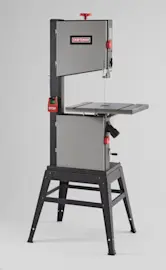
Owner’s manual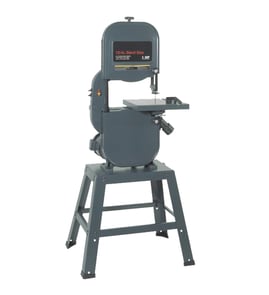

How do I know the size of my bandsaw blade?
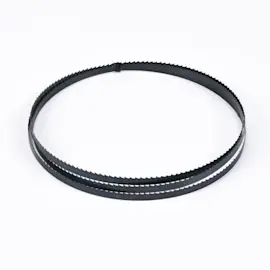
For the Craftsman 137214130 band saw, blade size means length, width, and tooth count (TPI). Your manual lists a blade length of 59 to 59-1/2 inches and commonly used blade widths 1/8 inch to 3/8 inch (with blade selection guidance for different cuts). See the owner's manual for the exact blade specs and setup notes.
Blade size specs for Craftsman 137214130
Use these as your starting point when buying or matching a replacement blade:
- Blade length: 59 to 59-1/2 inches
- Blade width (common range): 1/8 inch to 3/8 inch
- Blade speed rating: use blades rated 2480 FPM or greater
- Tooth direction: teeth must point down and toward the table
How to measure your current blade (length, width, and TPI)
If you already have a blade and want to confirm what it is:
- Length: with the saw unplugged, remove the blade, coil it safely, then measure around the full loop (mark the weld or a tooth as your start point).
- Width: measure from the tooth tip to the back edge of the blade.
- TPI (teeth per inch): count the number of teeth in 1 inch; common blades are labeled (for example, 6 TPI, 10 TPI).
- Thickness: most woodworking band saw blades are thin; match the old blade thickness when possible for proper tracking.
Choosing blade width by the type of cut
Wider blades track straighter; narrower blades turn tighter. The manual also notes that tight circle cutting depends on blade width.
| What you are doing | Typical blade width to use | Why it helps |
|---|---|---|
| Straight cuts, general cutting | 3/8 inch | Better tracking, less wandering |
| Curves and tighter turns | 1/8 inch to 1/4 inch | Smaller turning radius |
| Mixed work (general shop use) | 1/4 inch | Good balance of control and stiffness |
Why it matters
Using the correct blade length and width helps the blade tension correctly, track in the center of the wheels, and reduces common problems like blade breakage, rough cuts, and excessive drift.
Last updated: February 2026
What are the parts of a bandsaw?
A band saw is built around a continuous blade running on two wheels, guided and tensioned so it cuts accurately. On the Craftsman 137214130 band saw, key assemblies include the upper and lower blade wheels, blade guides, work table, blade guard, and the blade tension and tracking controls (see the owner's manual).
Main parts you will see on the Craftsman 137214130
- Blade: The continuous band that does the cutting.
- Upper blade wheel and lower blade wheel: Support and drive the blade around the saw.
- Blade guides and support bearings: Keep the blade from twisting during operation.
- Blade tension knob: Sets blade tension for stable tracking and straighter cuts.
- Blade tracking knob: Centers the blade on the wheels.
- Work table (with table insert): Supports the workpiece; the insert surrounds the blade slot.
- Blade guard and upper guide assembly: Helps protect you and positions the guides close to the work.
Quick “what it does” reference
| Part/assembly | What it does | When you adjust or check it |
|---|---|---|
| Blade tension knob | Tightens/loosens blade | Blade changes; blade slipping or flutter |
| Blade tracking knob | Centers blade on wheels | Blade wandering; after blade change |
| Blade guides | Supports blade, reduces twist | After blade change; poor cut quality |
| Table lock/tilt scale | Holds table angle for bevel cuts | Bevel cutting; table won’t stay square |
Why these parts matter
These components work together to keep the blade running true. Correct tension, tracking, and guide adjustment reduce blade breakage, improve cut accuracy (ripping, crosscutting, resawing), and help prevent the blade from twisting in curves.
Practical tips for safe, clean cuts
- Keep the upper guide assembly close to the work (about 1/8 inch above the workpiece).
- Use light, steady feed pressure; forcing the cut overheats the blade.
- For tighter curves, use a narrower blade; for smoother cuts, use a blade suited to the material.
- Turn the wheels by hand after setup to confirm the blade and guards move freely.
- Use dust collection at the sawdust port when possible to keep the cabinet and guides cleaner.
Last updated: February 2026
What is the 3-tooth rule for bandsaws?
The 3-tooth rule means you should choose a band saw blade so at least three teeth are in the cut at all times. On a Craftsman band saw model 137214130, this helps prevent tooth breakage and rough cutting by keeping the blade supported and clearing sawdust (chips) efficiently; see the blade and cutting guidance in the 137214130 owner's manual.
How to apply the 3-tooth rule (quick steps)
- Measure your material thickness (the direction the blade teeth pass through).
- Pick a blade TPI (teeth per inch) so 3 or more teeth contact the material.
- If you hear “clunking,” see tooth snagging, or the cut chatters, move to a finer TPI.
- If the blade burns, loads up with sawdust, or wanders, move to a coarser TPI (or improve dust removal).
- Set the upper blade guide and guard about 1/8 inch above the workpiece for better control.
- Use light, steady feed pressure; do not force the workpiece into the blade.
Simple TPI selection guide
Use this as a practical starting point; exact blade choice depends on wood species, cut type (ripping, resawing, curves), and finish expectations.
| Material thickness | Good starting TPI range | Why it works |
|---|---|---|
| 1/8 to 1/4 inch | 14 to 24 TPI | Keeps enough teeth engaged in thin stock |
| 1/4 to 3/4 inch | 6 to 14 TPI | Balanced chip clearance and cut quality |
| 3/4 to 2 inches | 3 to 6 TPI | Larger gullets clear sawdust in thicker cuts |
Why the rule matters
- Too few teeth in the cut: teeth can hook and strip, and the blade can grab the work.
- Too many teeth in the cut: gullets pack with sawdust, causing heat, drift, and slow cutting.
Safety and setup reminders for this Craftsman band saw
- Confirm the blade teeth point down and toward the table.
- Adjust blade guides, support bearings, and blade tension to reduce blade breakage.
- Turn the wheels by hand after adjustments to ensure the blade tracks correctly before powering on.
- Never cut ferrous metals with this band saw.
Last updated: February 2026
What is the specs of the Craftsman 12 inch bandsaw 137214130?
The Craftsman band saw model 137214130 is a 9-inch band saw (not a 12-inch model). From the model’s documentation, it uses a 59-1/4 inch x 1/4 inch blade and has 9-inch wheels; additional capacity and motor specs are listed in the 137214130 owner's manual.
Key specs we can confirm for Craftsman 137214130
- Band saw size class: 9-inch
- Wheel size: 9-inch (upper and lower wheels)
- Blade size listed: 59-1/4 inch x 1/4 inch
- Replacement parts are ordered by I.D. number in the parts list (example: blade I.D. X08P)
- Electrical servicing note: electrical-part repairs should be handled by a qualified service technician (per the manual)
12-inch vs 9-inch: why the model number matters
Many Craftsman band saws look similar, but the cutting capacity, blade length, and wheel size change by model. Here is a quick way to separate them:
| Item | Model 137214130 (this model) | Typical 12-inch band saw |
|---|---|---|
| Size class | 9-inch | 12-inch |
| Blade length | 59-1/4 inch (listed) | Often longer (varies by model) |
| Wheels | 9-inch | Often 12-inch class wheels |
Where to find the rest of the specifications
For the full spec list (cutting capacity, table size/tilt, motor rating, electrical requirements, and adjustments), use these sections in the 137214130 owner's manual:
- Assembly and adjustments (setup, tracking, guide adjustments)
- Operation (recommended use and safe cutting practices)
- Maintenance (blade, tires, bearings, belt checks)
- Troubleshooting guide (symptoms like slow cutting or motor overload)
Why it matters
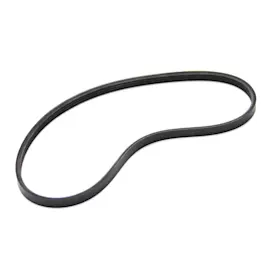
Using the correct specs prevents buying the wrong blade length, setting incorrect blade tension, or overloading the motor. Matching the blade size and setup procedure to model 137214130 also improves cut accuracy and reduces premature wear on tires, bearings, and the drive belt.
Last updated: February 2026