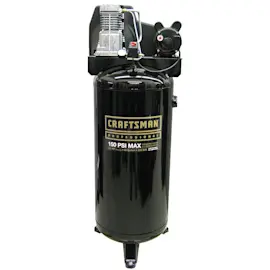
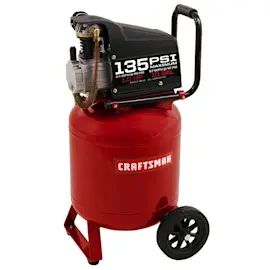
Owner’s manual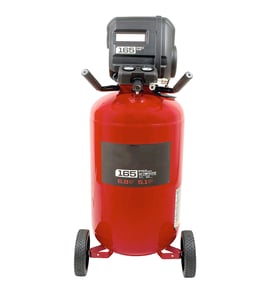

Is a 20 gallon air compressor big enough for air tools?
Yes, a 20-gallon compressor can be big enough for many air tools, as long as the tool’s air demand stays within the compressor’s SCFM output. For the Craftsman 16957, it’s designed for tools requiring less than 4.3 SCFM @ 90 PSI (and 6.1 SCFM @ 40 PSI), which fits many DIY and intermittent-use tools.
How to tell if your air tool will run well
Check the tool’s label or its manual for SCFM at 90 PSI (or at the tool’s rated pressure), then compare it to the compressor’s rating.
- If the tool’s SCFM is below 4.3 SCFM @ 90 PSI, it should run normally.
- If the tool’s SCFM is near 4.3 SCFM @ 90 PSI, expect more frequent cycling and occasional pauses.
- If the tool’s SCFM is above 4.3 SCFM @ 90 PSI, the tank pressure will drop and the compressor may run continuously.
- Remember the duty cycle: this model is rated 50% (5 minutes ON / 5 minutes OFF).
Quick fit guide (Craftsman 16957)
| Tool type | Typical air demand | How a 20-gallon tank usually performs |
|---|---|---|
| Brad/finish nailer, stapler | Low | Runs well |
| Tire inflator, blow gun | Low | Runs well |
| Impact wrench (DIY use) | Medium | Works with pauses |
| Die grinder, sander | High | Often struggles (continuous demand) |
| HVLP/paint spraying | Medium to high | Often inconsistent unless demand is low |
Setup tips that improve performance
- Set the regulator to the minimum pressure needed for the job; higher pressure drains the tank faster.
- Use the right hose and fittings; leaks and restrictions reduce usable airflow.
- Drain the tank after use to reduce moisture issues and keep performance consistent.
- Always switch OFF and bring outlet pressure to zero before changing tools.
Why it matters
Tank size (20 gallons) helps buffer short bursts, but SCFM output and duty cycle determine whether a tool can run continuously without pressure drop or overheating.
For operating limits, safety rules, and the full specifications for this compressor, use the owner's manual. For parts and model lookups, search by model 16957 on Sears PartsDirect.
Last updated: February 2026
What is the average lifespan of an air compressor?
Most homeowner-grade air compressors last 8 to 12 years with normal use and basic maintenance. For the Craftsman 16957, you can extend service life by following the operating limits and electrical guidance in the 16957 owner's manual and avoiding heat buildup from long run times.
Typical lifespan by compressor type
Air compressor life depends most on pump design, duty cycle, and maintenance.
| Compressor type | Typical lifespan | What usually ends it first |
|---|---|---|
| Oil-free portable (like Craftsman 16957) | 8 to 12 years | Pump wear, overheating, valve wear |
| Oil-lubricated portable | 10 to 15 years | Poor oil maintenance, contamination |
| Shop/industrial (rotary screw) | 15 to 20 years | Run hours, heat, missed service intervals |
What matters most for Craftsman 16957 longevity
These practices reduce motor heat, short-cycling, and premature pump wear:
- Use a proper grounded 120 V outlet and keep connections tight.
- Avoid long extension cords; use a longer air hose instead to reduce voltage drop.
- Let the unit cool between long runs to prevent overheating.
- Drain tank moisture regularly to reduce internal corrosion and water carryover.
- Fix air leaks quickly so the compressor does not run longer than necessary.
Replace vs. repair: quick decision guide
Common symptoms help you decide whether to troubleshoot or plan for replacement.
- Runs but won’t build tank pressure: often leaks, check valve issues, or pump/valve wear.
- Won’t start: commonly power supply, cord, pressure switch, or motor issues.
- Rapid cycling: usually a leak, regulator problem, or check valve problem.
- Tank won’t hold air: fittings, drain valve, or tank condition.
For step-by-step troubleshooting, use our DIY symptom help: air compressor won't start.
Why it matters
Most compressors “wear out early” from heat, moisture, and running harder than necessary. Good power supply practices, leak control, and routine draining protect the motor, pressure switch, and pump so the compressor maintains usable pressure and airflow longer.
If you need to look up diagrams or replacement items, start with the model parts list, or search by model number on Sears PartsDirect.
Last updated: February 2026
What is the most common cause of air compressor failure?
On the Craftsman 16957, the most common cause of air compressor failure is overheating and accelerated wear caused by poor maintenance and poor operating conditions. Low supply voltage, long or undersized extension cords, and restricted ventilation make the motor run hot and trip the thermal overload.
Most common causes (and what to do)
- Low voltage at the outlet: use a dedicated 120V, 60 Hz AC circuit when possible.
- Extension cord problems: use a longer air hose instead of a long cord; if you must use a cord, keep it short and correctly sized.
- Poor ventilation or high ambient temperature: keep the pump and motor area clear so heat can escape.
- Moisture left in the tank: drain condensation regularly to reduce internal rust and valve problems.
- Air leaks: leaks increase run time, which increases heat and wear.
Quick checks before you call it “failed”
- Unplug the compressor and let it cool for 30 minutes after a thermal overload trip.
- Confirm the ON/OFF switch is ON and the outlet is supplying steady power.
- Remove the extension cord and test again.
- Check that the tank is not already at cut-out pressure (it will not run when the tank is full).
- Drain the tank so water is not contributing to corrosion or sticking valves.
Symptom-to-cause guide
| Symptom | Likely cause | Next step |
|---|---|---|
| Won’t start | Low voltage, breaker/fuse issue, thermal overload | Verify power, cool/reset, correct cord use |
| Shuts off repeatedly | Overheating, poor ventilation | Improve airflow, reduce run time |
| Runs but won’t build pressure | Leak, intake restriction, pump/valve wear | Check for leaks, then diagnose pump |
Why it matters
Heat and moisture shorten compressor life fastest. Fixing power and airflow issues prevents repeated thermal overload trips; draining the tank prevents rust that leads to leaks and valve trouble.
For model-specific maintenance and thermal overload reset steps, use the 16957 owner's manual. For step-by-step troubleshooting by symptom, see air compressor won't start. To find replacement parts by model number, search on Sears PartsDirect.
Last updated: February 2026
What does 4.0 SCFM at 90 PSI mean?
“4.0 SCFM at 90 PSI” means an air compressor can deliver 4.0 standard cubic feet of air per minute while the outlet is regulated to 90 PSI. For the Craftsman 16957, our owner's manual lists 4.3 SCFM @ 90 PSI, which you use to match the compressor to air tools.
How to use SCFM @ 90 PSI to size air tools
Match the tool’s air demand to the compressor’s delivered airflow at the same pressure.
- Find the tool rating listed as SCFM (or CFM) @ 90 PSI
- Choose a compressor rated at or above that SCFM at 90 PSI
- Add capacity for continuous-use tools; 10% to 25% extra SCFM prevents pressure drop
- Keep hose runs short and use full-flow fittings; restrictions reduce delivered SCFM
- Set the regulator to the tool’s required PSI; tank PSI and outlet PSI are different
What “standard” means in SCFM
SCFM is a standardized airflow number so you can compare compressors more fairly.
| Term | What it tells you |
|---|---|
| PSI | Air pressure available to the tool (force) |
| SCFM | Air volume the compressor can supply (flow) |
| “@ 90 PSI” | Flow measured while maintaining 90 PSI at the rated point |
Craftsman 16957 specs that relate to this rating
These model-specific numbers explain how the compressor behaves while supplying air.
| Spec (Craftsman 16957) | Value |
|---|---|
| Air delivery | 4.3 SCFM @ 90 PSI; 6.1 SCFM @ 40 PSI |
| Max tank pressure (cut-off) | 155 PSI max (155 ± 5 PSI) |
| Cut-in pressure | 125 ± 5 PSI |
| Duty cycle | 50% (5 minutes ON, 5 minutes OFF) |
Why it matters
If a tool needs more SCFM at 90 PSI than the compressor can deliver, pressure drops quickly, the motor cycles more, and the tool loses power or runs inconsistently.
For repair and troubleshooting help, we use these same airflow and pressure concepts in guides like air compressor won't build tank pressure and air compressor won't start. You can also find parts by model number on the Craftsman 16957 parts list, or search more broadly on Sears PartsDirect.
Last updated: February 2026