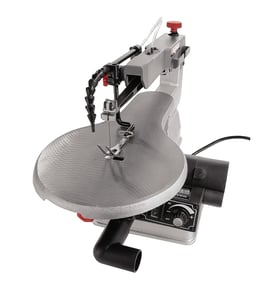

Should I get pinless or pinned scroll saw blades?
For the Dremel 571-5 scroll saw, we recommend pinless (plain-end) blades for most projects because they give you the cleanest control for tight turns and detailed cuts. Choose pinned blades only when your saw’s blade clamps are designed for pins or when you’re doing simple, thicker cuts.
Quick comparison
| Blade type | Best for | Typical tradeoff |
|---|---|---|
| Pinless (plain-end) | Fretwork, puzzles, fine inside cuts, tight curves | Takes a little more time to clamp and tension correctly |
| Pinned | Basic cuts, thicker stock, faster blade changes on older designs | Larger ends limit very small inside cuts and tight radiuses |
How to choose for your work
- Pick pinless if you cut intricate patterns, lettering, ornaments, or need small inside cutouts.
- Pick pinned if you mainly do straight or gentle curves in thicker wood and want quick blade swaps.
- Match the blade to the material: finer teeth for thin wood and plastics; coarser teeth for thicker wood.
- If you plan to do inside cuts, pinless blades are easier to thread through smaller starter holes.
- Keep multiple blade sizes on hand; most scroll saw results improve more from correct blade selection than from speed changes.
Setup tips that matter (either blade type)
- Tension: Increase tension until the blade “pings” when plucked; under-tension causes wandering and burning.
- Feed rate: Let the teeth cut; forcing the work overheats the blade and roughens the edge.
- Downstroke direction: Make sure the teeth point down toward the table so the work stays planted.
- Table support: Use a zero-clearance insert (or a tight-fitting auxiliary surface) to reduce tear-out on delicate cuts.
Why it matters
Blade style affects what your Dremel 571-5 can do cleanly. Pinless blades open up finer detail, tighter turns, and cleaner inside cuts, while pinned blades prioritize convenience for simpler work.
For general DIY safety and best practices before servicing or adjusting your tool, review are diy appliance repairs safe.
Last updated: February 2026
What do the numbers mean on scroll saw blades?
The numbers on scroll saw blades generally describe the blade size and aggressiveness: lower numbers are finer for thin material and tight, detailed cuts; higher numbers are larger and cut faster but leave a rougher kerf. This applies well to Dremel model 571-5 scroll saw setups.
Quick guide to blade numbers
In most scroll saw blade systems, the number increases as the blade gets bigger (and usually more aggressive).
- Lower numbers (smaller blades): best for thin stock, delicate work, and tight turns
- Higher numbers (larger blades): best for thicker stock, faster cutting, and straighter lines
- Finer blades: typically have smaller teeth and remove less material per stroke
- Coarser blades: typically have larger teeth and clear sawdust faster
- Your cut quality changes: finer blades usually cut smoother; coarser blades usually cut quicker
Typical blade number ranges and what they are used for
| Blade number range | Typical best use | What you will notice |
|---|---|---|
| #1 to #3 | Very thin wood, veneers, intricate fretwork | Tight turning, slower feed rate |
| #5 to #7 | General-purpose scrolling | Balanced speed and control |
| #9 and up | Thicker wood, faster rough cutting | Faster cutting, wider kerf |
How to choose the right blade number for your project
Use these practical rules of thumb when selecting a blade for your Dremel 571-5 scroll saw sander:
- Match the blade to material thickness first; thicker stock needs a larger blade
- Choose a smaller number when you need tight curves or fine detail
- Choose a larger number when you need speed and mostly straight cuts
- If the blade burns the wood or wanders, reduce feed pressure and consider a different blade size
- If the blade clogs with dust, a slightly larger, more open-tooth blade often clears better
Why it matters
Blade number affects control, cut quality, and how hard the saw works. Using too large a blade for delicate work can cause tear-out and overshooting corners; using too small a blade for thick stock can cause overheating, breakage, and slow cutting.
Helpful DIY reference
If you are troubleshooting power, switch, or cord issues while working on your saw, use how to use a multimeter to test electrical parts video to safely check continuity and basic electrical function.
Last updated: February 2026
How thick of wood can a scroll saw cut through?
For the Dremel scroll saw model 571-5, the maximum cutting capacity is 1 inch in softwood and 5/8 inch in hardwood. Staying within those limits gives cleaner cuts, better control, and fewer broken blades.
Thickness guidelines for model 571-5
Use these as practical targets when choosing stock for scrolling, fretwork, and curves:
- 1/8 inch to 1/2 inch: Best for tight turns and fine detail
- 1/2 inch to 5/8 inch hardwood: Maximum hardwood capacity; use a slow, steady feed
- 5/8 inch to 1 inch softwood: Maximum softwood capacity; expect slower cutting as thickness increases
- Over 1 inch: Not recommended for this saw; choose thinner stock or a different tool
What affects cut quality at max thickness
Even at the rated capacity, setup and technique make a big difference:
- Wood density: Maple and oak cut slower than pine and poplar
- Blade selection: Coarser blades clear sawdust better in thicker stock
- Blade tension and sharpness: Proper tension and a fresh blade reduce wandering
- Feed rate: Slow feed prevents burning and helps the blade track
- Curve tightness: Tight-radius cuts require thinner material than straight or gentle curves
Quick reference table
| Material type | Max thickness for 571-5 | Best use case |
|---|---|---|
| Softwood (pine, fir) | 1 inch | General shapes, moderate curves |
| Hardwood (oak, maple) | 5/8 inch | Detail work, controlled curves |
Why it matters
Cutting thicker than the saw’s capacity increases heat and side-load on the blade. That leads to blade drift, rough edges, burning, and frequent blade breakage.
Helpful DIY resource
- For basic safety practices before any repair or adjustment, use are diy appliance repairs safe.
Last updated: February 2026
Can you use a Dremel as a scroll saw?
Yes; you can do scroll-saw-style cutting with a Dremel when you are using a dedicated scroll saw like the Dremel 571-5. A standard handheld Dremel rotary tool is different because it spins a bit instead of moving a thin blade up and down.
What “using a Dremel as a scroll saw” means
A true scroll saw uses a reciprocating (up and down) blade and a table for control. Here is how common tools compare:
- Dremel 571-5 scroll saw: reciprocating blade for detailed cuts
- Handheld Dremel rotary tool: spinning bit or wheel; better for carving, routing, sanding, and small cutouts
- Jigsaw: reciprocating blade, but typically less precise for fine fretwork
Material thickness limits to plan around
For scroll-saw-style work, thin stock cuts cleaner and tracks better. Most compact scroll saws like the Dremel 571-5 perform best in these ranges:
- Soft wood: up to about 1 inch
- Hardwood: up to about 3/8 inch
- Craft plywood and thin sheet goods: best when well supported to reduce vibration
Quick comparison
| Tool | Motion | Best use | Key limitation |
|---|---|---|---|
| Dremel 571-5 scroll saw | Up/down blade | Tight curves, interior cutouts in thin stock | Slow cutting; thickness limits matter most |
| Handheld rotary tool | Spinning bit/wheel | Detail shaping, trimming, light cutouts | Hard to follow long, accurate curves |
| Jigsaw | Up/down blade | Faster curved cuts | Rougher, less precise on intricate patterns |
Setup and safety tips we recommend
- Clamp the saw to a stable bench to reduce vibration
- Use the right blade for the material; replace blades that wander or burn
- Drill a starter hole for interior cutouts, then thread the blade through
- Let the blade do the work; forcing the cut breaks blades and reduces accuracy
- Wear eye protection and control dust
Why it matters
If you treat a compact scroll saw like a full-size scroll saw, thicker hardwood can burn, stall, or cause blade drift. Matching the tool and blade to thin materials is what produces clean curves and accurate patterns.
For general DIY safety practices, use our guide: are diy appliance repairs safe
Last updated: February 2026
Can you make straight cuts with a scroll saw?
Yes. You can make straight cuts with the Dremel 571-5 scroll saw, but straight-line accuracy depends on setup and technique because scroll saw blades are built to turn easily and can drift. For best results, keep straight cuts guided and relatively short.
Best ways to get straighter cuts
- Clamp a straightedge or use a shop-made fence parallel to your cut line.
- Set blade tension correctly; higher tension (within the saw’s adjustment range) reduces wandering.
- Pick a blade that tracks straight: wider blades and lower TPI (coarser) blades typically drift less in wood.
- Feed the work slowly and evenly; forcing the cut increases deflection and heat.
- Keep the workpiece flat on the table; twisting or lifting steers the blade.
- Use a sharp blade; dull teeth pull the cut off-line.
What to expect (scroll saw vs. other saws)
A scroll saw is designed for curves, inside cutouts, and controlled detail work. It can cut hardwood within its rated capacity, but it is still not the best choice for long rip-style straight cuts.
| Task | Scroll saw result | Best practice |
|---|---|---|
| Short straight cuts (trim, small parts) | Accurate with a guide | Use a fence or straightedge |
| Straight cuts in hardwood within rated thickness | Works well with the right blade and feed rate | Use a coarser blade, slow feed |
| Long straight rip cuts | Drift more likely over distance | Use a table saw or band saw |
Quick drift check (takes 2 minutes)
- Draw a straight line on scrap.
- Cut 6 to 10 inches at your normal feed rate.
- If the blade pulls left or right, angle your fence slightly to match the blade’s natural tracking, then re-test.
Why it matters
Reducing drift improves fit-up for joinery, lowers sanding time, and helps prevent blade breakage caused by side-loading.
For general safety practices before adjusting or servicing any power tool, review are diy appliance repairs safe.
Last updated: February 2026