Installation guide
 Owner’s manual
 Error Codes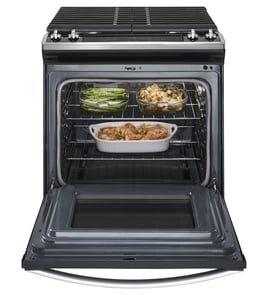




Where is the model number on a gas range?
On the Frigidaire LFGF3054TDF gas range, the model and serial number are on the identification plate located on the right-hand surface of the oven front frame. You access it by opening the storage drawer, warmer drawer, or broiler drawer (depending on your configuration). See the LFGF3054TDF installation guide for the exact location diagram.
How to find it (quick steps)
- Turn the oven off and let everything cool.
- Pull out and open the bottom drawer (storage, warmer, or broiler drawer).
- Look at the right-hand side of the oven front frame for a rating plate.
- Write down the model number, serial number, and any lot number/letter.
- Keep that info with your Use and Care Guide for future parts orders.
What the identification plate tells you
The plate is more than a model tag; it helps match the correct Frigidaire parts and setup details.
| Plate detail | What it’s used for |
|---|---|
| Model number | Ensures parts fit your exact range |
| Serial number | Helps confirm production run and compatibility |
| Lot number/letter | Helps narrow down version changes |
| Fuel and pressure info | Confirms how the range was set up from the factory |
Why it matters
Using the correct model number for LFGF3054TDF prevents ordering the wrong oven igniter, temperature sensor, control board, or burner components, and it speeds up troubleshooting and service.
Last updated: January 2026
How long does a Frigidaire gas range last?
A Frigidaire gas range like model LFGF3054TDF typically lasts 13 to 19 years with normal household use. Lifespan depends most on how consistently the burners and oven are kept clean, and whether wear items (especially igniters) are replaced when performance starts to drop.
Typical lifespan and what affects it
Most gas ranges reach the longer end of the range when they get regular cleaning, stable gas supply, and prompt repair of ignition or heating issues.
Common factors that shorten lifespan:
- Heavy daily cooking and frequent high-heat use
- Spills and boilovers that clog burner ports or soak igniters
- Running self-clean too often (high heat stresses components)
- Poor airflow around the range or blocked oven vents
- Delaying repairs when the oven starts heating slowly
Parts that commonly wear out first
On gas ranges, ignition and temperature-control parts usually fail before the cabinet or cooktop does.
- Oven igniter: slow preheat, no bake flame, or intermittent ignition
- Broil igniter: weak or no broil flame
- Oven temperature sensor: temperature swings, underbaking, overbaking
- Control board: erratic display, unresponsive keys, random shutoffs
If your oven will not ignite or takes much longer to preheat than it used to, the bake igniter 316489403 is a common fix on this model.
Quick “is it worth fixing?” guide
Use this as a practical rule of thumb for LFGF3054TDF.
| Range age | Typical recommendation | Why |
|---|---|---|
| 0 to 7 years | Repair is usually the best value | Most failures are single-part fixes |
| 8 to 14 years | Repair if the cabinet and burners are in good shape | Wear items are common and manageable |
| 15+ years | Repair if the cost is low and performance is otherwise strong | Multiple parts may be nearing end of life |
Why it matters
Knowing the expected lifespan helps you decide whether to troubleshoot a no-heat or slow-heat problem (often an igniter) versus planning for replacement. It also helps you prioritize maintenance that prevents repeat failures.
Where to confirm model-specific care and maintenance
For cleaning guidance, operating tips, and service-life maintenance steps, follow the LFGF3054TDF owner’s manual.
Last updated: January 2026
Why does my Frigidaire oven smell like gas?
A gas smell from a Frigidaire LFGF3054TDF oven usually happens when the burner is not lighting cleanly right away (delayed ignition) or when combustion is incomplete. If the odor is strong, persistent, or present when the oven is off, treat it as a safety issue and stop using the range until it’s checked.
First, do these safety checks
- If you smell gas with the oven off, turn the oven off, avoid flames or switches, and ventilate the room.
- If the smell is only during preheat and then goes away, delayed ignition is the most common cause.
- If you hear clicking but the oven takes a long time to light, focus on the igniter and burner.
- If you recently ran Self Clean, some odor and smoke from soil removal can be normal (but it should not smell like raw gas). See the LFGF3054TDF owner’s manual.
Most common causes on this model
1) Weak or failing bake igniter (delayed ignition)
A weak igniter can glow but not pull enough current to open the gas valve quickly, letting gas build up before ignition.
- Oven takes longer than usual to ignite
- “Whoosh” sound when it finally lights
- Gas odor strongest right before ignition
Model-matched part to consider: bake igniter 316489403.
2) Clogged or dirty burner ports
Spills, grease, or debris can disrupt the gas-air mix and cause incomplete combustion.
- Uneven flame pattern
- Sooting or strong combustion odor
- Longer preheat times
3) Gas valve or regulator issues (less common)
If ignition components check out, a sticking valve or pressure regulation problem can contribute to odor and poor flame quality.
Related parts sometimes involved:
Quick symptom-to-likely-cause guide
| What you notice | Most likely cause | What we recommend |
|---|---|---|
| Smell right before ignition, then “whoosh” | Weak bake igniter | Inspect/replace igniter |
| Smell plus uneven flame or soot | Dirty burner ports | Clean burner and ports |
| Smell persists, poor heating | Gas valve/regulator | Have gas system tested |
| Odor during Self Clean | Normal cleaning odors | Ventilate; follow manual guidance |
Why it matters
A delayed ignition condition can worsen over time and can damage the bake burner or create unsafe operating conditions. Addressing ignition and airflow issues early helps the oven heat evenly and reduces odor.
Last updated: January 2026