Owner’s manual
 Error Codes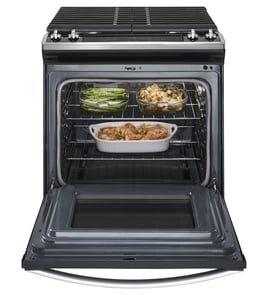







How long should a Samsung gas oven last?
A Samsung gas oven like model NX60A6511SG typically lasts about 15 years with normal household use. Consistent cleaning, proper burner ignition, and avoiding overheating events help the oven, igniter system, and gas valves reach that expected lifespan.
Typical lifespan at a glance
| Appliance type | Typical lifespan |
|---|---|
| Gas range / gas oven | 15 years |
| Electric range / electric oven | 13 years |
What affects how long your NX60A6511SG lasts
These factors usually make the biggest difference in real-world life expectancy:
- Cleaning habits: grease buildup can cause smoke, odors, and heat stress
- Ventilation: blocked oven vents can lead to performance problems
- Power quality: repeated breaker trips or power issues can stress controls and ignition
- Cooking patterns: frequent high-heat broiling and self-clean cycles add wear
- Maintenance timing: replacing worn items (like an oven light bulb) prevents secondary issues
Practical ways to extend the life of a Samsung gas oven
We recommend these habits for long-term reliability:
- Keep the oven vent area clear so heat and combustion air flow properly
- Clean spills promptly; avoid harsh abrasives on stainless steel and enamel surfaces
- Confirm burners ignite cleanly; address repeated clicking or uneven flames early
- Use self-clean only as needed; wipe heavy soils first to reduce smoke and overheating
- Follow the care and safety steps in the NX60A6511SG user manual
Why it matters
A gas range that is maintained well is more likely to heat evenly, ignite reliably, and avoid nuisance shutdowns. That helps you get the full expected service life and reduces the chance of costly repairs to ignition, controls, or gas components.
Last updated: January 2026
Is the NX60A6511SG a gas or electric range?
The Samsung NX60A6511SG is a gas range (it uses gas surface burners and a gas oven). It still requires a standard electrical supply for features like electronic ignition, the control panel, and the convection fan; see the NX60A6511SG user manual.
How we can tell on this model
The NX60A6511SG is identified as a gas free-standing range, and the manual describes gas burners, gas safety steps, and gas-oven operation.
- Cooktop uses 5 gas burners with electronic ignition
- Oven is a gas oven (bake and broil burners)
- Requires electricity for ignition and controls
- Includes a convection fan and Air Fry mode
- Has a storage drawer (not a warming drawer)
Gas vs. electric: what changes for installation and daily use
| Feature | Gas range (NX60A6511SG) | Electric range (typical) |
|---|---|---|
| Cooktop heat | Open flame burners | Radiant element or induction |
| Oven heat source | Gas burner | Electric bake/broil elements |
| Power needed | 120V for ignition and controls | 240V for heating (most models) |
| Common hookup | Gas line + grounded outlet | 240V outlet (no gas line) |
Why it matters
Knowing whether your range is gas or electric helps you buy the right replacement parts (like burner components vs. heating elements), confirm the correct utility hookups (gas line vs. 240V outlet), and follow the right safety steps if you smell gas.
Last updated: January 2026
What are common problems with Samsung gas ranges?
Common problems we see on Samsung gas ranges like model NX60A6511SG include surface burners that click or fail to ignite, uneven burner flames from dirty or misassembled burner parts, and oven performance issues such as temperature running hot or cold (often corrected by calibration). For model-specific operating checks, use the NX60A6511SG user manual.
Most common symptoms (and what they usually point to)
- Burner will not ignite or ignites slowly: burner cap/head not seated, wet/dirty ports, or power supply issue
- Burner keeps clicking after it lights: knob left in LITE, moisture around the electrode, or ignition issue
- Uneven flame or sputtering: clogged burner ports, dirty burner head/cap, or incorrect assembly/leveling
- Oven not heating or won’t turn on: outlet/circuit issue, control settings, or door lock/Sabbath mode interaction
- Oven temperature too hot or too cold: temperature calibration needed (adjustable on this model)
Quick checks we recommend for NX60A6511SG
- Confirm power and gas: the igniters need household power; verify the range is plugged into a grounded outlet and gas is on.
- Re-seat burner parts: remove grates, dry and reinstall burner heads and caps so they sit flat and centered.
- Clean safely: keep moisture out of the manifold/ignition areas; avoid spraying cleaner into openings.
- Check control settings: make sure the oven is not in Demo mode, and verify Oven Lock and Sabbath are off.
- Calibrate oven temp if needed: this model supports temperature adjustment (useful when baking results are consistently off).
Symptom-to-action table
| Symptom | What to try first | When to stop DIY |
|---|---|---|
| Burner won’t light | Dry/clean and reassemble cap/head; try another burner | If you smell gas or ignition still fails |
| Clicking continues | Turn knob off LITE; dry around electrode | If clicking persists across clean, dry parts |
| Oven temp off | Use temperature adjust feature | If error codes appear or overheating occurs |
| Oven won’t start | Verify outlet/breaker; confirm not in Demo mode | If it repeatedly shuts down or won’t respond |
Why it matters
Small issues like a misaligned burner cap can cause delayed ignition, uneven cooking, and extra wear on the ignition system. Catching the simple causes first helps you avoid unnecessary parts replacement and reduces safety risks.
Last updated: January 2026