Owner’s manual
 Error Codes




How to remove bottom grille on GE refrigerator?
On the GE GNE27JYMNFFS bottom-mount refrigerator, the bottom grille (base grille) is typically held in place by a couple of screws and/or snap-in tabs. We remove it by taking out any visible fasteners first, then pulling the grille straight out from the bottom front of the cabinet.
- Unplug the refrigerator (or switch off power at the breaker) for safety.
- Locate fasteners along the top edge of the grille (often Phillips-head screws).
- Remove screws and set them aside.
- Grip the grille at both ends and pull straight outward to release the retaining tabs.
- If it feels stuck, wiggle gently side-to-side while pulling forward; do not pry hard against the painted cabinet.
- Unplug the refrigerator to reduce shock risk.
- Use a Phillips screwdriver and a flashlight.
- Pull the refrigerator straight out only if you need more access (avoid twisting it).
- Protect floors; leveling legs and rollers can mark soft flooring.
- Keep screws in a cup so they do not get lost.
Line up the grille tabs with the slots, push it straight in until it seats flush, then reinstall the screws.
| What you see | What it usually means | What to do |
|---|---|---|
| Grille won’t pull off | A hidden screw is still installed | Recheck corners and top edge for fasteners |
| One side pops out, other won’t | Tabs are binding | Pull evenly with two hands, straight out |
| Grille sits crooked after reinstall | Tabs not fully seated | Remove and reinsert, then tighten screws |
We remove the bottom grille to access and clean the condenser area, check for water line routing, or reach lower-front components. Removing it correctly prevents broken tabs and helps the grille seal and align properly.
- If you are moving the refrigerator for access, follow the “behind the refrigerator” handling guidance in the GNE27JYMNFFS owner's manual to avoid floor damage and pinched cords/lines.
Last updated: February 2026
What is the most common problem with a GE refrigerator?
The most common GE refrigerator problem is a cooling complaint (warm fresh food section or freezer) caused by restricted airflow or heat not being removed efficiently. On the GE GNE27JYMNFFS, we also frequently see water and ice issues tied to the filter and water system, plus occasional fan or defrost-related symptoms.
- Refrigerator not cold enough, freezer temperature drifting
- Frost buildup or uneven temperatures (defrost or airflow issue)
- Ice maker slow or not making ice
- Water dispenser dripping after you release the paddle
- Door or drawer not closing smoothly, or freezer drawer “pops” open
Start with these simple, high-impact steps before replacing parts:
- Confirm vents are not blocked; food too close to the rear air vent can cause freezing or warm spots.
- If water drips after dispensing, hold the glass under the dispenser 2 to 3 seconds after releasing.
- Purge air from the water system by dispensing water for at least 2 minutes.
- If a drawer does not self-close, adjust the leveling legs (leveling affects door and drawer sealing).
- Review control settings and features (for example, “TC” indicates Turbo Cool is active); see the GNE27JYMNFFS owner's manual.
| Problem area | What you notice | What usually helps first |
|---|---|---|
| Airflow/vents | Warm sections or items freezing near vent | Move food away from vents; allow air circulation |
| Water system | Drips after dispensing, slow water | Purge air; check filter condition |
| Ice maker | No ice or slow production | Verify water supply and filter; purge air |
| Door/drawer sealing | Drawer won’t close, freezer pops open | Level the refrigerator; check for obstructions |
If the basic checks do not resolve the symptom, these model-matched parts are often involved:
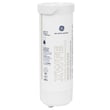
- Water and ice performance: GE refrigerator water filter XWFE
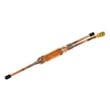
- Water supply to dispenser/ice maker: refrigerator water inlet valve WR57X30890
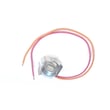
- Temperature regulation complaints: GE profile refrigerator temperature sensor WR55X10025
Cooling and water issues usually get worse over time: poor airflow can lead to food spoilage, and air in the water line can cause dripping and inconsistent ice production. Addressing the basics early helps protect the compressor and sealed system.
Last updated: February 2026
How do I find the model number on my GNE27JYMNFFS?
On the GE GNE27JYMNFFS refrigerator, the model number is printed on a label inside the fresh food (refrigerator) compartment on the left side, near the middle. Use that exact model number when ordering parts or looking up diagrams in the owner's manual.
- Open the refrigerator (fresh food) door, not the freezer drawer
- Check the left interior wall
- Look near the middle height of the compartment
- Find the label that lists Model # and Serial #
- Write both down; the serial number helps confirm the production run
GE makes multiple similar bottom-mount and French door refrigerators; one character difference can change which water filter, control board, or door bin fits.
| What you’re doing | What to use | Why it helps |
|---|---|---|
| Ordering replacement parts | Model number (GNE27JYMNFFS) | Ensures correct fit and wiring/connector match |
| Checking compatibility | Serial number | Confirms version changes within the same model |
| Troubleshooting | Model and serial | Helps match the right diagrams and procedures |
- Reading the number from a sales receipt instead of the appliance label
- Mixing up similar characters (for example, 0 vs O, 1 vs I)
- Using only the series name (like “GNE27”) instead of the full model
Using the correct model number prevents wrong-part returns and speeds up repairs, especially for fit-sensitive items like a water filter, water inlet valve, or electronic control board.
Last updated: March 2026