Installation guide
 Owner’s manual
 Error Codes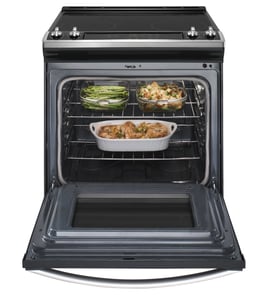



Is a stove 120v or 240v?
Most electric ranges like the Frigidaire FCRE3052ASF are designed to run on 240 volts (often supplied as a 120/240V split system). The heating elements use the full 240V for cooking performance, while some controls and lights may use 120V within the same supply.
For the FCRE3052ASF, the installation instructions call for a range cord kit rated 125/250V minimum and describe 3-wire or 4-wire power cord connections, which aligns with a 240V range circuit. Check the exact connection method in the FCRE3052ASF installation guide.
- Most freestanding electric ranges use a dedicated 240V circuit.
- The range may be connected with a 3-conductor or 4-conductor cord (depending on your installation requirements).
- The terminal block is accessed behind the rear access cover during installation.
- A properly sized cord kit and strain relief are required for safe operation.
- Grounding and local electrical codes matter for the correct setup.
| Appliance type | Typical supply | Common examples |
|---|---|---|
| Full-size electric range | 240V (120/240 split) | Freestanding ranges with bake and broil elements |
| Small countertop cooker | 120V | Hot plates, small portable cooktops |
| Some induction cooktops | 120V or 240V | Varies by size and power level |
Using the correct voltage and cord configuration helps your range heat properly and helps prevent nuisance breaker trips, damaged wiring, or unsafe connections. We also recommend following the grounding guidance in the FCRE3052ASF owner's manual so the outlet or junction box matches the required voltage and is properly grounded.
Last updated: January 2026
What does F3 mean on an electric stove?
On a Frigidaire FCRE3052ASF electric range, an F3 code points to a temperature-sensing problem in the oven circuit (most often the oven temperature sensor or its wiring). We recommend clearing the code, then checking for a repeat and testing the sensor if it returns; see the FCRE3052ASF owner's manual.
- Press OFF/CANCEL to clear the code.
- If it comes back, turn off power at the breaker for 5 minutes, then restore power.
- Set the clock after power is restored (some ovens will not run until time-of-day is set).
- Try Bake again and watch for the code to return.
- If the code repeats, move to sensor and wiring checks.
Most F3 faults are triggered when the control thinks the oven temperature reading is out of range.
| Likely cause | What you may notice | Common fix |
|---|---|---|
| Oven temperature sensor out of spec | Oven won’t heat, heats erratically, or throws F3 during preheat | Replace the sensor |
| Loose/damaged sensor wiring or connector | Intermittent F3, especially after moving/cleaning | Reseat/repair wiring |
| Control board issue (less common) | F3 persists after sensor checks good | Diagnose/replace control board |
If the reset does not hold and the code repeats, the first part we check on this model is the sensor.
- Frigidaire range oven temperature sensor 316490000 (primary temperature feedback to the control)
- Inspect the sensor harness for pinched wires, corrosion, or a loose plug at the control.
When the oven control cannot trust the temperature signal, it may shut down heating for safety and performance. Fixing the sensor circuit restores accurate baking temperatures and helps prevent repeated shutdowns.
Last updated: January 2026
How do I reset my Frigidaire electric range?
To reset your Frigidaire FCRE3052ASF electric range, turn the range off and disconnect power for about 30 seconds, then restore power. This clears many control glitches; if the oven and all surface burners still do not heat, focus next on the home power supply and range wiring.
- Turn all surface controls to OFF and cancel any oven cycle.
- Unplug the range, or switch OFF the range breaker.
- Wait 30 seconds.
- Restore power and set the clock if needed (see the FCRE3052ASF owner’s manual).
- Test Bake and one surface element.
When all burners and the oven stop heating, the most common cause is a power supply issue (missing one “hot” leg of 240V) or a wiring/terminal block connection problem.
- Check that the double-pole breaker is fully ON (cycle it OFF then ON).
- If the range was recently installed, recheck the power cord connection at the terminal block using the FCRE3052ASF installation guide.
- Do not loosen the factory-installed nuts that secure the range wiring to the terminal block; loose connections can cause loss of power.
- If you see heat damage, melted insulation, or a burning smell, stop and have the wiring inspected.
| Symptom | Most likely cause | What to check first |
|---|---|---|
| Display works, but oven and all burners do not heat | Missing L1 or L2 (no 240V) | Breaker, outlet, cord/terminal block |
| Oven heats but one burner does not | Failed surface control or element | Switch and element for that position |
| Oven temperature is erratic | Sensor or control issue | Oven sensor and calibration |
These are common fixes depending on the symptom (not required for a basic reset):
- Universal/multiflex (Frigidaire) range terminal block 5303935271 (burned or loose power connections)
- Frigidaire range bake element 316075103 (bake not heating)
- Frigidaire range oven temperature sensor 316490000 (temperature problems)
A reset can clear a temporary control fault, but a full “no heat” condition often points to a 240V supply or terminal block connection issue. Correcting that prevents repeat shutdowns and protects the range’s wiring and control components.
Last updated: January 2026