 Installation guide
 Owner’s manual
 Error Codes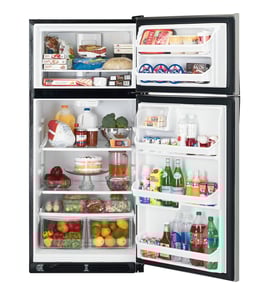



What is the top part of the fridge called?
On the Frigidaire LFTR1835VF3 top-mount refrigerator, the top compartment is the freezer compartment (often just called the freezer). It’s designed to keep foods frozen and, on some versions, it can also house an optional ice maker.
Common components and features in the freezer area include:
- Freezer shelf (for organizing frozen foods)
- Ice bucket (on models equipped for ice)
- Ice maker (optional on some models)
- Freezer temperature control
- Air vents that circulate cold air to the fresh-food section
For the model-specific feature layout, we reference the LFTR1835VF3 use & care manual.
Knowing the correct term helps when you’re:
- Looking up diagrams and parts for the right compartment
- Following troubleshooting steps (for example, “freezer cold but refrigerator warm”)
- Ordering the correct door, gasket, shelf, or ice maker-related components
| What you call it | Common name | What it does |
|---|---|---|
| Top part of the fridge | Freezer compartment | Freezes food and helps cool the refrigerator section |
| Bottom part of a top-mount | Fresh-food (refrigerator) compartment | Keeps food cold (not frozen) |
If you’re troubleshooting cooling performance, remember that on many top-mount designs, the freezer produces the cold air and a fan/vents distribute it to the refrigerator section. If airflow is blocked by packages, temperatures can drift.
Last updated: January 2026
What is the most common problem with Frigidaire refrigerators?
The most common issue we see with Frigidaire refrigerators like model LFTR1835VF3 is a cooling complaint: the refrigerator section is too warm, the freezer has frost buildup, or temperatures swing. Many times it traces back to airflow, dirty condenser coils, or a defrost-system problem (see the LFTR1835VF3 use & care manual).
- Fridge warm, freezer OK: restricted airflow, iced-up evaporator area, or a control/damper issue
- Freezer frost buildup: door not sealing, frequent door openings, or a defrost failure
- Runs a lot or seems loud: dirty condenser coils, warm room temps, or condenser fan issues
- Ice maker not working (if equipped): water supply/pressure issue, ice maker switched off, or frozen fill tube
- Water under the unit: defrost drain issue or drain pan overflow
- Confirm controls are set to Recommended, then wait 24 hours after any change.
- Check door seals for gaps and make sure doors close fully.
- Do not block air vents with food packages.
- Clean condenser coils and make sure the toe grille area has good airflow.
- If you have an ice maker, verify the water supply is on and connections are not leaking.
If basic checks do not fix the cooling or frost issue, these model-compatible parts are often involved:
| Symptom | Common part to inspect/replace | Why it matters |
|---|---|---|
| Frost buildup, warm temps | Refrigerator defrost heater and thermostat 5304522340 | Defrost system clears ice so air can circulate |
| Temps drift or won’t regulate | Refrigerator temperature control thermostat 5304522330 | Controls compressor run time and cooling |
| Warm cabinet, poor heat removal | Refrigeration appliance condenser fan motor assembly 5304519734 | Moves air across the condenser coils |
Cooling problems can lead to food spoilage and can also make the compressor run longer than normal. Catching airflow and defrost issues early usually prevents bigger repairs.
Last updated: January 2026
What is the average lifespan of a Frigidaire refrigerator?
A Frigidaire refrigerator typically lasts 10 to 15 years with normal household use. For your Frigidaire LFTR1835VF3 top-mount refrigerator, good airflow, correct temperature settings, and routine cleaning are the biggest factors that help it reach the upper end of that range (or beyond). See the maintenance guidance in the LFTR1835VF3 use & care manual.
- Keep condenser and airflow areas clear of dust and pet hair
- Keep doors closing and sealing fully (avoid warm air leaks)
- Set temperatures gradually and allow 24 hours to stabilize after changes
- Avoid overpacking so cold air vents are not blocked
- Clean spills promptly to prevent odors and gasket damage
The LFTR1835VF3 manual emphasizes basics that directly affect compressor workload and cooling stability.
| Task | How often | Why it helps |
|---|---|---|
| Verify doors seal and close squarely | Monthly | Prevents moisture intrusion and longer run times |
| Clean interior and wipe gaskets | 2x per year | Reduces odors, helps gaskets seal |
| Confirm controls are near “Recommended” | As needed | Avoids freezing or warm temps that strain the system |
| Keep toe grille area unblocked | Always | Maintains proper air circulation |
These symptoms do not always mean replacement, but they are common “age” indicators:
- Temperature swings (food freezing in fresh food section or warming)
- Compressor running much longer than normal
- Excess frost buildup in the freezer
- Water leaking or recurring puddles
- Doors not sealing well even after cleaning and leveling
Most costly wear happens when the sealed system and compressor have to run longer than designed. Simple maintenance (airflow, seals, and stable settings) reduces run time, helps food stay safe, and can delay major repairs.
Last updated: January 2026





