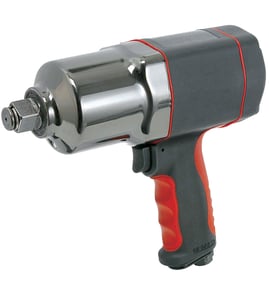

Should I get a 1/2 or 3/4 impact wrench?
For most DIY and automotive work, we recommend a 1/2-inch drive impact wrench; it is the most versatile size for common lug nuts and general fastener removal. A 3/4-inch drive is best reserved for heavy-duty, high-torque jobs on large equipment.
- 1/2-inch drive: general-purpose use, most common socket availability, best all-around choice
- 3/4-inch drive: heavy equipment, large fasteners, higher torque demands, larger/heavier sockets
- 3/8-inch drive (for comparison): tight spaces and lighter-duty fasteners (lower torque range)
Use these decision points to pick the right drive size for the work you actually do:
- If you work on cars, light trucks, trailers, and home projects, choose 1/2-inch.
- If you regularly service farm, construction, or industrial equipment, consider 3/4-inch.
- If you want one tool that covers the widest range of sockets and accessories, choose 1/2-inch.
- If you expect frequent use on rusted, oversized fasteners, 3/4-inch can be the better match.
- If fatigue and access matter, 1/2-inch tools are typically lighter and easier to handle.
| Feature | 1/2-inch drive | 3/4-inch drive |
|---|---|---|
| Best for | General use, automotive | Heavy-duty equipment |
| Tool size/weight | Usually smaller | Usually larger |
| Socket cost/availability | Widest selection | More specialized |
| Torque needs | Moderate to high | High to very high |
Choosing the right drive size helps you avoid rounded fasteners, broken sockets, and wasted effort. A 1/2-inch drive is the practical standard because it balances torque, control, and socket availability, while 3/4-inch is purpose-built for bigger, tougher jobs.
If you are shopping parts for your Craftsman 875199840 impact wrench or want to search by model number, we recommend starting with the model parts list and then using Sears PartsDirect for broader lookup.
Last updated: February 2026
Who makes Craftsman impact wrenches?
Craftsman is a tool brand (not a single factory), and Craftsman impact wrenches are made for the Craftsman brand by its parent company, Stanley Black & Decker, and by approved manufacturing partners depending on the specific model, such as 875199840. For parts lookup and model matching, we use the Craftsman model number on the tool.
Because Craftsman is a brand with multiple product lines, the most reliable way to identify who made a specific impact wrench and which parts fit is to match the model number 875199840 and the tool’s type (impact wrench).
- Check the model tag/label on the tool housing, handle, or motor cover
- Match the full model number exactly: 875199840
- Use the model-based parts list first when searching for compatible components
- If you are comparing similar tools, also match voltage/air fitting type and drive size (for example, 1/2-in drive)
| Term | What it means | Why you care for parts |
|---|---|---|
| Craftsman | The brand name on the tool | Determines the product family and labeling |
| Stanley Black & Decker | The brand owner | Oversees product lines and sourcing |
| Manufacturing partner | The factory that built a specific run | Can affect internal design and part compatibility |
This model page does not list individual part pages, so the best approach is to search by the exact model number and then confirm fit by description and diagrams.
- Start with the model number search for 875199840
- Compare the part description to your symptom (trigger, anvil, motor, switch, cord, brushes)
- Confirm the part matches your tool’s configuration before ordering
- If you are shopping across multiple models, search by model number on Sears PartsDirect
Impact wrenches often look similar across Craftsman lines, but internal components (switches, brush sets, anvils, hammer mechanisms, and housings) can differ by production run. Matching by model number prevents ordering a part that will not mount correctly or handle the tool’s load.
Last updated: February 2026
Will a 100 psi air compressor run an impact wrench?
Yes, a 100 PSI air compressor can run a Craftsman impact wrench like model 875199840, but PSI alone is not the deciding factor. What matters most is whether your compressor can supply enough airflow (CFM) at 90 PSI to keep the tool hitting hard without constant waiting.
Most pneumatic impact wrenches are rated around 90 PSI working pressure, so a compressor that reaches 100 PSI is usually fine on pressure. The common problem is low CFM, especially with small “pancake” compressors.
- PSI: sets the pressure the tool sees (often regulated to ~90 PSI)
- CFM: determines how long the impact can run at full power
- Tank size: affects how long you can burst before pressure drops
- Hose and fittings: restrictions can starve the tool even with a good compressor
- Duty cycle: small compressors may overheat if you run the impact continuously
Use this as a practical rule of thumb for air impact wrench use.
| Compressor capability (at 90 PSI) | What you can expect with an impact wrench |
|---|---|
| Under ~3 CFM | Short bursts only; power drops fast |
| ~3 to 5 CFM | Light to moderate use; frequent recovery time |
| ~5 to 8 CFM | Good performance for most DIY lug nuts |
| 8+ CFM | Strong, consistent performance for repeated use |
These steps often fix “weak impact” complaints without changing the compressor.
- Set the regulator so the tool sees about 90 PSI while the trigger is pulled (dynamic pressure).
- Use a 3/8-inch ID air hose for impacts when possible; small hoses restrict airflow.
- Keep the hose as short as practical and avoid multiple quick-connects.
- Add 2 to 3 drops of air tool oil in the inlet (or use an oiler) to maintain vane seal.
- Drain the tank and use a filter; water in the air line reduces performance and tool life.
If CFM is too low, the impact wrench will spin but not deliver full torque, leading to stuck lug nuts, rounded fasteners, and longer repair time. Matching airflow to the tool keeps the hammer mechanism hitting consistently.
For replacement parts and diagrams for your Craftsman 875199840 impact wrench, start with the parts list for this model, or search by model number on Sears PartsDirect.
Last updated: February 2026
What is the main component of an impact wrench?
The main working component in a Craftsman impact wrench like model 875199840 is the impact mechanism (often called the hammer-and-anvil assembly). It converts the motor’s rotation into rapid impacts that deliver high torque to the square drive for loosening and tightening fasteners.
Most impact wrenches use a few core internal pieces to create the “hammering” action:
- Hammer(s): rotating mass that builds momentum
- Anvil: the output shaft the hammer strikes (connected to the square drive)
- Cam/roller or clutch parts: control when the hammer releases and strikes
- Gear reduction: increases torque from the motor before it reaches the hammer
- Lubrication (grease/oil): reduces wear and heat in the mechanism
The impact mechanism is what makes an impact wrench different from a standard drill or ratchet. It delivers torque in pulses, which helps break loose stuck lug nuts and bolts without requiring constant high hand force.
| What you observe | Most common area involved | What it usually means |
|---|---|---|
| Strong rattling sound and fast removal | Hammer/anvil | Normal impact action |
| Motor spins but little turning force | Hammer/anvil or worn drive | Impacts not transferring torque |
| Intermittent impacts, power drops | Lubrication or worn internal parts | Mechanism binding or slipping |
| Grinding or harsh metal noise | Gears or hammer cage | Internal wear that needs service |
- Confirm the correct socket type (impact-rated) and fully seated on the anvil.
- Verify the direction selector is fully engaged (forward or reverse).
- Check the air supply (air tools) or battery/cord condition (electric tools).
- Inspect the square drive for rounding, cracks, or excessive wobble.
- If the tool has been heavily used, service the mechanism lubrication on schedule.
For Craftsman 875199840, we use the model number to match the correct internal components (impact mechanism parts, gears, switches, housings, and fasteners). If you do not see the exact part listed for your repair, search by the full model number on Sears PartsDirect to locate the correct diagram and replacement parts.
Why it matters: The hammer-and-anvil assembly determines real-world torque delivery, durability, and how well the tool handles stubborn fasteners.
Last updated: February 2026