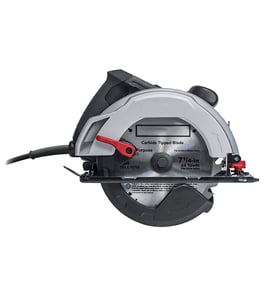

How deep will a 7 1/4 SKILSAW cut?
A 7-1/4 inch Skil circular saw like model 77 typically cuts about 2-3/8 inches to 2-5/8 inches deep at 90 degrees (straight down). At a 45-degree bevel, the max depth is usually around 1-3/4 inches to 1-7/8 inches, depending on the exact guard and base design.
Typical cutting depth ranges (what to expect)
Most 7-1/4 inch circular saws fall into these common ranges:
- 90 degrees (square cut): ~2-3/8 in. to 2-5/8 in.
- 45 degrees (bevel cut): ~1-3/4 in. to 1-7/8 in.
- Worn blade or thin-kerf blade: can slightly reduce effective depth
- Blade not fully raised: reduces depth quickly
- Thick shoe or guard clearance: can limit max depth on some saws
How to measure your saw’s actual max depth
Use this quick check to get the real number for your specific Skil 77:
- Unplug the saw.
- Set bevel to 0 degrees.
- Raise the blade to the maximum depth setting.
- Measure from the bottom of the shoe to the lowest tooth tip.
- Repeat at 45 degrees if you use bevel cuts.
| Setting | What to measure | Typical result for 7-1/4 in. saws |
|---|---|---|
| 0 degrees | Shoe to lowest tooth | ~2-3/8 in. to 2-5/8 in. |
| 45 degrees | Shoe to lowest tooth | ~1-3/4 in. to 1-7/8 in. |
Why it matters
Knowing max cutting depth helps us choose the right approach for framing lumber, sheet goods, and bevel work. It also prevents binding and kickback caused by forcing a cut that is too deep for the blade setting.
Related DIY help
If you are troubleshooting power, intermittent running, or a dead saw, our guide on how to use a multimeter to test electrical parts video helps you safely check switches, cords, and continuity.
Last updated: February 2026
What size blade is a SKILSAW 77?
A Skil 77 TYPE 77 circular saw uses a 7-1/4 inch (7.25 in.) diameter blade. For best fit and safe operation, match the blade’s arbor (center hole) size and the saw’s maximum RPM rating before installing a new blade.
How to confirm the correct blade for model 77
Use these checks so the blade mounts correctly and runs true:
- Blade diameter: 7-1/4 in.
- Arbor (center hole) size: match the saw’s arbor and any required bushing
- Kerf (blade thickness): thinner kerf cuts easier; full kerf is more rigid
- Tooth count: fewer teeth for framing, more teeth for plywood and finish cuts
- Blade speed rating: blade max RPM should meet or exceed the saw’s no-load speed
A quick way to verify what you have now is to remove the blade and read the markings stamped on it.
Common blade choices (what to buy for the cut you want)
| Cut type | Typical tooth count | What you’ll notice |
|---|---|---|
| Framing lumber (2x) | 18 to 24T | Fast cuts, rougher edge |
| General purpose | 24 to 40T | Balanced speed and finish |
| Plywood, trim, finish | 40 to 60T | Cleaner edge, slower feed |
Why it matters
Using the correct 7-1/4 in. blade size helps prevent guard interference, wobble, poor cut quality, and unsafe mounting. Matching arbor size and RPM rating is just as important as the diameter.
Helpful related DIY content
If you’re troubleshooting power or wiring issues while servicing the saw, use how to use a multimeter to test electrical parts video.
Last updated: February 2026
When was the SKILSAW model 77 made?
SKILSAW model 77 saws were made across many years; “77” is a long-running model family, not a single one-year production run. To pin down when your specific Skil 77 saw was made, use the type number and serial number from the saw’s data label.
What “made” usually means for Skil 77
Most owners are trying to identify one of these:
- The production year of their exact saw (based on serial or date code)
- The type number (variant) that determines which parts fit
- The generation (older vs newer design changes)
How to find the build date on your specific saw
- Unplug the saw and remove the blade for safer handling.
- Find the nameplate/data label (commonly on the motor housing, handle area, or base plate).
- Write down these items exactly:
- Model: 77
- Type number (example format: Type 16, Type 17)
- Serial number and any date code
- Use that information when looking up parts and diagrams for your Skil circular saw.
Helpful guide: how to find your appliance model number (and what it means for parts)
What to record (and why)
| Label item | Example | Why it matters |
|---|---|---|
| Model number | 77 | Identifies the model family |
| Type number | TYPE 77 (or Type 16, etc.) | Identifies the exact variant; parts can change |
| Serial/date code | Varies | Used to narrow the production run |
Why it matters
Skil 77 circular saws can look similar across decades, but parts like the switch, cord, brushes, bearings, and blade guard often vary by type and production run. Matching the label details prevents ordering the wrong power tool parts.
Last updated: February 2026
Why do framers use worm drive saws?
Framers commonly choose a worm drive circular saw like the Skil model 77 because it delivers high torque for long rip cuts and dense framing lumber, and the blade-left layout makes it easier for many right-handed users to see the cut line while working fast.
What framers get from a worm drive saw
- More torque under load for wet lumber, LVL, and stacked cuts
- Blade-left visibility (common on worm drives) for tracking a chalk line
- Better balance for long rips because the motor sits behind the blade
- Durability for daily jobsite use with a gear-driven power transfer
- Consistent cutting feel when pushing through knots and pitchy wood
Worm drive vs sidewinder: quick comparison
| Feature | Worm drive saw | Sidewinder saw |
|---|---|---|
| Power feel | High torque, steady pull | Faster spin, lighter push |
| Weight | Heavier | Lighter |
| Typical blade position | Often left | Often right |
| Best fit | Framing, ripping, tough stock | General carpentry, overhead cuts |
When a worm drive is the better choice
A worm drive is usually the right pick when the work is repetitive and demanding, such as:
- Ripping sheathing or subfloor all day
- Cutting thicker framing packs
- Working with wet or pressure-treated lumber
- Needing clear sight of the blade and kerf on a line
Why it matters
On a framing crew, time and consistency matter. A worm drive’s torque and stable tracking help reduce bogging, wandering cuts, and rework, even though the saw is heavier than many sidewinders.
For general DIY repair know-how that applies to power tools (like checking cords and connections safely), see are diy appliance repairs safe.
Last updated: February 2026
