Error Codes




How big of a room will a 5000 BTU air conditioner cool?
A 5,000 BTU room air conditioner like the GE AHV05LYQ1 typically cools a small room around 150 to 250 sq. ft. (often best in the 150 to 200 sq. ft. range), assuming average ceiling height, normal sun exposure, and a reasonably sealed space.
Quick sizing guide (what 5,000 BTU fits best)
- 150 to 200 sq. ft.: Ideal comfort range for most homes
- 200 to 250 sq. ft.: Works if the room is shaded and well insulated
- Under 150 sq. ft.: Cools fast but may short-cycle if oversized
- Over 250 sq. ft.: Usually struggles on hot days; consider a higher BTU unit
What can change the “right” room size
A 5,000 BTU window air conditioner can feel too small or too large depending on conditions:
- Sun exposure (south or west facing rooms need more BTUs)
- Ceiling height (tall ceilings increase the air volume to cool)
- Insulation and air leaks (drafty windows and doors reduce performance)
- Heat sources (kitchens, electronics, and many occupants add load)
- Doorway traffic (open doors to hallways or other rooms increases the area)
Rule-of-thumb table
| Room size | Typical result with 5,000 BTU | What to do |
|---|---|---|
| 100 to 150 sq. ft. | Very strong cooling | Use a higher temp setting to avoid short cycling |
| 150 to 200 sq. ft. | Best match | Keep the filter clean and vents unobstructed |
| 200 to 250 sq. ft. | Acceptable in mild conditions | Reduce sun load with blinds/curtains |
| 250+ sq. ft. | Often not enough | Step up to a higher BTU model |
Why it matters
Correct sizing helps your GE room air conditioner maintain steadier temperature and humidity. Too small runs constantly and may not keep up; too large can cool quickly but remove less moisture, leaving the room feeling clammy.
Maintenance tip that helps cooling capacity
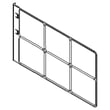
Restricted airflow makes any BTU rating perform worse. If your unit is not cooling like it used to, start by cleaning or replacing the filter; for this model, the correct part is the room air conditioner air filter WJ85X21746.
Last updated: January 2026
How to determine AC tonnage from model number?
For the GE room air conditioner model AHV05LYQ1, you typically do not determine “tonnage” from the model number the way you would on a central AC system. Room (window) air conditioners are usually sized in BTUs, and the model number often does not include a clear BTU code you can reliably convert to tons.
How sizing works for room AC vs central AC
Central AC model numbers often include a two-digit BTU code (like 24, 36, 48) that you divide by 12 to estimate tons. Room air conditioners are different: they are commonly labeled directly in BTUs (for example, 5,000 BTU, 8,000 BTU).
Quick conversion (when you know BTUs):
- 12,000 BTU/hr = 1 ton
- 6,000 BTU/hr = 0.5 ton
- 5,000 BTU/hr ≈ 0.42 ton
Practical ways to find the capacity for AHV05LYQ1
Use these checks to get the correct size for your specific unit:
- Look for the rating label on the cabinet (often behind the front grille or on the side) and find “Cooling capacity” in BTU/hr.
- Check the original packaging or sales listing if you still have it.
- If the unit is not cooling well, confirm airflow first; a clogged filter can make a correctly sized unit perform like it is undersized.
A common maintenance item for this model is the room air conditioner air filter WJ85X21746.
BTU-to-tons cheat sheet
| Cooling capacity (BTU/hr) | Approx. tons |
|---|---|
| 5,000 | 0.42 |
| 6,000 | 0.50 |
| 8,000 | 0.67 |
| 10,000 | 0.83 |
| 12,000 | 1.00 |
Why it matters
Correct sizing affects comfort and cost. An undersized room air conditioner runs constantly and struggles to cool; an oversized unit can short-cycle and remove less humidity.
For GE-specific display or diagnostic issues that may affect operation, use GE error codes.
Last updated: January 2026
What are the most common issues with AHV05LYQ1?
The most common issues we see with the GE AHV05LYQ1 room air conditioner are weak cooling or airflow, water leaking or not draining correctly, and control or power problems. Many of these start with basic maintenance (especially the air filter) or a worn external control part.
Common symptoms and what they usually point to
- Not cooling well: dirty air filter, blocked grille, dirty coils, or poor window seal letting hot air in
- Weak airflow: clogged filter, obstructed front grille, fan wheel debris
- Water dripping inside: unit not level, drain path restricted, dirty base pan
- Won’t turn on: outlet or cord issue, internal fuse/controls, loose wiring
- Knob won’t adjust settings: stripped or cracked knob
Quick checks you can do first (no tools)
- Clean or replace the room air conditioner air filter WJ85X21746; restricted airflow is the top cause of poor cooling.
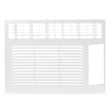
- Make sure the front intake is not blocked; a damaged grille can restrict airflow (see front grille assembly WJ71X24801).
- Confirm the unit tilts slightly toward the outside so condensate drains outdoors.
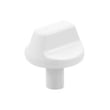
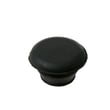
- Verify the control knob is firmly seated and not cracked (see room air conditioner control knob WJ12X24802).
- Unplug the unit for 5 minutes, then restore power to reset the controls.
Parts that commonly solve these problems
| Symptom | Common fix | Part to check |
|---|---|---|
| Weak airflow, icing, poor cooling | Restore airflow | Room air conditioner air filter WJ85X21746 |
| Airflow blocked at front | Replace damaged grille | Front grille assembly WJ71X24801 |
| Can’t change settings | Replace knob | Room air conditioner control knob WJ12X24802 |
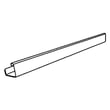
| Unit shifts in the chassis | Inspect mounting/rails | Room air conditioner track rail, upper WJ65X22182 |
Why it matters
A room air conditioner like the GE AHV05LYQ1 depends on steady airflow across the evaporator coil. When airflow drops, cooling performance falls fast and the coil can ice up, which can also lead to water leaks when the ice melts.
Last updated: March 2026