 Owner’s manual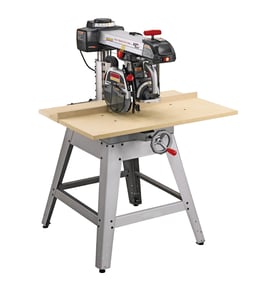

What has replaced the radial arm saw?
For most home workshops, the compound miter saw largely replaced the radial arm saw for crosscuts and miter cuts because it is smaller, easier to set up, and typically more accurate for repeat angle cuts. A table saw is still the common replacement when you need rip cuts.
What tool replaces it for each type of cut
- Crosscuts (90 degrees): compound miter saw
- Miter cuts (angles): compound miter saw
- Bevel cuts (tilt): compound miter saw (single or dual bevel)
- Rip cuts (with the grain): table saw (or a track saw for sheet goods)
- Wide panels and plywood breakdown: track saw or circular saw with a straightedge
Quick comparison
| Task | Radial arm saw | Common replacement today |
|---|---|---|
| Crosscutting boards | Very capable | Compound miter saw |
| Accurate angle repeats | Can be finicky to keep dialed in | Compound miter saw |
| Ripping lumber | Possible on some setups, but less common now | Table saw |
| Jobsite portability | Bulky | Compound miter saw |
Why it matters
Choosing the right replacement depends on what you do most. If your Craftsman 113198110 10" radial saw is mainly used for trim, framing crosscuts, and miters, a compound miter saw matches those strengths. If you routinely rip boards or build cabinets, a table saw setup fits that workflow better.
If you are keeping your Craftsman 113198110
Use the owner's manual to confirm the correct cutting procedures, alignment checks, and safe adjustment points (especially for arm travel, yoke position, and blade direction) before you tune it up or change how you use it.
Last updated: February 2026
Are radial arm saws worth anything?
Yes. A Craftsman radial arm saw like model 113198110 can be worth owning and worth money, mainly because it excels at accurate, repeatable crosscuts and can handle wide stock when it is tuned and used with the right setup. Value depends most on condition, completeness, and how smoothly the arm and carriage travel.
What makes a radial arm saw valuable
- Accuracy after tuning: tight arm bearings, solid column lock, and a fence that stays straight.
- Smooth travel: the carriage should glide without play or binding.
- Complete safety and setup parts: blade guard, anti-kickback parts (if equipped), table boards, and fence hardware.
- Motor health: starts quickly, runs without excessive sparking, and does not bog down under load.
- Low rust and minimal abuse: especially on the arm ways, column, and yoke pivots.
Typical resale value ranges (used market)
These are common ranges for older 10 inch radial arm saws; local demand and condition move the number up or down.
| Condition | What it usually includes | Typical range |
|---|---|---|
| As-is / needs work | missing guard, rough travel, needs alignment | $25 to $75 |
| Working, average | runs well, aligns, normal wear | $75 to $150 |
| Clean, complete, tuned | smooth travel, complete guard, solid table/fence | $150 to $300 |
When a radial arm saw is “worth it” to keep
- You regularly cut wide boards that are awkward on a miter saw.
- You want repeatable crosscuts with a stop block setup.
- You have space for a dedicated station and can keep the table and fence in good shape.
Why it matters
Radial arm saws reward careful setup. When the arm, yoke, and fence are aligned, you get fast, consistent crosscuts; when they are loose or out of square, you get wandering cuts and higher risk of kickback. Use the alignment and adjustment procedures in the 113198110 owner's manual to keep the saw accurate.
Last updated: February 2026
Do you push or pull a radial arm saw?
For most crosscuts on a Craftsman 113198110 10-inch radial arm saw, we pull the carriage toward us through the work while the board stays firmly against the fence. Pushing the saw away is mainly for returning to the start position, not for making the cut.
The safe, standard crosscut motion
- Set the workpiece flat on the table and tight to the fence.
- Start with the blade in front of the fence (closest to you) and clear of the work.
- Turn the saw on and let the blade reach full speed.
- Feed the carriage smoothly by pulling it toward you through the cut.
- Keep steady downward and fence pressure on the workpiece the entire time.
- After the cut, push the carriage back only after the blade is clear of the work.
Why “pulling” is typically recommended
A radial arm saw’s blade rotation can try to “self-feed” (climb) into the cut if the feed direction is wrong or too aggressive. Pulling with a controlled, light feed helps you manage that tendency and keeps the workpiece seated against the fence.
Quick guide: pull vs push
| Action | When to do it | Goal |
|---|---|---|
| Pull the carriage toward you | During the crosscut | Controlled feed through the work |
| Push the carriage away | After the cut, blade clear | Return to the start position |
| Force the saw either direction | Never | Avoid kickback and loss of control |
Setup checks that matter before you cut
- Fence is straight and securely fastened.
- Table surface is flat and supports the work fully.
- Blade is sharp and correct for crosscutting.
- Guard, anti-kickback features, and yoke locks are in place and working.
- Arm and carriage adjustments are tight with no play.
Where to confirm your model’s operating steps
We recommend following the operating and adjustment procedures in the 113198110 owner's manual, especially for yoke/arm lock settings, guard setup, and alignment.
Last updated: February 2026
Who makes the best radial arm saws?
Craftsman radial arm saws like model 113198110 are among the most common and well-supported saws you will see, largely because Craftsman-branded radial arm saws were produced in high volume over many years. “Best” depends on the cuts you need, the condition of the saw, and whether key adjustments and safety features are intact.
What “best” means for a radial arm saw
Radial arm saws vary more by setup and condition than by brand name alone. We recommend judging “best” using these practical factors:
- Accuracy and repeatability: the arm locks solidly at 90 degrees and common miter angles
- Carriage travel: smooth movement with minimal play in the roller bearings
- Motor health: starts quickly, runs smoothly, and does not bog down under normal load
- Guarding and anti-kickback: complete blade guard, splitter/riving-style components (if equipped), and pawls where applicable
- Alignment capability: you can square the arm, yoke, and fence and keep them locked
- Parts support: diagrams and part identification are available for maintenance
Quick brand and support comparison
Use this as a simple way to think about “best” when shopping or deciding what to restore.
| What you care about most | What typically works well | Why it helps |
|---|---|---|
| Finding used units and community know-how | Craftsman (common models like 113198110) | More units in circulation means more setup tips and shared fixes |
| Heavy-duty feel and long-term durability | Industrial or contractor-grade saws | More robust castings and mechanisms can hold alignment better |
| Easy maintenance and safe operation | Any brand in excellent condition with complete guarding | Condition and correct setup matter more than the badge |
Why it matters
A radial arm saw can crosscut, dado, and perform repetitive cuts efficiently, but only when it is properly aligned and fully guarded. A “best” saw is one you can tune accurately and operate safely for the work you actually do.
What we recommend for your Craftsman 113198110
Start with the exploded views, adjustment points, and safety guidance in the 113198110 owner's manual. For most owners, a careful tune-up (squaring the arm and fence, checking carriage play, verifying blade direction, and confirming guard condition) makes a bigger difference than switching brands.
Last updated: February 2026