 Owner’s manual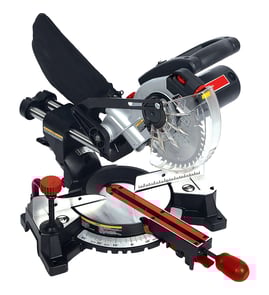

Can I use a 7 1/4 blade on a 10 miter saw?
Yes, a 7-1/4 inch blade can physically fit on many 10-inch miter saws if the arbor (bore) size matches, but on the Makita LS1011 we recommend using the specified 10-inch (255 mm) blade for safe operation and full cutting capacity. See the blade size and hole diameter listed in the LS1011 owner's manual.
What the Makita LS1011 is designed to use
The LS1011 is factory set up for a 255 mm (10-inch) blade with a 15.88 mm (5/8-inch) arbor hole. Using the correct diameter helps maintain proper guard coverage, cutting depth, and alignment.
| Item | Spec for LS1011 | What changes with a 7-1/4 in blade |
|---|---|---|
| Blade diameter | 255 mm (10 in) | Smaller diameter reduces max cut depth |
| Arbor (hole) size | 15.88 mm (5/8 in) | Must match exactly; adapters can create runout |
| Cutting capacity | Set for 10 in blade | You may not cut through thicker stock |
If you still choose to use a smaller blade
We focus on safety first. A smaller blade can work for limited tasks, but it increases the chance of poor results or unsafe setup.
- Match the arbor size exactly (LS1011 uses 5/8 inch). Do not force-fit.
- Confirm the blade is rated for the saw’s RPM (check the blade label).
- Expect reduced cutting depth; plan your cuts accordingly.
- Check guard movement and coverage before powering on.
- Test-run the saw with no load and watch for vibration or wobble.
- Keep hands out of the blade path and never hold the work by hand; clamp the workpiece.
Why it matters
The LS1011 manual warns that using different accessories, including blades, increases injury risk. The saw is also adjusted to deliver maximum cutting capacity with a 10-inch blade; changing diameter affects how the tool performs and how safely it operates.
Last updated: February 2026
How to resquare a miter saw?
To re-square your Makita LS1011 miter saw, set the miter to 0°, seat the turn base in the 0° notch, then loosen the guide fence bolts and use a try-square to align the blade 90° to the fence before tightening everything. Follow the factory procedure in the owner's manual.
Before you start (safety and setup)
- Unplug the saw before any inspection or adjustment.
- Clear dust and pitch from the turn base and fence faces.
- Confirm the blade is installed correctly and does not contact the lower base when the handle is fully lowered.
- Use a known-true try-square or triangular rule (avoid touching a blade tooth).
- Use a straight test board to verify results.
Re-square the miter at 0° (blade to fence)
- Push the carriage toward the guide fence.
- Tighten the clamp screw on the turn base to hold position.
- Set the miter to 0° on the miter scale.
- Rock the turn base slightly left and right to seat it in the 0° miter notch.
- Loosen the four hex bolts securing the guide fence.
- Lower the handle fully; square the blade body to the fence.
- Tighten the fence bolts securely (tighten in order from the left side).
- If the pointer does not read 0° afterward, loosen the pointer screw and reset it to 0°.
Quick accuracy checks
| Check | How to do it | What it tells you |
|---|---|---|
| Flip test | Crosscut, flip one piece, butt edges | Gap means not square |
| Pointer check | Compare pointer to 0° mark | Pointer may need reset |
| Notch seating | Re-seat in 0° notch | Prevents repeat error |
Why it matters
Squaring the blade to the guide fence at 0° restores a reliable baseline so miter and bevel settings stay accurate for trim, framing, and cabinetry.
Last updated: February 2026
What should you never cut with a miter saw?
You should never cut anything you cannot clamp and control securely on your Makita LS1011 miter saw, and you should never make a cut with your hands in the blade path. Unsafe setups lead to binding and kickback, even after you release the trigger. See the owner's manual for model-specific safety rules.
Never cut these (or cut only with the right setup)
- Small, short, or narrow pieces that cannot be held firmly with a vise or clamp (never use your hand to secure the workpiece).
- Anything not flat against the fence and table (bowed, twisted, or rough stock that rocks or gaps).
- Freehand cuts where the workpiece is not guided by the fence and secured.
- Cuts that require reaching around the blade or placing fingers near the cut line.
- Slide cuts done in the wrong direction on a sliding setup (this can cause sudden kickback).
Critical safety rules for the LS1011
The LS1011 manual calls out several must-follow practices that directly prevent kickback and contact injuries:
- Keep hands out of the blade path; avoid contact with a coasting blade.
- Never reach around the saw blade.
- Let the blade reach full speed before cutting.
- Shut off power and wait for the blade to stop before adjusting or servicing.
- For slide cuts: pull the carriage fully toward you first, then push the carriage toward the guide fence to cut.
Quick “safe vs unsafe” checklist
| Setup item | Safe | Unsafe |
|---|---|---|
| Workpiece control | Clamped/vise against fence | Held by hand or floating |
| Stock condition | Flat, stable, supported | Warped, rocking, gapped |
| Slide-cut motion | Pull fully out, then push to fence | Pulling toward you while cutting |
| Hand position | Outside blade path | Near cut line or reaching around |
Why it matters
Most miter saw injuries come from two things: loss of workpiece control (kickback or thrown material) and hand placement (contact with the blade or coasting blade). A stable, clamped workpiece and correct slide-cut technique prevent both.
Last updated: February 2026