Owner’s manual
 View engine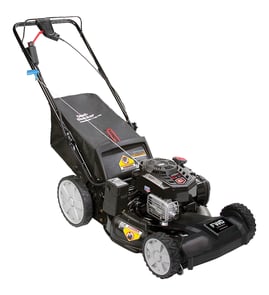



Should I use 87 or 91 gas for lawn mower?
For your Craftsman walk-behind mower model 917378891, use 87-octane (regular) unleaded gasoline for normal operation. Higher octane (like 91) does not add power in a typical small mower engine; the most important thing is using fresh, clean fuel and storing it correctly per the owner's manual.
- Use: Fresh 87 octane unleaded gasoline.
- Avoid: Stale fuel (old gas is a top cause of no-start issues).
- Avoid: Fuel contaminated with water, rust, or dirt (it can cause running problems).
- Do not store gas from one season to the next; start each season with fresh fuel.
- Replace a rusty gas can; rust and debris end up in the tank and carburetor.
| Fuel choice | OK for 917378891? | What it does | Best practice |
|---|---|---|---|
| 87 octane (regular) | Yes | Correct for normal mowing | Use fresh fuel; keep container clean |
| 91 octane (premium) | Yes, but unnecessary | No performance benefit in most mower engines | Only use if it is the freshest fuel available |
| Old/stale gasoline | No | Causes hard starting and poor running | Drain and refill with fresh gasoline |
| Dirty/rusty container fuel | No | Can clog carburetor jets | Replace the gas can if it is rusting |
The manual’s troubleshooting points to fuel quality as a common cause. Use this checklist:
- Confirm the tank has fresh gasoline (not last season’s fuel).
- If fuel is old, empty the tank and refill with fresh, clean gasoline.
- Check for water in fuel; if suspected, drain and refill.
- Inspect the ignition system basics (spark plug wire connected, spark plug condition).
- If you suspect a starting or ignition issue, keep a spare key on hand; the molded ignition key 532180331 is a common replacement item.
Small mower engines are sensitive to fuel condition. Fresh, clean gasoline helps prevent hard starting, surging, and carburetor problems, and it supports reliable performance through the mowing season.
Last updated: February 2026
What year is Craftsman Model 917378891?
Craftsman model 917378891 is identified by its model number, not by a built-in “year” code. For the most accurate dating, we use the product ID/serial information shown on the mower’s ID label and match it to the model documentation in the owner's manual.
On Craftsman walk-behind mowers like 917378891, the model number alone does not reliably decode the year. Use these steps instead:
- Look for the model/serial label on the mower deck (often near the rear wheel area) or on the handle support.
- Write down the serial number exactly as shown.
- Compare the label details to the identification and parts information in the owner's manual.
- If the label is damaged, clean it gently and take a clear photo before the text fades further.
- Use the model number 917378891 when searching parts so you get the correct diagrams and part matches.
| Item | What it tells you | What to use it for |
|---|---|---|
| Model number (917378891) | The exact mower design and parts breakdown | Ordering correct parts and using the right manual |
| Serial number (from ID label) | Production run details (often includes date coding) | Determining the mower’s approximate build year |
The build year affects small but important fit details, especially on wear items and drive components. For example, the correct drive system parts for this model include items like the lawn mower ground drive belt, 3/8 x 32-1/2-in 532175436 and the lawn mower engine zone control cable 532184588. Using the right identification info helps prevent ordering a part that looks similar but mounts differently.
When you are ready to replace parts for Craftsman 917378891, order from the parts list for this model, or search by model number on Sears PartsDirect.
Last updated: February 2026
How to find Craftsman model number?
On your Craftsman walk-behind mower, the model and serial numbers are printed on a decal on the rear of the mower housing. For model 917378891, use that decal information to match the correct parts list and the correct owner's manual.
Check these common spots on the mower body (not the engine):
- Rear of the mower deck or rear housing panel (most common)
- Back edge of the deck near the discharge opening
- Near the height adjuster area on the deck
- On the handle mounting area (less common)
- Under heavy grass buildup (wipe the area clean first)
Record both numbers exactly as shown:
- Model number (example format: 917.378891)
- Serial number
- Date of purchase (helpful for maintenance tracking)
The model number identifies the exact deck, drive system, and handle configuration so you get the right replacement parts (for example, a drive belt, wheel, or control cable) and the right torque and adjustment specs.
Use this table to avoid mix-ups when ordering parts.
| Item on the decal | What it’s used for | Tip |
|---|---|---|
| Model number | Matching the correct parts diagrams | Use all digits (917378891) |
| Serial number | Identifying production run details | Copy it exactly, including letters |
| Engine model (if listed) | Engine-specific tune-up parts | Engine numbers do not replace the mower model number |
Use these steps to identify the mower accurately:
- Compare your mower’s features to the diagrams in the owner's manual
- Look for a stamped or printed number on the rear deck area after cleaning
- Match key components to the parts list, such as the lawn mower ground drive belt, 3/8 x 32-1/2-in 532175436 or the lawn mower wheel 582976701
- If your mower uses a key start, match the ignition parts such as the lawn mower key start switch and key 532189686
- Order parts from the model parts list first; for broader model searches, use Sears PartsDirect
Last updated: February 2026
How much does it cost to repair a hydrostatic transmission on a lawn mower?
Hydrostatic transmission repairs are typically a riding-mower cost category; your Craftsman walk-behind mower model 917378891 usually uses a belt-and-gear drive system instead of a hydrostatic transmission. For riding mowers that do have hydrostatic drive, repairs commonly run $300 to $2,500, depending on whether you’re fixing a linkage/seal or replacing the full transaxle; confirm your drive type in the owner's manual.
Hydrostatic costs vary because the “transmission” can mean anything from a simple control issue to a full unit replacement.
- Diagnosis and adjustment (linkage, control cable, drive engagement)
- Fluid leak repair (seals, gaskets, axle seals)
- Hydrostatic fan or pulley replacement (if equipped)
- Full hydrostatic transaxle replacement (highest cost)
- Labor time (often the biggest variable)
For model 917378891, the parts list and manual focus on typical walk-behind components (blade, blade adapter, wheels, control cable). If your mower is self-propelled but not hydrostatic, a drive issue is more often belt, cable, or wheel-drive related.
| Drive type | Common symptoms | Typical repair approach |
|---|---|---|
| Hydrostatic (usually riding) | Won’t move, weak drive hot/cold, fluid leaks | Seal repair, linkage adjustment, or transaxle replacement |
| Belt/gear self-propelled (common walk-behind) | Slips, won’t pull, intermittent drive | Belt/cable adjustment, wheel/gear service |
If your Craftsman 917378891 is not moving, we start with the self-propelled drive components and controls.
- Inspect the drive control and cable routing; replace if stretched or binding
- Check the ground drive belt for glazing, cracking, or slack
- Verify wheel drive engagement and wheel condition
- Confirm the blade area is clear (debris can affect operation and safety)
Helpful model-matched parts to consider:
- Lawn mower engine zone control cable 532184588
- Lawn mower ground drive belt, 3/8 x 32-1/2-in 532175436
- Lawn mower wheel 582976701
Hydrostatic repairs can be expensive because the drive unit is often sealed and labor-intensive to access. On a walk-behind mower like 917378891, solving a “won’t move” complaint is usually faster and less costly because the drive system is simpler and uses serviceable wear parts.
If you need to order replacement parts for your Craftsman 917378891, use the parts list for this model or search by model number on Sears PartsDirect.
Last updated: February 2026