 Owner’s manual

What is the 4 inch rule for drill press?
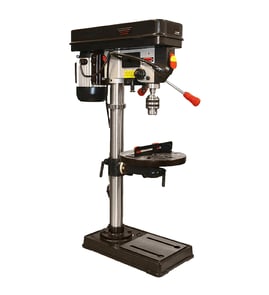
The 4-inch rule for a drill press is a safety best practice: we keep our hands at least 4 inches away from the rotating drill bit and any cutting accessory. On the Craftsman 113213213 20" industrial rated drill press, this helps prevent sudden contact if the bit grabs, the workpiece shifts, or kickback occurs.
How to follow the 4-inch rule (practical steps)
- Clamp the workpiece to the table whenever possible; clamping reduces spinning and kickback risk.
- Use a vise, V-block, or fixture for small or round stock instead of holding it by hand.
- Use a brush or vacuum to clear chips; never sweep chips away with your fingers near the bit.
- Stop the machine before measuring, marking, or repositioning the work.
- Remove the switch key when you step away so the drill press cannot be started accidentally.
What the manual emphasizes for this model
The owner's manual for the Craftsman 113213213 focuses on keeping fingers out of the tool path, clamping work to prevent grabbing, and avoiding setup work while the cutting tool is rotating.
Related safety limits called out in the manual
| Topic | What to do | Why it matters |
|---|---|---|
| Large hole cutting | Clamp firmly; use one-piece cup-type cutters; keep speed below 1,500 RPM | Reduces grabbing and spinning work |
| Bit length | Do not use a drill that exceeds 7 inches in length or extends 6 inches below the chuck jaws | Helps prevent bending or breakage |
| Stability | Bolt the drill press down if it tends to move or tip | Prevents shifting during drilling |
Why it matters
A drill press can pull hands in faster than you can react, especially if the bit binds or the workpiece spins. Keeping a 4-inch buffer forces us to use clamps and fixtures, which is the safest way to control the work.
Last updated: February 2026
When to use a drill press vs. a drill?
Use a drill press (like the Craftsman 113213213 20" industrial rated drill press) when you need repeatable accuracy: straight holes, consistent depth, and better control on larger bits or harder materials. Use a handheld drill for quick, portable work where perfect alignment and depth are not critical.
Best times to use a drill press
A drill press is the right choice when precision and safety depend on controlling the workpiece and the bit.
- Drilling multiple holes that must line up exactly
- Drilling to a repeatable depth using the depth scale and depth scale lock
- Cutting larger diameter holes (with the work clamped securely)
- Reducing wobble and vibration by setting up the tool, then jogging the motor switch before drilling
- Keeping the work supported on the table (not freehand)
Best times to use a handheld drill
A handheld drill is usually better when the job is simple, access is tight, or the work cannot be brought to the drill press.
- Fast pilot holes in wood or drywall
- Working on installed assemblies (cabinets, framing, fences)
- Drilling in awkward positions where a table and vise cannot be used
- Occasional holes where minor angle variation is acceptable
Safety and setup differences that matter
The 113213213 drill press is designed around clamping and controlled feed. For safe, accurate drilling, we follow the same basics the manual calls out.
| Task | Drill press approach | Handheld drill approach |
|---|---|---|
| Work holding | Clamp to table; use backup material | Hold or clamp as needed |
| Hole accuracy | High (fixed spindle and table) | Medium (depends on user control) |
| Depth control | Depth scale and lock | Mark bit or use a stop collar |
| Risk of work spinning | Higher if not clamped | Lower, but still possible |
Why it matters
Choosing the right tool helps prevent oblong holes, broken bits, and workpieces grabbing and spinning. On a drill press, clamping the work and locking the head and table before operation is a key safety step.
For model-specific operating and safety details (including clamping guidance and accessory limits), follow the owner's manual.
Last updated: February 2026
What can I use instead of a drill press?
If you do not have a drill press like the Craftsman 113213213, the best substitutes are a handheld drill paired with a drill guide, a drill stand, or a simple jig that helps you keep the bit square. These options help you drill straighter, safer holes than freehand drilling.
Best drill press alternatives (from most to least accurate)
- Portable drill guide (90-degree guide): Keeps the drill perpendicular for cleaner, more repeatable holes.
- Drill stand (bench-top drill stand): Turns a handheld drill into a press-style setup for better control.
- Doweling jig or drilling jig: Great for woodworking; guides the bit and controls hole placement.
- Right-angle drill attachment: Helps in tight spaces, but it is not a precision substitute.
- Handheld drill with a square as a visual reference: Works for quick jobs, but accuracy depends on technique.
How to get straighter holes without a drill press
- Clamp the workpiece to a stable surface so it cannot spin or shift.
- Use backup material under the workpiece to reduce tear-out when the bit breaks through.
- Start with a center punch or pilot hole to keep the bit from walking.
- Keep the drill speed appropriate for the bit size and material.
- Clear chips often by backing the bit out periodically.
Safety rules we follow (especially important without a press)
The drill press manual emphasizes controlling the workpiece to prevent kickback and spinning. Apply the same mindset with any substitute setup:
- Never hold small parts in your hand while drilling
- Clamp the workpiece whenever possible
- Keep hands clear of the rotating bit
- Do not do setup work while the tool is rotating
- Use stable support so the work cannot tip or bind
Quick comparison
| Option | Accuracy | Best for | Typical limitation |
|---|---|---|---|
| Portable drill guide | High | Straight holes in wood/metal | Needs solid clamping |
| Drill stand | High | Repeated drilling | Takes bench space |
| Doweling jig | Medium to high | Wood joinery | Limited to certain hole patterns |
| Freehand + square | Low to medium | Quick, non-critical holes | Easy to drill off-angle |
Why it matters
A drill press gives you controlled feed and alignment; substitutes work best when you recreate those two advantages with guides, clamping, and backup material. For model-specific operating and safety practices, we follow the 113213213 owner's manual.
Last updated: February 2026
How to repair a drill press spindle?
On the Craftsman 113213213 20" industrial rated drill press, “spindle repair” usually means fixing chuck wobble or runout by cleaning and reseating the arbor and chuck, then addressing worn spindle bearings if wobble remains. Use the owner's manual for safe disassembly and correct chuck installation.
Safety and prep
- Turn the switch OFF and unplug the drill press before service.
- Protect the table with a scrap board when seating the chuck.
- Keep hands clear of pinch points around the quill and feed handles.
- Cleanliness matters; dirt on tapers causes wobble.
Fix wobble first: reseat the arbor and chuck
Most spindle complaints on this model come from a dirty or improperly seated taper.
- Remove the chuck using the drift key method described in the manual.
- Clean the tapered surfaces on the arbor and spindle with a clean cloth.
- Slide the arbor into the spindle; push up while rotating until the rectangular end slips into the spindle notch.
- Raise the table to about 2 inches below the chuck tip, open the jaws fully, then use the feed handles to press the chuck firmly against the table to lock the taper.
If wobble remains: check bearings and other causes
- Try a straight drill bit to rule out a bent bit.
- Confirm the bit is clamped correctly in the chuck.
- Recheck that the chuck is fully seated on a clean taper.
- Inspect for worn spindle bearings (a common cause of persistent runout).
- If vibration is also present, adjust belt tension and tighten pulley fasteners.
| Symptom | Likely cause | Next step |
|---|---|---|
| Chuck won’t stay seated | Dirty taper or arbor not in notch | Clean and reseat |
| Runout with multiple bits | Worn spindle bearings | Replace bearings |
| Vibration under load | Belt tension or pulley hardware | Adjust and tighten |
Why it matters
A taper that is not fully seated can let the chuck come loose during operation and it also creates runout that looks like a bent spindle.
Last updated: February 2026
What is a good horsepower for a drill press?
For most home-shop drilling, 3/4 to 1 HP is the best all-around drill press motor size; it handles wood and moderate metal drilling without bogging down. For frequent large-hole drilling in steel, step up to 1-1/2 to 3 HP. Use the 113213213 owner's manual to confirm your drill press motor requirements and safe operating limits.
Quick horsepower guide
- 1/3 to 1/2 HP: light-duty wood, plastics, small bits
- 3/4 to 1 HP: best all-around for wood plus moderate metal drilling
- 1-1/2 to 2 HP: frequent metal drilling, larger bits, tougher workloads
- 3+ HP: production work or very large cutters (often better served by dedicated equipment)
Model-specific notes for Craftsman 113213213
Your Craftsman 113213213 drill press uses a belt-and-pulley drive with 12 fixed spindle speeds. You set speed by moving the belt to the correct pulley steps (use the chart inside the belt guard).
Listed spindle speeds (RPM): 150, 260, 300, 440, 490, 540, 1150, 1550, 1840, 2220, 2950, 4200.
| If you are drilling | Best setup | What horsepower helps with |
|---|---|---|
| Small bits in wood | Higher RPM, light feed | Smooth drilling without stalling |
| General shop use | Match RPM to material, steady feed | Less belt slip, better torque |
| Larger holes in metal | Lower RPM, cutting oil, clamp work | Prevents bogging and overheating |
Why it matters
Horsepower and speed work together. Using the correct RPM and not forcing the feed reduces bit overheating, belt slip, rough holes, and workpiece grabbing, especially when drilling larger diameters.
Last updated: February 2026