Owner’s manual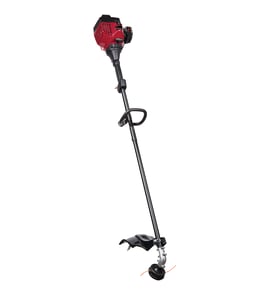



Is the .095 trimmer line good?
.095-inch trimmer line is a strong, all-purpose choice for many homeowners because it holds up well in thicker grass and light weeds. For Craftsman model 316791870, the operator manual lists a specific line type and diameter; matching that spec gives the best feed, cut quality, and head life.
What our manual says for Craftsman 316791870
The 316791870 trimmer is designed around a specific line diameter and line style for its Hassle Free head. Use the spec in the 316791870 operator's manual to avoid poor feeding, extra vibration, or premature head wear.
- Confirm the recommended line diameter before buying bulk spools.
- Match the line shape/type (for example, spiral or round) when possible.
- If you go thicker than recommended, the head can bind and the engine can bog.
- If you go thinner than recommended, it can break faster and cut less aggressively.
When .095 line is a good pick (and when it is not)
In general, .095 line performs best when you need durability more than maximum runtime per spool.
- Good for: thicker grass, fence lines, edging, and occasional contact with rough surfaces.
- Not ideal for: very small engines, light trimming only, or heads rated for thinner line.
- If the trimmer struggles at full throttle, step down to the manual’s diameter.
Quick comparison
| Line diameter | Typical use | Tradeoff |
|---|---|---|
| .065 to .080 | light grass, detail trimming | breaks easier, less aggressive cut |
| .085 | general trimming | balanced durability and load |
| .095 | heavier trimming, tougher weeds | more engine load, can reduce RPM |
Why it matters
Using the correct trimmer line diameter helps your 2-cycle engine stay in its power band, keeps the cutting head feeding smoothly, and reduces stress on the drive system and clutch.
Last updated: January 2026
How to unflood a string trimmer?
On the Craftsman 316791870 gas line trimmer, an engine that will not start after repeated pulls is often flooded. We unflood it by stopping fuel enrichment, opening the throttle, and pulling the starter rope until it begins to fire, then running it briefly to warm up (per the starting steps in the 316791870 owner's manual).
Quick unflood steps (works for most 2-cycle trimmers)
- Move the On/Off stop control to Start/On.
- Set the choke or starting lever to the run position (not full choke). On this model, the red EZ-Fire lever should click off when you squeeze the throttle.
- Hold the throttle control open and pull the starter rope until the engine attempts to start.
- When it starts, keep squeezing the throttle for 15 to 30 seconds to warm the unit.
- If it sputters and dies, keep the throttle held and pull again until it stays running.
If it is still flooded
Check these common causes
- Primer bulb pressed too many times.
- Old or improperly mixed 2-cycle fuel.
- Fouled spark plug.
- Plugged air filter.
What to do next (simple checks)
| Symptom | Most likely cause | Next step |
|---|---|---|
| Strong fuel smell, wet plug | Flooded engine | Hold throttle open; pull to clear |
| Starts then dies | Dirty air filter or fuel issue | Clean/replace filter; refresh fuel |
| No start at all | Fouled plug | Inspect, dry, and gap plug |
If the air filter is fuel-soaked or heavily dirty, replacing it can restore airflow and make starting easier; the engine air filter 791-180350B is a common service item for this trimmer family.
Why it matters
Flooding loads the cylinder with excess fuel, which prevents proper ignition. Clearing the extra fuel and restoring airflow (throttle open, choke off, clean filter) gets the air-fuel mix back into a range the ignition system can light.
Last updated: January 2026
How to replace line on Craftsman gas trimmer?
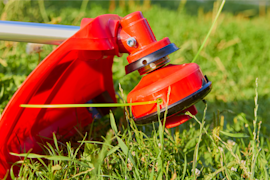
On the Craftsman 316791870 gas line trimmer, we replace trimmer line by removing the old line and line glide plate, reinstalling the glide plate in the correct position, then feeding a new length of line through the correct holes in the cutting head and pulling it even. See the 316791870 owner's manual for the hole and glide-plate position details.
Steps to replace the trimmer line (Hassle-Free cutting head)
- Shut the engine off and let the cutting head stop completely.
- Remove the old line and remove the line glide plate from the cutting head.
- Clean the entire surface of the cutting head.
- Reinstall the line glide plate before installing new line.
- Set the glide plate position:
- Align the arrow to A for medium (red) or large (black) line.
- Align the arrow to B for line smaller than medium (red).
- Insert both ends of the new line through the proper holes in the side of the cutting head.
- Pull both ends until the line lengths are even.
Quick checklist (to prevent tangles and poor cutting)
- Use the line size recommended for the job (grass vs. heavier weeds).
- Feed both ends through the correct pair of holes (match the glide plate directions).
- Keep the two line ends even in length after pulling through.
- Make sure the line glide plate is installed (the head will not feed correctly without it).
- Do not remove the cutting head from the trimmer just to replace line.
Line selection guide
| Line type | Best for | Glide plate setting |
|---|---|---|
| Medium (red) | Grass and small weeds | A |
| Large (black) | Larger weeds and light brush | A |
| Smaller than medium | Light trimming | B |
Why it matters
Correctly positioning the line glide plate and feeding the line through the proper holes helps the line track smoothly and reduces tangling, vibration, and uneven cutting. It also keeps the cutting head working as designed on the Craftsman 316791870.
Last updated: January 2026
What is the fuel mix for a Craftsman gas trimmer?
For the Craftsman gas line trimmer model 316791870, we use a 40:1 gasoline-to-2-cycle oil fuel mix. That ratio equals 3.2 fl oz of 2-cycle oil per 1 US gallon of unleaded gasoline (or 25 ml oil per 1 liter gas); mix it in a separate fuel can.
Quick mix chart (40:1)
| Gasoline amount | 2-cycle oil amount | Notes |
|---|---|---|
| 1 US gallon | 3.2 fl oz (about 95 ml) | Mix in a clean fuel can |
| 1 liter | 25 ml | Same 40:1 ratio |
How we recommend mixing fuel
- Use fresh, unleaded gasoline and quality 2-cycle engine oil.
- Measure oil first, then add gasoline to the fuel can.
- Cap the can and shake to blend thoroughly.
- Fill the trimmer only after the mix is fully blended.
- Never mix gas and oil directly in the trimmer’s fuel tank.
Why it matters
A correct 40:1 fuel/oil mixture protects the 2-cycle engine from poor lubrication (too little oil) and heavy smoke, plug fouling, and carbon buildup (too much oil). Following the specified ratio helps the trimmer start easier and run more reliably.
Related parts that often come up with fuel issues
If the trimmer runs poorly even with the right mix, these fuel-system items are common wear points:
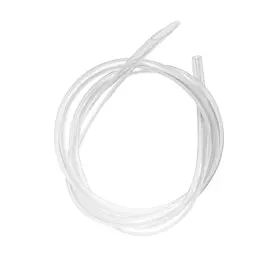
- Mtd yard machines line trimmer fuel line 791-181086 (cracked or leaking lines)
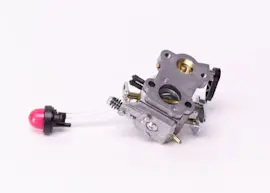
- Mtd yard machines line trimmer primer bulb and hose assembly 791-683974B (won’t prime or collapses)
- Air filter maintenance (restricted airflow can mimic fuel problems)
For model-specific fuel and maintenance details, follow the 316791870 operator's manual.
Last updated: January 2026