Owner’s manual
 Error Codes




How to find Samsung fridge part number?
To find the correct part number for your Samsung refrigerator model RF28JBEDBSR, we match parts using the model/serial label inside the fresh food compartment, then confirm the part on the parts diagram or in the RF28JBEDBSR owner's manual. This prevents ordering a look-alike part that will not fit.
On most Samsung French door and bottom-mount refrigerators like RF28JBEDBSR, the model/serial label is inside the refrigerator compartment (often on a side wall near the crisper area).
- Open the fresh food doors and look along the left or right interior wall
- Write down the model number and serial number exactly as shown
- If the label is hard to read, take a clear photo and zoom in
- Use the model number to narrow parts; use the serial number when revisions matter
Once you have the model number, confirm the part by name and function (not just by appearance).
- Identify the symptom or the part you are replacing (water filter, auger motor, temperature sensor)
- Compare the part description to your refrigerator’s location and connections
- If multiple versions exist, match any markings on the old part (stickers, stamped numbers)
- For maintenance items, follow the replacement interval and reset steps in the manual
| What you are replacing | What to match | Example part listed for RF28JBEDBSR |
|---|---|---|
| Water filter | Filter style and housing fit | DA29-00020B |
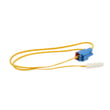
| Temperature sensor | Sensor location and connector | DA32-10104N or DA32-00033C |
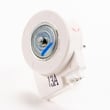
| Ice dispensing issue | Ice bucket fit, auger drive | DA97-14474C or DA97-12540G |
Samsung refrigerators often have multiple part revisions across production runs. Using the exact model/serial information helps us select the correct refrigerator water filter, control board, sensor, or door hardware the first time and avoids returns and downtime.
For water filter questions specifically, use our step-by-step guide: how to replace the water filter in a Samsung refrigerator.
Last updated: February 2026
How to reset a Samsung refrigerator ice maker?
To reset the ice maker on your Samsung RF28JBEDBSR, we press and hold the ice maker Test/Reset button until you hear a chime (or the unit starts a test cycle). After a successful reset, allow up to 24 hours for normal ice production to fully return; confirm the freezer is set cold enough.
- Remove the ice bucket/bin.
- Locate the Test/Reset button on the ice maker (often blue/gray, sometimes marked with an arrow).
- Press and hold the button until you hear a chime (typically several seconds).
- Reinstall the ice bucket and close the door.
- Wait for the harvest and refill cycle to complete.
- Make sure the ice maker is turned ON (if your model has an on/off setting).
- Verify freezer temperature is about 0°F to 5°F for reliable ice production.
- Confirm the water supply valve is fully open and the water line is not kinked.
- Replace an overdue water filter; restricted flow can stop ice production.
- Dump old/clumped ice and reseat the bucket fully.
- Power cycle the refrigerator: unplug (or switch breaker off) for 2 minutes, then restore power and retry the reset.
| Symptom | Most common cause | What we check/replace |
|---|---|---|
| Small cubes or slow ice | Low water flow | Refrigerator water filter DA29-00020B |
| No ice, dispenser weak too | Filter or supply issue | Filter, shutoff valve, line |
| Ice clumps or jams | Bucket/auger issue | Bucket seating, auger area |
A reset forces the ice maker to run a test cycle so we can confirm it is getting power, the mechanism can move, and the unit can call for water. If the reset works but ice stays slow, water flow (often the filter) and freezer temperature are the two fastest fixes.
For model-specific button location and indicator behavior, use the RF28JBEDBSR manual.
You can also use our troubleshooting guide: why your Samsung fridge stopped making ice and how to fix it.
Last updated: February 2026
Is RF28JBEDBSR a side by side refrigerator?
No. Samsung model RF28JBEDBSR is a bottom-mount (French door) refrigerator, not a side-by-side. In a bottom-mount design, the fresh food section is on top and the freezer is a pull-out drawer on the bottom; see the RF28JBEDBSR owner's manual for the exact layout and feature set.
- French door/bottom-mount: two upper doors, freezer drawer on the bottom
- Side-by-side: full-height refrigerator door on one side, full-height freezer door on the other
- Bottom-mount benefit: easier access to fresh food at eye level
- Side-by-side benefit: narrow door swing, tall freezer storage
Parts are often organized by the compartment they serve. For RF28JBEDBSR, many common service items relate to the ice and water system and the bottom freezer section.
| Refrigerator style | Freezer location | Typical door layout |
|---|---|---|
| Bottom-mount (French door) | Bottom drawer | Two upper doors + one lower drawer |
| Side-by-side | Left or right vertical section | Two full-height doors |
Ordering the right parts depends on the refrigerator style and internal layout. For example, water filtration and ice storage components are model-specific; if you are replacing the filter, match it to the correct Samsung part such as the refrigerator water filter DA29-00020B.
Last updated: February 2026
Is it worth replacing the ice maker on a refrigerator?
Yes, replacing the ice maker is usually worth it when the refrigerator is otherwise cooling normally and the rest of the unit is in good shape; for Samsung model RF28JBEDBSR, it often makes sense because an ice-making problem is frequently isolated to the ice system, water supply, or filtration. Use the RF28JBEDBSR owner's manual to confirm the exact ice maker checks and reset steps for your control panel.
- The refrigerator and freezer temperatures are stable (food stays safely cold).
- The repair cost is clearly less than about half the cost of replacing the refrigerator.
- The issue is limited to ice production (no widespread cooling, defrost, or electrical problems).
- You have verified water flow at the dispenser (if equipped) and the shutoff valve is fully open.
- You are not seeing repeated icing or freezing in the ice room that keeps coming back.
Many “bad ice maker” symptoms are caused by restricted water flow or a frozen fill path.
- Replace the water filter on schedule; a clogged filter can slow fill and stop ice production.
- Flush the system after a filter change (several gallons total) to clear air and carbon fines.
- Inspect the ice bin for clumps and the auger area for jams.
- Look for frost buildup around the ice area that can block the fill tube.
- Power-cycle the refrigerator for a few minutes, then retry an ice maker reset.
Helpful parts for common ice and water complaints:
| Symptom | Most common cause | Part to consider for RF28JBEDBSR |
|---|---|---|
| Slow water, small cubes, no ice | Restricted filtration | Refrigerator water filter DA29-00020B |
| Ice dispenses poorly or jams | Ice clumping or bin damage | Samsung refrigerator ice container DA97-14474C |
| Ice maker runs but output is inconsistent | Temperature sensing/airflow issue | Refrigerator temperature sensor DA32-10104N |
Replacing the ice maker is usually not the best spend when the refrigerator has bigger reliability or cooling problems.
- The freezer is warm or temperatures swing widely.
- You hear the compressor or fans struggling and cooling performance is declining.
- You have multiple recurring failures (ice plus cooling plus electrical symptoms).
An ice maker depends on steady freezer temperature, good airflow, and consistent water pressure. If those basics are solid, an ice maker repair is typically a targeted fix that restores convenience without the cost and disruption of replacing the entire refrigerator.
Last updated: February 2026
What are the dimensions of the Samsung RF28JBEDBSR?
The Samsung RF28JBEDBSR measures 35 3/4 in. wide and is about 70 in. tall with hinges; depth varies by configuration (about 36 1/2 in. with handles, or about 29 3/8 in. without hinges and doors). For the exact fit notes and clearances, use the RF28JBEDBSR owner's manual.
Use the set that matches how you plan to install the refrigerator (handles on or off, hinges included or not):
- With hinges, handles, and doors (W x H x D): 35 3/4" x 70" x 36 1/2"
- Without hinges and door (W x H x D): 35 3/4" x 68 7/8" x 29 3/8"
- With hinge and door, no handle (W x H x D): 35 3/4" x 70" x 34"
| Setup | Width | Height | Depth |
|---|---|---|---|
| Hinges + handles + doors | 35 3/4" | 70" | 36 1/2" |
| No hinges + no door | 35 3/4" | 68 7/8" | 29 3/8" |
| Hinges + doors, no handles | 35 3/4" | 70" | 34" |
- Approximate weight: 390.2 lb
Correct width, height, and depth help prevent installation problems like doors that cannot open fully, drawers that hit cabinetry, or a refrigerator that cannot slide into the cutout. Using the “with handles” depth is especially important for tight kitchen aisles.
Last updated: February 2026
What is the common problem with Samsung fridge ice maker?
On the Samsung RF28JBEDBSR, the most common ice maker problems are ice production stopping, ice clumping or freezing in the bin, frost buildup around the ice room, and weak or jammed dispensing. These issues usually trace back to airflow and temperature problems, water supply restrictions, or ice maker components icing up.
- No ice at all: water supply off, low water pressure, frozen fill tube, or a restricted filter
- Small, hollow, or slow ice: restricted water flow (often the filter) or low pressure
- Ice clumps or freezes into a block: temperature too cold, warm air leaks, or frequent door openings
- Frost/ice buildup near the ice maker: door seal leak, ice room not sealing, or humid air intrusion
- Dispenser motor hums but no ice dispenses: ice jam in the bucket or auger drive issue
- Confirm the freezer is set near 0°F and the fresh food section near 37°F.
- Make sure the ice maker is turned ON and the ice bin is seated fully.
- Check the water line shutoff valve is fully open and the supply line is not kinked.
- Replace the filter if it is overdue; a restricted filter commonly causes slow fill and poor cubes.
- Empty the ice container, break up clumps, and reinstall it to clear jams.
| What you notice | Likely area | Example part for RF28JBEDBSR |
|---|---|---|
| Slow fill, hollow cubes | Water filtration or supply | Refrigerator water filter DA29-00020B |
| Ice won’t dispense, bucket jams | Ice bucket or auger drive | Samsung refrigerator ice container DA97-14474C |
| Frost buildup, inconsistent temps | Cooling/airflow control | Condenser fan, evaporator cover, air damper |
Ice makers are sensitive to both water flow and freezer temperature stability. A slightly restricted filter, a small air leak, or a freezer running too cold can quickly lead to freezing, clumping, and repeated jams.
- Use the RF28JBEDBSR owner's manual for the exact control settings, ice maker on/off location, and any reset steps.
- For step-by-step troubleshooting and prevention tips, follow why your Samsung fridge stopped making ice and how to fix it.
Last updated: February 2026
What is the most common problem with Samsung refrigerators?
The most common problem we see on Samsung refrigerators like model RF28JBEDBSR is a cooling complaint caused by airflow restriction from frost or ice buildup on the evaporator area. Close behind are ice maker and dispenser issues (slow ice production, clumping, or no ice), often tied to temperature, airflow, or water supply.
- Fresh food section warm but freezer still cold
- Frost or a “snowy” panel inside the refrigerator compartment
- Fan noise, rattling, or a fan that stops when ice builds up
- Ice maker stops producing or makes small/hollow cubes
- Water dispenser flow slows down over time
- Confirm temperatures: set refrigerator to about 37°F and freezer to about 0°F.
- Check door sealing: look for gaps, torn gaskets, or doors not closing fully.
- Look for frost patterns: heavy frost behind the interior rear panel points to a defrost or airflow issue.
- Check condenser airflow: make sure the condenser area is not packed with dust and the fan can move air.
- Rule out filter restriction: a clogged filter can reduce water flow and affect ice maker fill.
| Problem area | What you notice | Parts that commonly relate |
|---|---|---|
| Defrost/temperature sensing | Frost buildup, warming fridge | Temperature sensor, evaporator components |
| Airflow control | Uneven temps, warm spots | Air damper assembly |
| Ice and water system | No ice, slow fill, slow dispense | Water filter, ice container, auger motor |
If you are troubleshooting ice or water performance on RF28JBEDBSR, we often start with the refrigerator water filter DA29-00020B and then move to ice delivery components like the refrigerator auger motor assembly DA97-12540G if the dispenser is not pushing ice properly.
Cooling and ice maker problems usually share the same root causes: temperature stability and airflow. Fixing frost buildup, restoring fan airflow, and keeping water flow strong prevents food spoilage, reduces ice clumping, and helps the compressor run less.
Use the defrost, temperature, and diagnostic guidance in the RF28JBEDBSR owner's manual to match your exact symptom to the right checks (especially if you see error codes or repeated icing).
Last updated: February 2026
Why is ice forming in the bottom of my Samsung fridge?
Ice at the bottom of your Samsung RF28JBEDBSR refrigerator almost always comes from water that cannot drain away during defrost. The usual causes are a clogged or frozen defrost drain, warm humid air leaking past the door gasket, or airflow issues that create excess frost.
- Frozen or clogged defrost drain: Meltwater backs up, refreezes, and builds into a sheet of ice.
- Door not sealing: A torn, dirty, or warped gasket lets humid air in, which turns into frost and then meltwater.
- Frequent door openings or overloading: Adds humidity and blocks vents, increasing frost.
- Temperature set too cold: Can increase frost buildup and overwhelm the drain path.
- Ice maker or dispenser area frost: Can drip and refreeze if the ice room is icing up.
- Unplug the refrigerator and remove food from the affected area.
- Melt the ice with the doors open (towels under the area). Avoid sharp tools.
- Clear the drain path: After ice melts, flush the drain with warm water (a turkey baster works well) until it flows freely.
- Inspect the door gasket: Clean it with warm soapy water; confirm the door closes evenly.
- Confirm airflow: Make sure packages are not blocking vents in the fresh food section.
If the drain keeps freezing, a drain component or cooling system issue can be involved.
| Symptom you see | Likely area | What we typically do |
|---|---|---|
| Ice sheet under crisper drawers | Defrost drain system | Defrost and flush drain, verify drain parts are seated |
| Water pooling then freezing | Drain restriction | Clear blockage, check drain cap fit |
| Warm temps plus frost | Cooling/airflow | Check fans, coils, and airflow paths |
If you need to replace a drain component, the refrigerator drain cap DA67-01301A is one of the parts used in the drain area on this model family.
When defrost water cannot drain, it refreezes and can eventually cause leaks, odors, and poor cooling. Fixing the drain and sealing issues early helps protect the evaporator area and keeps temperatures stable.
For model-specific locations and access steps, follow the RF28JBEDBSR owner's manual.
Last updated: February 2026