Owner’s manual
 View engine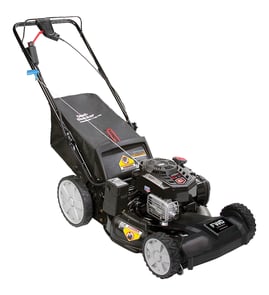


Is it cheaper to repair or replace a lawn mower?
For a Craftsman walk-behind mower like model 917376165, repairing is cheaper when the problem is a normal wear item (blade, belt, cable) or a simple tune-up; replacement makes more sense when the engine or drive system needs major work and the repair total approaches about half the cost of a comparable new mower.
- Repair when parts are inexpensive and the job is straightforward (typical maintenance or a single failed part).
- Replace when multiple systems are failing (engine performance plus self-propel drive issues) or when the repair estimate is high.
- Use the 50% rule: if the repair (parts plus labor) is near 50% of replacement cost, replacement is usually the better value.
These are the types of fixes that typically keep a mower economical to repair:
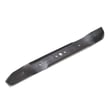
- Replace a worn or bent blade such as the lawn mower blade 532406713
- Replace a slipping self-propel belt such as the ground drive belt 532196857
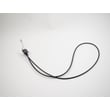
- Replace a stretched/binding drive cable such as the drive control cable 583261801
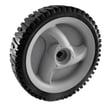
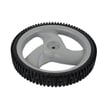
- Replace worn drive wheel components such as the lawn mower wheel and tire, 8 x 1.75-in 583719501
- Sharpen and balance the blade, then verify safe reinstallation (see the owner's manual)
| Situation | Typical best choice | Why |
|---|---|---|
| Routine maintenance (blade, air filter, spark plug) | Repair | Low parts cost, improves performance and lifespan |
| Self-propel slips but engine runs strong | Repair | Often belt, cable, or wheel drive parts |
| Engine has low power, hard starting, or internal damage | Replace | Major engine work can exceed mower value |
| Multiple failures at once (drive plus engine plus deck damage) | Replace | Costs stack quickly |
Your 917376165 manual calls out regular maintenance (for example, checking blade wear and replacing wear items) because upkeep prevents bigger failures that push you into replacement territory. Staying on schedule also protects performance and cut quality.
Last updated: February 2026
What are the common problems with Craftsman lawn mowers?
Common problems on the Craftsman 917376165 walk-behind mower include no-start conditions (fuel, spark, airflow), loss of drive or slow self-propelled speed, poor or uneven cutting, excessive vibration, and a starter rope that’s hard to pull. Our owner's manual troubleshooting chart maps these symptoms to the most likely causes.
- Won’t start or starts then dies: old fuel, dirty air filter, fouled spark plug, fuel valve not ON (if equipped)
- Loss of drive or slow drive speed: grass or debris packed in the drive wheel area; worn drive components
- Poor cut or uneven cut: blade worn/bent/loose; deck packed with grass; wheel heights uneven
- Excessive vibration: blade damage or looseness; bent crankshaft (stop using until inspected)
- Starter rope hard to pull: blade dragging in grass; flywheel brake engaged; blade adapter issues
The manual calls out a frequent self-propelled problem: front drive wheels that do not turn freely because debris is packed in the drive wheel area. Cleaning the dust cover, pinion, and gear teeth often restores drive.
If you’re servicing the wheel area, these model-matched parts are commonly involved:
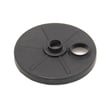
- Lawn mower wheel dust cover 581840401
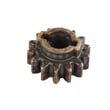
- Pinion 532403849
- Lawn mower wheel and tire, 8 x 1.75-in 583719501
| Symptom | Most likely cause | Best first action |
|---|---|---|
| Won’t start | Fuel/spark/air issue | Refresh fuel, check spark plug, clean/replace air filter |
| Self-propelled weak | Debris in drive wheels | Clean both front drive wheels and gear teeth |
| Uneven cut | Blade or height issue | Verify wheel height settings; inspect blade |
| Vibration | Blade damage/loose | Stop engine; inspect and tighten/replace blade |
Catching issues early prevents bigger failures. For example, mowing with a bent or loose blade can create severe vibration and damage the engine shaft, and packed drive wheels can make a good transmission feel “dead.”
Last updated: February 2026
How do I find the model number on my 917376165?
Your Craftsman walk-behind mower’s model number is printed on the mower’s model and serial number label; for this unit, the owner’s manual identifies it as model 917.376165. Use the label number (not just the engine numbers) when ordering parts.
We use the mower’s product label because it matches the parts diagrams and parts list.
- Check the rear of the mower deck near the discharge opening
- Look on the top of the deck near the engine mounting area
- Inspect the frame area near the handle brackets
- Wipe off grass and dirt; the label is often hard to read when dirty
- Write down both the model and serial number for accurate part matching
For this Craftsman mower, the manual shows the model format as 917.376165 (often printed with a dot). Many parts listings also show it without the dot as 917376165.
| You may see it printed as | It refers to |
|---|---|
| 917.376165 | Same mower model number |
| 917376165 | Same mower model number (dot omitted) |
The engine model number and the mower model number are different. The mower model number (917.376165) is what we use to pull the correct Craftsman parts diagrams and ensure items like the blade, drive belt, wheels, and cables fit correctly.
If the label is damaged or gone, confirm the model using the parts diagrams and descriptions in the owner's manual for 917.376165, then match your mower’s features (deck size, drive system, handle style) to the diagram.
Last updated: March 2026