Owner’s manual
 Error Codes

Are bottom mount fridges better?
Bottom-mount refrigerators are better for many households because the fresh-food section sits at eye level, so you reach for everyday items with less bending. For the GE PDS22SFSBLSS, this layout also supports steady temperature control when you use the recommended settings and airflow practices in the owner's manual.
When a bottom-mount fridge is the better choice
- You use the refrigerator compartment more often than the freezer.
- You want fresh food at a more comfortable height.
- You prefer wider refrigerator shelves and easier visibility.
- You want a freezer drawer that can hold bulky frozen items.
- You are trying to reduce daily bending and squatting.
Tradeoffs to consider
Bottom-mount is not “best” for every kitchen. Here are the common pros and cons.
| Factor | Bottom-mount refrigerator | Top-freezer refrigerator |
|---|---|---|
| Fresh-food access | Easier (eye level) | More bending |
| Freezer access | More bending (drawer) | Easier (higher) |
| Organization | Drawer bins help sorting | Simpler shelves |
| Space needs | Drawer needs clearance | Door swing only |
Tips to get the best performance from your bottom-mount
The layout helps convenience, but temperature and airflow habits still matter.
- Keep food from blocking rear air vents; airflow is designed to stabilize temperatures.
- After changing temperature settings, allow about 24 hours for temperatures to fully stabilize.
- Use the preset targets as a baseline (commonly 37°F refrigerator and 0°F freezer) and adjust gradually.
- If food freezes in the fresh-food section, move items away from the air vent and raise the refrigerator temperature setting.
Why it matters
A bottom-mount design improves day-to-day ergonomics, but consistent cooling depends on proper control settings and keeping airflow paths clear. That combination helps reduce temperature swings that can shorten food life or cause freezing in the refrigerator compartment.
Last updated: February 2026
What are the disadvantages of a bottom freezer refrigerator?
Bottom-freezer refrigerators like the GE PDS22SFSBLSS keep fresh food at eye level, but the tradeoff is that frozen items sit low in a pull-out drawer, which can be less convenient for frequent freezer use and can put more wear on drawer slides and door seals over time. For model-specific use and care details, use the owner's manual.
Common disadvantages (what most owners notice)
- You have to bend or squat to reach frozen foods in the bottom drawer.
- Freezer drawers can feel heavy when fully loaded, especially with bulk items.
- Organization can be harder because items stack in a deep bin (things get buried).
- Drawer gaskets and alignment can be more sensitive; if the unit is not level, the drawer may not close as smoothly.
- Bottom-freezer models often cost more than basic top-freezer designs with similar capacity.
What to watch for on a bottom-freezer drawer
A bottom freezer relies on the drawer closing squarely to maintain a tight seal. If you notice the drawer not closing consistently, leveling is the first thing to check.
| Symptom | What it usually points to | What we recommend |
|---|---|---|
| Drawer feels hard to close | Refrigerator not level, overloaded drawer | Level the cabinet, reduce load, re-check closure |
| Drawer pops open after closing the fresh-food door | Normal pressure equalization when seals are good | Wait a moment, then confirm it closes fully |
| Frost or moisture near the drawer | Door left open, weak seal, frequent openings | Inspect gasket area, minimize open time |
Why it matters
A bottom-freezer design is efficient for everyday fresh-food access, but freezer convenience depends heavily on smooth drawer operation and a good seal. Keeping the refrigerator level and avoiding overloading the drawer helps prevent temperature swings, frost, and premature wear.
Last updated: February 2026
What is the most common problem with GE PDS22SFSBLSS refrigerators?
The most common issues we see on the GE PDS22SFSBLSS bottom-mount refrigerator are ice maker and cooling complaints: not making ice or slow ice production, warm fresh-food section, or temperature swings. These problems usually trace back to airflow restrictions, ice buildup, or a failed temperature-sensing or control component (see the owner's manual).
Most common symptoms (and what they usually mean)
- Slow ice cube freezing or low ice production: freezer temperature too warm, door left open, or airflow blocked.
- Ice cubes taste or smell bad: food odors transferring to ice, or the interior needs cleaning.
- Food freezing in the refrigerator section: items too close to an air vent, or the refrigerator control set too cold.
- Moisture inside or outside: frequent door openings or high humidity.
- Beeping: door alarm from a door not fully closed.
Quick checks we recommend first
- Confirm doors fully close and nothing is holding them open.
- Move food away from the air vent near the controls (blocked vents cause uneven temps).
- Adjust temperature controls one step at a time and allow 24 hours to stabilize.
- Clean the interior and tightly wrap strong-odor foods (helps ice taste).
- If you use a water filter, replace it on schedule; a restricted filter can reduce water flow to the ice maker.
Parts that commonly solve “ice maker” and “not cooling” complaints
If the basic checks do not help, these model-compatible parts are common next steps:
| Symptom | Common part to check | Example part on this model page |
|---|---|---|
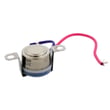
| Warm temps, temp swings | Temperature sensor (thermistor) | GE profile refrigerator temperature sensor WR55X10025 |
| No water to ice maker/dispenser | Water inlet valve | Refrigerator water valve WR57X10033 |
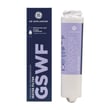
| Poor-tasting ice/water | Water filter | GE smartwater refrigerator water filter GSWF |
| Intermittent cooling, odd behavior | Main control board | Refrigerator main board WR55X10942C |
Why it matters
Ice production and cooling performance depend on steady airflow and accurate temperature feedback. When vents are blocked, doors are left ajar, or a sensor/control part fails, the refrigerator can run at the wrong temperature, leading to slow ice, thawing, or freezing in the fresh-food section.
Last updated: February 2026