 Owner’s manual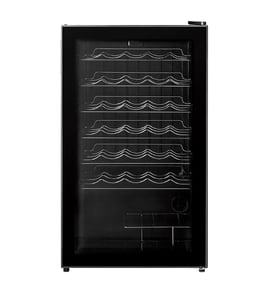



What is the difference between a wine cooler and a beverage cooler?
A wine cooler like the Danby DWC172BL is built to keep wine in a narrower, steadier temperature range with minimal vibration and consistent air circulation, while a beverage cooler is optimized for mixed drinks (cans and bottles) and frequent door openings.
- Temperature targets: Wine storage focuses on stable, moderate chilling; beverage storage often aims colder for ready-to-drink refreshment.
- Shelving and layout: Wine coolers typically use bottle-friendly shelves; beverage coolers prioritize flexible space for cans and mixed sizes.
- Door-opening tolerance: Beverage coolers are designed for frequent access; wine coolers perform best with fewer openings.
- Airflow needs: Wine coolers rely on unobstructed circulation (for example, do not cover shelves with foil or liners).
- Placement and ventilation: Wine coolers commonly require rear clearance for airflow (the DWC172BL guidance calls for about 5 inches behind the cabinet).
Use these habits to get wine-cooler performance from your Danby DWC172BL:
- Keep the cabinet level to reduce vibration.
- Leave rear clearance for ventilation.
- Avoid direct sunlight and nearby heat sources.
- Minimize door openings to help maintain stable temperatures.
- Use the temperature control and allow a few minutes before restarting after an interruption.
For operating details and recommended wine chilling temperatures, follow the DWC172BL owner's manual.
| Feature | Wine cooler (DWC172BL type) | Beverage cooler (typical) |
|---|---|---|
| Best for | Wine bottles | Soda, beer, sparkling water, mixers |
| Typical use pattern | Longer storage, fewer openings | Frequent access |
| Interior design | Bottle shelves, steady airflow | Adjustable racks, mixed container sizes |
| Temperature approach | Stable, moderate chilling | Often colder, fast recovery |
Wine quality is sensitive to temperature swings, vibration, and poor airflow. A wine cooler is designed to reduce those stressors, while a beverage cooler is designed around convenience and quick access.
Last updated: January 2026
What is the life expectancy of a wine cooler?
Most wine coolers typically last 10 to 15 years with normal home use. For the Danby DWC172BL wine cooler, steady temperatures, good airflow clearance, and avoiding power-cord or outlet issues are the biggest factors that help you reach that lifespan; see the DWC172BL owner's manual for care and placement guidance.
- Ventilation and placement: Keep the back of the cabinet about 5 inches from the wall for airflow.
- Stable power: Use a dedicated wall outlet and avoid extension cords.
- Door habits: Frequent door openings make the compressor work harder.
- Load and airflow inside: Do not overload; do not block airflow with shelf liners or foil.
- Cleaning and storage practices: Clean periodically; if stored unused, leave the door ajar to prevent odors and mold.
- Set the cabinet level to reduce vibration and noise.
- Keep it away from direct sunlight and nearby heat sources.
- After a power interruption, wait 3 to 5 minutes before restarting.
- Minimize door openings during a power outage.
- If you will not use it for a long period, unplug it, clean it, and leave the door partially open.
| Cooler type | Typical lifespan | What usually ends it first |
|---|---|---|
| Standard home wine cooler | 10 to 15 years | Compressor wear, thermostat/control issues |
| Budget compact cooler | 7 to 10 years | Cooling system strain, door seal issues |
| Higher-end built-in style | 10 to 15 years | Fan/compressor wear, control board issues |
A wine cooler that is level, well-ventilated, and powered correctly runs fewer long compressor cycles. That reduces heat stress on the sealed system and helps the Danby DWC172BL maintain consistent wine temperatures for more years.
Last updated: January 2026
What is the most common problem with wine coolers?
The most common wine cooler problem is not cooling to the set temperature. On the Danby DWC172BL, the fastest fixes are power and installation basics: use a properly grounded outlet (no extension cord), keep airflow clearance, and level the cabinet as outlined in the DWC172BL owner's manual.
- Plug the unit directly into a properly grounded wall outlet (no extension cord).
- Keep about 5 inches of clearance behind the cabinet for ventilation.
- Avoid direct sunlight and nearby heat sources that raise cabinet temperature.
- Level the wine cooler to reduce vibration and help it cool evenly.
- Minimize door openings; temperature changes with load and door use.
- If cooling was interrupted, wait 3 to 5 minutes before restarting.
| Symptom | Most common cause | What to do first |
|---|---|---|
| Runs but will not get cold enough | Poor ventilation, warm location, frequent door openings | Improve clearance, move away from heat, reduce openings |
| Excessive vibration or rattling | Cabinet not level, bottles or shelves vibrating | Level the unit, re-seat bottles and shelves |
| Condensation, moldy smell during storage | Stored unplugged with door closed | Clean, then store with door partially open |
| Frost or water inside | Door opened often, airflow blocked by overloading | Reduce openings, do not overload, keep vents clear |
Wine coolers rely on steady airflow and a stable room environment. When ventilation is restricted or the door is opened frequently, the unit runs longer, temperatures swing more, and noise and vibration become more noticeable.
If the DWC172BL has correct power, good clearance, and is level but still will not cool, a technician typically checks the start circuit, thermostat control, and sealed-system components. For model-matched parts, use the diagrams and part list in the DWC172BL owner's manual.
Last updated: January 2026